Sound Intensity and Distance: Inverse-Square Worked Examples
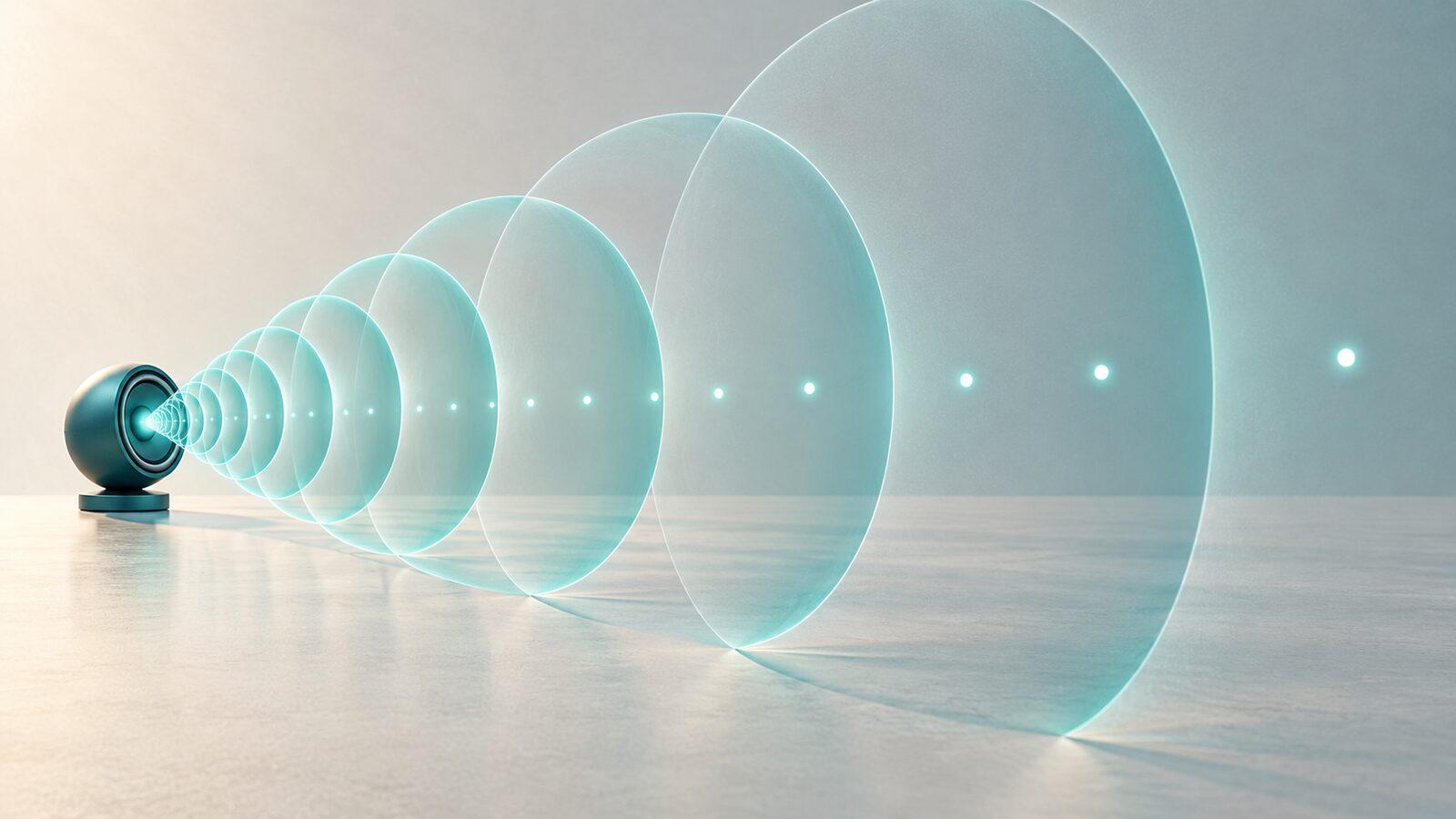
Move twice as far from a small sound source in an open space. Does the sound intensity halve? In the simplest physical model, it falls to one quarter. The power has not vanished. It is spread over a spherical surface with four times the area. Move four times as far and the area is sixteen times as large, so the intensity at each unit of area is one sixteenth as much.
That is the inverse-square rule for sound intensity. It is a rule about energy flow per area, not a promise that a person will judge the sound as one quarter as loud. This guide derives the relationship, works numerical examples, turns an intensity ratio into a decibel difference, and marks where a room or a large source breaks the simple picture. Our Doppler guide concerns a different change, frequency when source and listener move relative to one another.
Start with what intensity measures
A sound wave transports energy. Power is energy transferred per second, measured in watts. Intensity is the power crossing one unit of area perpendicular to the energy flow, measured in watts per square metre:
That definition is not specific to hearing. OpenStax University Physics, Volume 1, §17.3 applies it to sound and then introduces the ideal spherical model. The units check before any arithmetic: watts divided by square metres gives . A result in watts alone is power, not intensity.
A speaker can send the same acoustic power while the intensity measured farther away changes. The surface over which that power passes grows with distance. This is why asking for “the intensity of the speaker” without a distance or measurement surface is incomplete. It also explains why two measurements at different distances cannot be compared as if the source changed by itself.
Let a sphere show where the square comes from
Imagine a small source radiating equally in all directions, with no obstruction, reflection, or significant loss of power to the medium over the distances considered. At radius , the same outward power crosses a spherical area
Substitute that area into the intensity definition:
The radius is squared because a sphere's surface area grows as the square of its radius. It is not an inverse-cube rule just because the sound moves through three-dimensional space. We divide by a surface, not by the volume inside that surface. If the radius doubles, . With the same power spread over four times the surface, each square metre receives one quarter of the intensity.
The formula is useful only under its assumptions. A directional loudspeaker does not radiate equally in all directions. A wall sends some energy back. A source that is physically large compared with the distance does not look like a point. Keep the spherical calculation as an ideal model, not a universal microphone prediction.
Use ratios before reaching for a calculator
If the source power is unchanged, divide the two spherical formulas. Power and cancel:
Suppose a measured intensity is at in the ideal model. At , the ratio is , so the expected intensity is . At , the ratio is , giving about .
A distance change is a ratio of distances from the source. Do not square the number of extra metres. Going from 2 m to 4 m doubles distance; going from 4 m to 6 m multiplies it by 1.5, so those changes cannot have the same intensity ratio. Do not write “twice as far means half the intensity.” That is the tempting linear answer, and it misses the growing area.
| Distance from source | Factor relative to 2 m | Ideal intensity from 0.0080 W/m² at 2 m |
|---|---|---|
| 2 m | 1 | 0.0080 W/m² |
| 4 m | 0.0020 W/m² | |
| 6 m | About 0.00089 W/m² |
Work from power through area to intensity
Now start without a known intensity. Let a hypothetical point source radiate acoustic power equally in all directions. At , the spherical area is . Therefore
At 2.0 m, area is and intensity is . At 4.0 m, area is and intensity is . Notice that the power in the numerator never changes. In this model the loss in local intensity is geometric spreading, not the source turning down.
| Radius | Spherical area | Intensity | Relative to 1 m |
|---|---|---|---|
| 1.0 m | 1 | ||
| 2.0 m | 1/4 | ||
| 4.0 m | 1/16 |
This is an invented arithmetic example. It does not specify a real speaker, measurement room, or safe exposure level. Use it to test the geometry: doubling the radius from 2 m to 4 m quarters the intensity again. If your table instead doubles the area, the square was lost.
Convert an intensity ratio to decibels carefully
A sound intensity level uses a logarithmic scale. For intensity and reference intensity , OpenStax writes
For the conventional reference , the 1 m value in our example has level . At 2 m it is . At 4 m it is about . Each doubling of distance corresponds to a drop of approximately 6 dB in this ideal case.
You can get the difference without calculating either absolute level:
Do not subtract one quarter of 80 dB or say the level is 20 dB because intensity is one quarter. Decibels are logarithms of ratios, so ordinary multiplication in intensity becomes addition or subtraction in level. Also, intensity level is a physical quantity; perceived loudness depends on frequency, hearing, and context. This example cannot tell you that a person hears the sound as one quarter as loud. The same OpenStax section separates intensity, intensity level, and loudness.
Check where the simple rule stops
The inverse-square model needs a roughly point-like source and a free field. In a room, reflected sound can return from walls, ceiling, and floor. The total level at a listener may not drop by 6 dB each time they double distance. Auditory Neuroscience's inverse-square explanation explicitly flags the reflection limit. Outdoors, barriers, ground effects, source direction, and absorption can also change the result. None of those complications makes the geometry wrong; they mean the real setup no longer matches the simple assumptions.
Close to a large loudspeaker or other extended source, the “one small point radiating in all directions” picture may also be poor. Do not use the spherical equation at a distance comparable with the source size without checking the model. In a worksheet, look for phrases such as “isotropic point source,” “spherical wave,” and “neglect absorption.” Those are permissions to use the formula. Without them, state the assumption you are making.
A sound-level meter or phone app may report a number in dB, but that alone does not identify the acoustic power of the source or prove inverse-square behavior. You would need the measurement setup and its calibration. Here the calculation predicts an ideal intensity from a stated power and distance; it is not an instruction to assess hearing safety from a phone reading.
Two short problems to test the model
Problem 1. A point source in the ideal free field produces at 3 m. What is the intensity at 9 m? The distance triples, so the intensity becomes one ninth: . The corresponding intensity-level difference is . You do not need the reference intensity to calculate that difference.
Problem 2. Two listeners stand 1 m and 2 m from a source in a small reflective room. Should you promise a 6 dB difference? No. You can calculate approximately 6 dB for the direct spherical component under ideal assumptions, but reflections can change the total sound at either listener. Write which quantity your answer describes. That caveat is part of solving the problem, not an afterthought.
For another kind of sound calculation, standing waves decide which frequencies fit a string or pipe, while Doppler shifts describe an apparent frequency change. Intensity asks a different question: how much power crosses each square metre here? Once you name that quantity and the model assumptions, the square and the logarithm each have a clear job.