Standing Waves in Strings and Pipes: Worked Examples
A standing wave looks still in one respect: its nodes stay put. Yet the string or air between those nodes keeps moving. To solve a frequency problem, start at the ends. The ends determine which patterns can fit; the wave speed then turns each allowed wavelength into a frequency.
This guide works three examples and checks each answer against a sketch, units, and the next allowed mode. It uses ideal strings and air columns. Real instrument ends, temperature changes, and damping need more care, so the final section marks where the simple equations stop.
A travelling wave becomes a standing pattern
A wave sent along a string reflects at an end. When incoming and reflected waves of the same frequency overlap, their displacements can add in some places and cancel in others. A node stays at zero displacement. An antinode reaches the largest displacement of that mode. The pattern does not carry a single hump steadily from left to right, though energy is still supplied and lost in a real driven system.
OpenStax's standing-wave chapter derives the allowed modes from the end conditions. The key is not to memorize a formula first. Draw what the material at each end is allowed to do, then count the fractions of a wavelength that fit between them.
Frequency, wavelength, and wave speed still obey
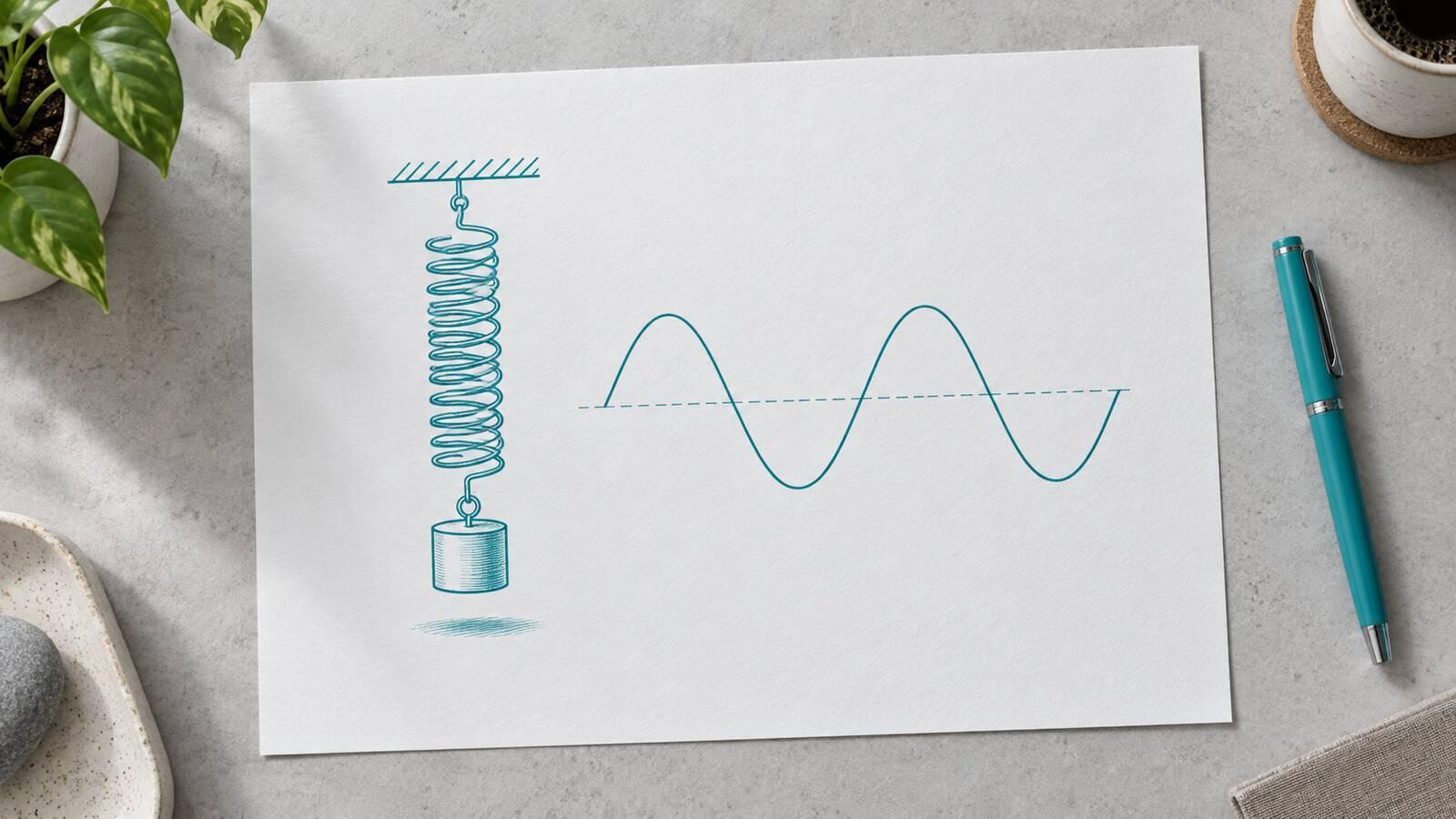
Here is the speed at which a travelling disturbance moves through the medium, is cycles per second, and is metres per cycle. The standing pattern comes from two such waves; it does not change that relation. This is different from the mass on a spring in our simple harmonic motion guide: a single point on a string can oscillate approximately that way, while the string has many points and many possible mode shapes.
Fixed string: nodes at both ends
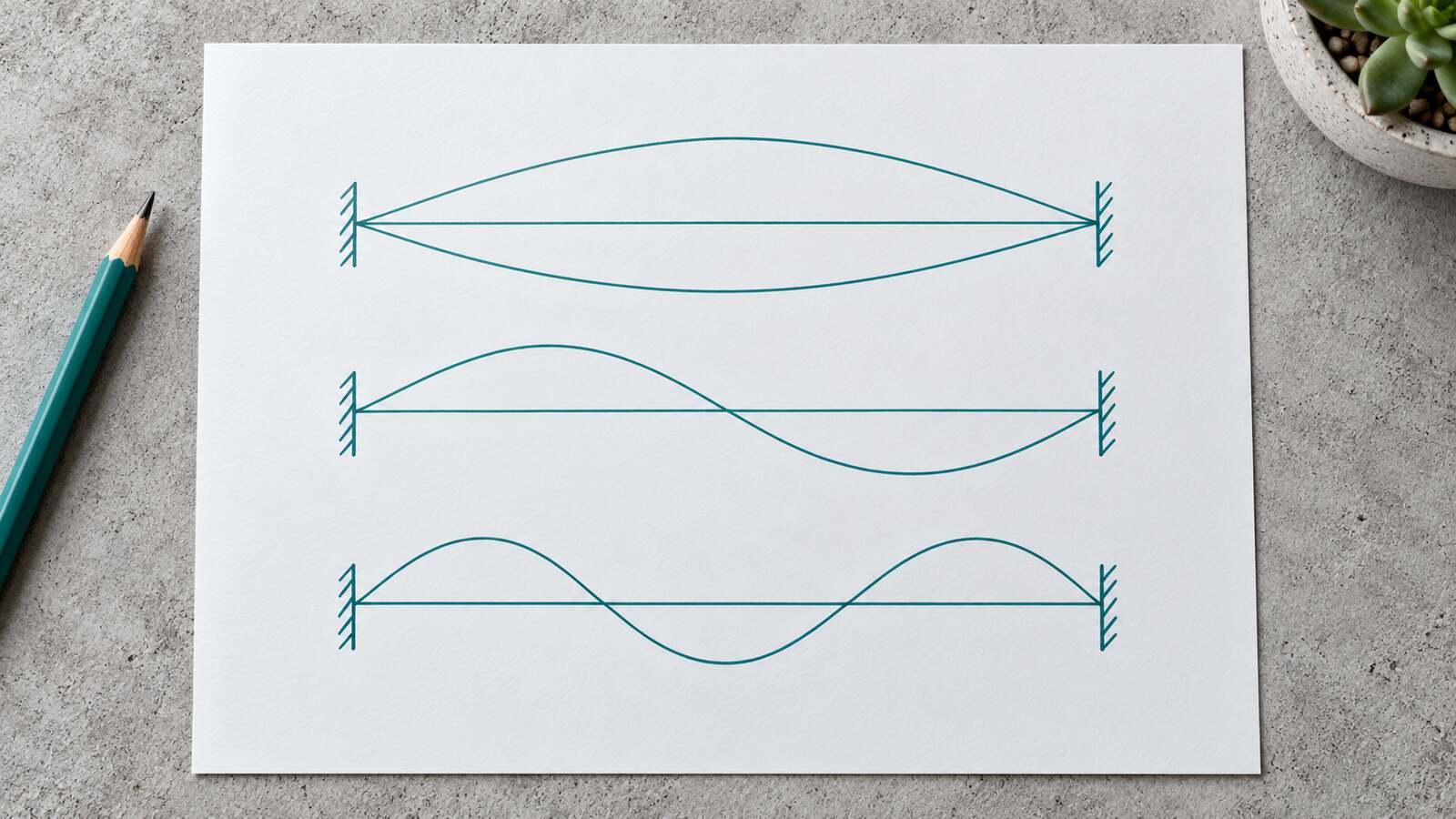
A string tied firmly at both ends cannot move at either tie. Draw a displacement node at each end. The shortest pattern has one bulge between them: half a wavelength fits in length . Add another half wavelength for each higher mode:
The first mode is the fundamental, . The second is and has one extra node inside the string. The third is . Calling these frequencies harmonics is useful only after you have checked that both ends really are fixed. A free end would impose a different displacement condition.
For an ideal stretched string, tension and linear mass density set the speed:
Tension must be in newtons and in kilograms per metre. The square root then has units of metres per second. This model assumes a flexible string, nearly constant tension, and small transverse displacement. It does not claim that a thick, stiff, strongly driven real string follows every ideal harmonic exactly.
Worked example 1: a string with known tension
A 1.20 m string has tension and linear density . Find its first and third allowed frequencies. Speed comes first:
Then and . For the third mode, . Check: . The sketch must show nodes at both ends and two internal nodes. A result at twice the fundamental would describe the second mode, not the third.
Changing tension changes , so it changes all the mode frequencies. Doubling tension does not double frequency: the square-root formula makes the factor . Changing length while holding speed fixed has a different effect: frequency varies inversely with . State what is held constant before comparing two strings.
Pipe ends: specify displacement or pressure
Sound in a pipe is a longitudinal disturbance. Air moves back and forth along the tube, while pressure rises and falls. The word “node” is ambiguous until you say which quantity you are drawing. At an approximately closed end, air displacement is constrained: displacement node, pressure antinode. At an approximately open end, air is freer to move and its pressure stays close to atmospheric pressure: displacement antinode, pressure node.
| End condition | Air-displacement pattern | Pressure-variation pattern |
|---|---|---|
| Closed, rigid end | Node | Antinode |
| Open end, ideal approximation | Antinode | Node |
The University of Tennessee air-column notes explicitly pair the pressure and displacement boundaries. The two columns are complementary. If a drawing labels a closed end as a pressure node and then uses a displacement formula, it has mixed models. OpenStax's sound-wave modes use displacement to show the allowed pipe patterns. Before working a problem, write “air displacement” above your sketch; then place its nodes and antinodes. You can label pressure underneath as a cross-check.
A pipe open at both ends has displacement antinodes at both ends. The simplest pattern contains half a wavelength over , like the fixed string in wavelength count, although its ends are antinodes rather than nodes. Thus for in the ideal open-open pipe. A pipe closed at both ends also has symmetric end conditions and the same frequency sequence in the simple model, with displacement nodes at both ends.
Worked example 2: an open pipe
Take an ideal 0.85 m pipe open at both ends and assume sound speed for this exercise. The fundamental fits half a wavelength: . Its frequency is . The next allowed mode is , with .
Check the geometry before trusting the arithmetic: the open ends are displacement antinodes, and the second mode adds another half wavelength along the tube. Check the units too: metres per second divided by metres gives inverse seconds, or hertz. The assumed 340 m/s is a supplied problem value, not a universal speed of sound; temperature and medium can change it.
A closed-open pipe admits odd harmonics
Now close one end of a pipe and leave the other open. Displacement must be a node at one end and an antinode at the other. The shortest pattern needs only a quarter wavelength over , so and . The next pattern that satisfies the same two ends needs three quarter-wavelengths. The next needs five:
The frequencies are . “Only odd harmonics” describes this ideal end condition. The second allowed mode is the third harmonic, not the second harmonic. That distinction prevents a common answer of for a closed-open pipe. If a problem says “second resonance,” use in this ideal model.
Worked example 3: a pipe closed at one end
Use a 0.50 m closed-open pipe and the stated exercise value . First resonance: , so . Second allowed resonance: , with . Three quarters of that wavelength is approximately 0.50 m, which fits the pipe. By contrast, would require a displacement pattern that misses one boundary condition.
Boundary condition check: closed end equals a displacement node and pressure antinode; open end equals a displacement antinode and pressure node. Then check units, odd-harmonic numbering, and . All four checks should agree before you accept the answer.
Standing-wave modes tell you which frequencies fit; these sound-intensity examples answer how power per area changes with distance.
Where the ideal model stops
The air at an open mouth does not stop moving exactly at the physical rim. A real pipe therefore has an effective acoustic length slightly different from its measured length. This is called end correction; the University of Connecticut air-column notes explain why the acoustic length differs from the physical length. Its size depends on the opening and surroundings, so a formula for a perfectly idealized pipe cannot predict every real resonance to the hertz. For the worked examples above, the problem explicitly uses the simple boundary model and measured as its effective length.
Temperature changes sound speed; rigid-wall assumptions and losses also matter. A string's stiffness and damping can shift or blur modes. These are reasons to read the question's assumptions, not reasons to abandon the node sketch. The sketch tells you which ideal family to start from and which correction a more advanced problem might require.
Do not transfer the odd-harmonic rule to every sound source. It belongs to one approximately closed and one approximately open end. An open-open air column has the full integer sequence in the same idealization. A vibrating string has its own fixed-end conditions. The boundary, not the instrument's name, chooses the formula.
Practice the setup, then the arithmetic
For a fresh problem, draw the end conditions, write whether nodes refer to displacement or pressure, count the allowed fraction of , and only then substitute and . Finish by reversing the calculation with . That last line catches many factor-of-two errors.
Physics Zen's Waves & Sound practice includes the standing-wave skill for strings and pipes, with fresh values and checked solutions. Use the three examples here as templates: string speed from tension and density, open pipe from a half wavelength, and closed-open pipe from odd quarter-wavelength counts.
Frequently asked questions
Why is there no second harmonic in a closed-open pipe? A half-wavelength pattern cannot place a displacement node at one end and an antinode at the other. Only one, three, five, and further odd quarter-wavelength counts satisfy both ends in the ideal model.
Is an open end a node or an antinode? For air displacement it is approximately an antinode; for pressure variation it is approximately a node. State the quantity before using either word.
Can I use measured pipe length directly? Use the length specified by a textbook problem under its ideal assumptions. Real measurements can require an end correction, so note whether a supplied length is physical or effective.