Simple Harmonic Motion Intuitively: Why Oscillations Repeat
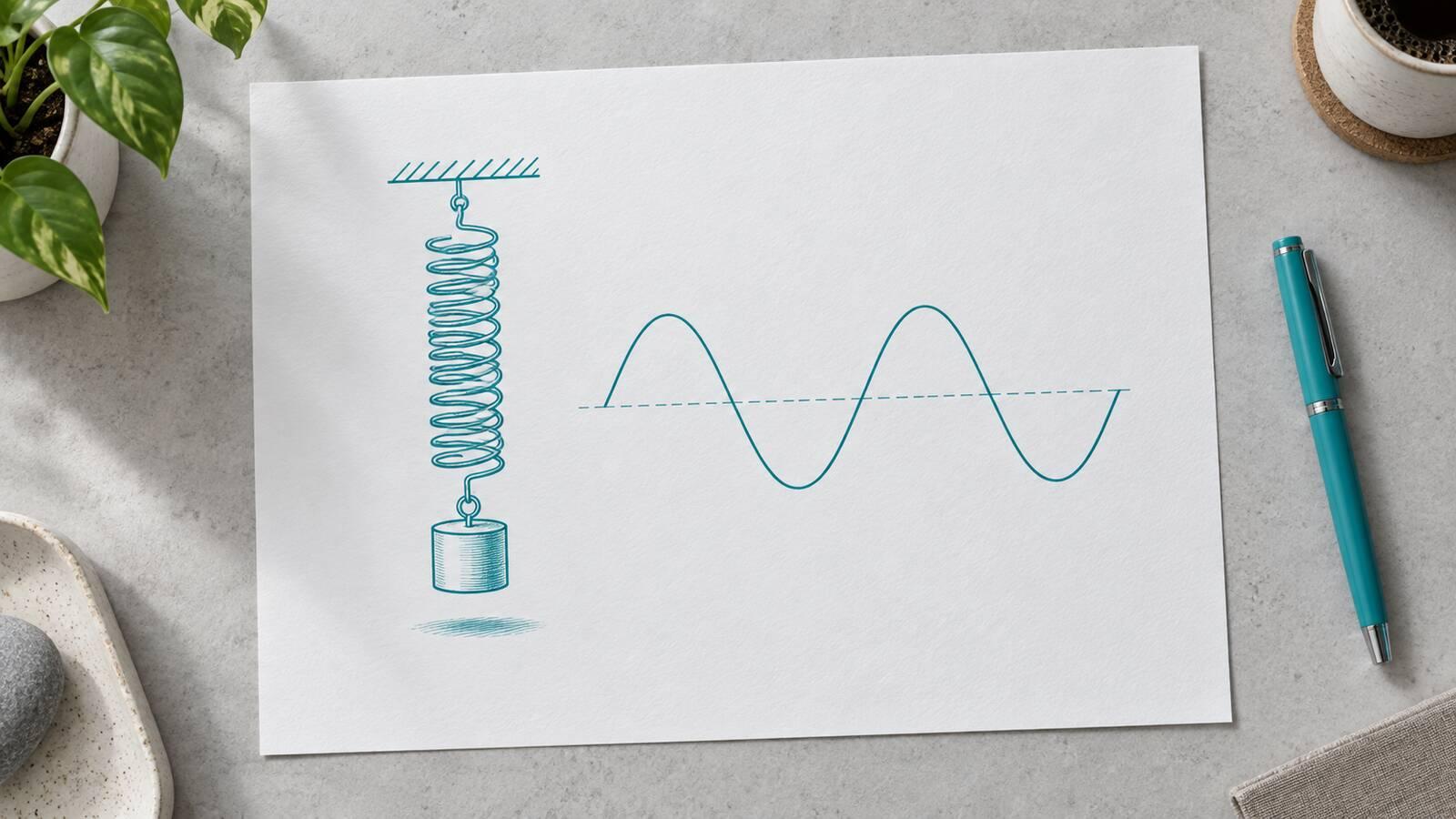
Pull a mass away from the equilibrium point of a spring and release it. The spring pulls it back, but the mass does not stop at the center. It arrives with speed, passes through, compresses the spring, and is pushed back again.
This repeating exchange is simple harmonic motion, often shortened to SHM. The sine and cosine equations describe it, but they are not the starting idea. The starting idea is a force that always points home and grows in direct proportion to how far the object has wandered.
Equilibrium is the center of the motion
Equilibrium is the position where the net force is zero. For a horizontal ideal spring, call that position . Stretching to the right gives positive displacement; compressing to the left gives negative displacement.
Hooke's law is:
The spring constant measures stiffness. The minus sign says the force points opposite the displacement. If the mass is right of equilibrium, the force points left. If it is left, the force points right.
Newton's second law then gives:
This relationship defines the pattern. Acceleration is proportional to displacement and directed toward equilibrium. Our Newton's laws guide supplies the force framework; SHM is what that framework predicts for a linear restoring force.
OpenStax University Physics derives the same relation from Hooke's law and uses it to obtain the mass-spring period. The derivation matters because it shows exactly where the ideal model begins.
Not every repeated motion is simple harmonic. A bouncing ball repeats, but its acceleration is not proportional to displacement from a central equilibrium. A real oscillator can also depart from SHM when its restoring force becomes nonlinear or when damping is strong.
Why the mass overshoots
At the right turning point, displacement is , where is the amplitude. The spring force and acceleration point left, and the mass is instantaneously at rest.
As it moves toward the center, it speeds up. At equilibrium, the spring force and acceleration are zero, but the speed is greatest. Zero force at one instant does not mean zero velocity. The mass has inertia, so it crosses the center.
Beyond the center, displacement becomes negative. The restoring force now points right, slowing the mass until it stops at . The process reverses.
That produces a useful map:
- At : speed is zero and acceleration magnitude is greatest.
- At : speed is greatest and acceleration is zero.
- Between them: displacement, velocity, and acceleration all change continuously.
Acceleration is not generally opposite velocity. While the mass travels toward equilibrium, acceleration and velocity point the same way, so it speeds up. After it crosses equilibrium, they point opposite ways, so it slows down.
The cosine equation is a clock for the cycle
If the oscillator starts at maximum positive displacement and is released from rest, its position can be written:
The angular frequency tells how quickly the oscillator advances through its cycle. A more general starting condition needs a phase constant:
The phase chooses where in the cycle the clock reads zero. It does not change the amplitude or repetition rate.
Differentiating position gives velocity and acceleration:
The last equality returns to the defining idea: acceleration is proportional to displacement and points the other way.
The maximum magnitudes follow directly:
Position, velocity, and acceleration are not three separate motions. They are three views of the same cycle, shifted relative to one another.
Period, frequency, and angular frequency
The period is the time for one complete oscillation. Frequency counts oscillations per second:
Angular frequency measures the same rate in radians per second:
For an ideal mass-spring oscillator:
Therefore:
A larger mass oscillates more slowly, while a stiffer spring oscillates more quickly. In the ideal model, amplitude does not appear in the period formula. Pulling the mass farther increases the force, but it also gives the mass farther to travel; those effects balance so the cycle time stays the same.
Worked spring example
Take a mass on an ideal spring with . Pull it from equilibrium and release it from rest on a frictionless surface.
First find angular frequency:
The period is:
Because release occurs from maximum positive displacement, and:
The maximum speed is:
The maximum acceleration magnitude is:
These maxima occur at different places. Speed reaches 1.6 m/s at equilibrium. Acceleration magnitude reaches 32 m/s² at the endpoints.
Energy explains the same motion without the clock
An ideal oscillator continually trades spring potential energy for kinetic energy:
At the endpoints, the mass is at rest, so all mechanical energy is spring potential. At equilibrium, spring potential is zero relative to that point and kinetic energy is greatest. The total remains:
For the worked example:
At any position, energy conservation can find speed without solving for time:
This is the connection to our work and energy guide. Use the sinusoidal equations when time and phase matter. Use energy when the question connects speed with position and does not ask when the oscillator gets there.
A pendulum is SHM only in the small-angle model
A simple pendulum has a restoring component of gravity. Its exact angular equation contains , so it is not exactly linear. For small angles measured in radians, , and the motion is approximately simple harmonic.
The small-angle period is:
The mass does not appear. In the ideal small-angle model, a heavier pendulum bob has the same period as a lighter one at the same length and location. Lengthening the pendulum increases the period; stronger gravity decreases it.
For and :
At larger amplitudes, the small-angle approximation worsens and the true period becomes longer than this formula predicts. State the approximation rather than treating every pendulum swing as exact SHM.
Real oscillators lose energy
Ideal SHM continues forever because no energy leaves the system. Real oscillators experience friction, air resistance, or internal losses. Their amplitude decreases with time, which is damping.
A periodic external force can replace lost energy and drive the oscillator. When the driving frequency lies near the system's natural frequency, the response can become large. That is resonance. Damping limits the growth and changes how sharp the response is.
These effects extend the basic model rather than erase it. First identify the equilibrium, restoring force, natural frequency, and energy exchange. Then add damping or driving if the problem includes them.
A reliable problem-solving sequence
Start by defining equilibrium and the positive direction. Measure displacement from equilibrium, not automatically from a spring's unstretched length. For a vertical spring, gravity shifts the equilibrium position; oscillations about that shifted point still follow the same mass-spring period in the ideal model.
Next decide what the question asks. If it asks for repetition rate, use the period relation. If it asks for position at a time, choose the correct phase from the initial conditions. If it asks for speed at a position, energy is often shorter.
Finally, check the physical pattern. Acceleration must point toward equilibrium. Speed should be zero at the endpoints and greatest at the center. A stiffer spring should shorten the period, while a larger mass should lengthen it.
Practice these ideas in Physics Zen's Simple Harmonic Motion topic, which covers springs, pendulums, and energy in SHM. Keep the picture ahead of the formula: displacement creates a restoring force, the object overshoots equilibrium, and energy moves back and forth while the cycle repeats.
Common questions
- What makes motion simple harmonic?
- Motion is simple harmonic when the restoring force, and therefore the acceleration, is proportional to displacement from equilibrium and points back toward equilibrium. In one dimension this is written F = -kx or a = -ω²x. The minus sign gives the direction; proportionality produces the repeating sinusoidal motion.
- Where are speed and acceleration greatest in SHM?
- Speed is greatest at equilibrium, where displacement is zero and the stored potential energy is smallest. Acceleration magnitude is greatest at the turning points, where displacement magnitude is the amplitude and speed is zero. Acceleration always points toward equilibrium.
- Does amplitude change the period of simple harmonic motion?
- For an ideal Hooke's-law spring, the period does not depend on amplitude. A simple pendulum also has an approximately amplitude-independent period only for small angles. Real springs, large pendulum swings, friction, and other nonlinear effects can make the period depend on amplitude.
- What is the difference between period, frequency, and angular frequency?
- Period T is the time for one complete cycle. Frequency f is the number of cycles per second, so f = 1/T. Angular frequency ω measures phase advance in radians per second, so ω = 2πf = 2π/T. These describe the same repetition rate in different units.
- Why is a pendulum only approximately simple harmonic?
- The exact tangential restoring force is proportional to sin θ, not θ. For small angles measured in radians, sin θ is close to θ, so the equation becomes the simple harmonic form. At larger amplitudes that approximation worsens, and the true period becomes longer than the small-angle formula predicts.