Understanding Newton's Laws Intuitively (Where Motion Comes From)
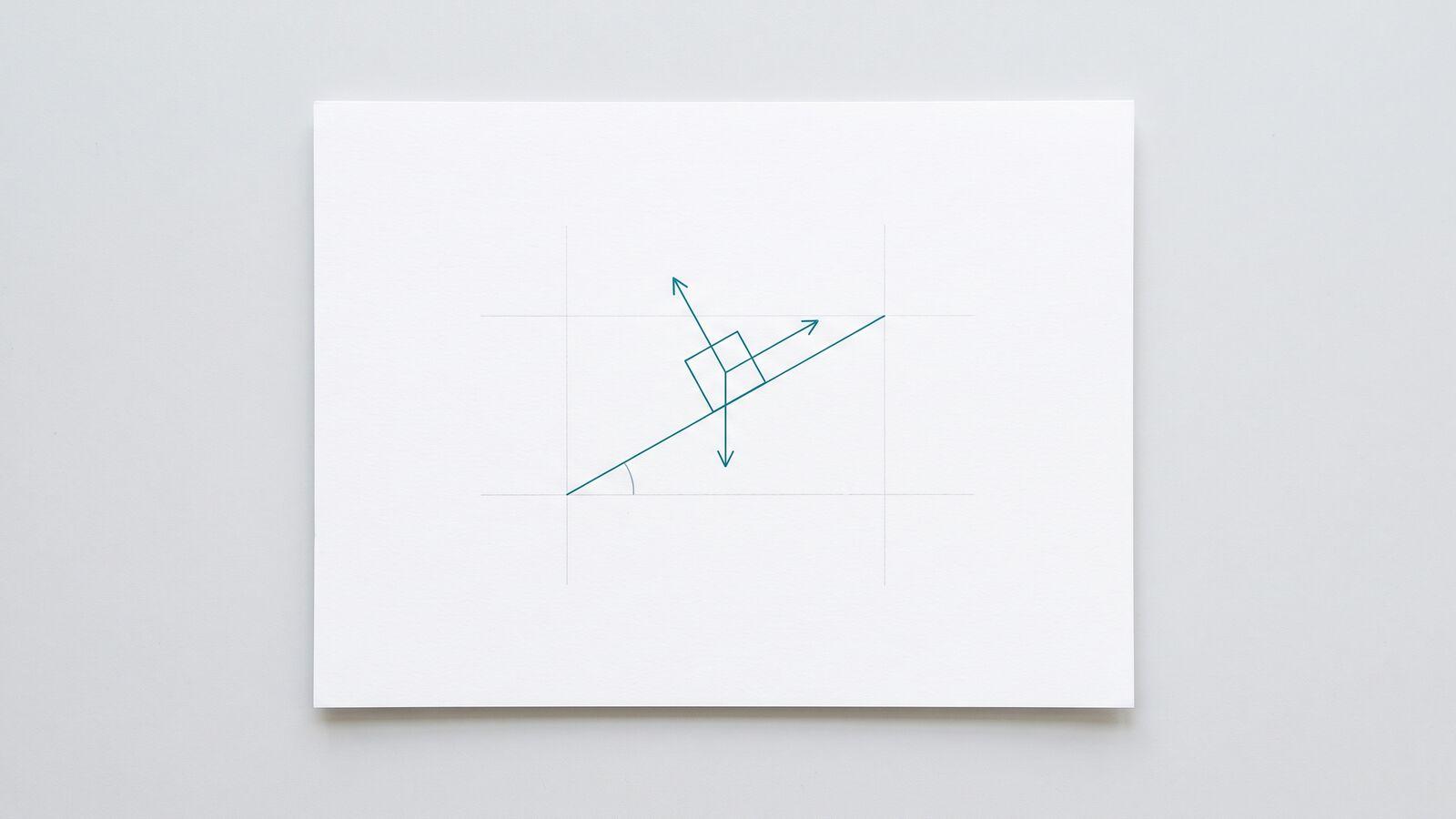
Kinematics says how something moves. It never says why. The moment a problem mentions a push, a rope, a rough floor or a slope, you have left the kinematics chapter and the question has become "what is the net force on this object, and what acceleration does that produce?"
That single question is what all three of Newton's laws are about. The laws are not three separate facts to memorize. They are one relationship, net force determines acceleration, plus two boundary notes: what happens when the net force is zero, and where forces actually come from.
If you already read Understanding Kinematics Intuitively, this is the sequel. If you want to practise as you go, the Dynamics topic in Physics Zen generates fresh problems on Newton's laws, friction and inclines.
The First Law Is About Zero
Newton's first law is usually recited as "an object at rest stays at rest, and an object in motion stays in motion, unless a force acts on it." The wording hides the content. The content is this: if the net force is zero, the velocity does not change.
Two words carry the weight. Net means you add up every force as a vector. Five forces can act on a book lying on a table and the net force is still zero. Velocity includes direction, so "does not change" rules out speeding up, slowing down and turning. A car at a steady 20 m/s on a straight road has zero net force on it. The engine is fighting friction and air, and the fight is a draw.
The trap is thinking rest is special. It is not. Rest is constant velocity with the number zero. An object moving at constant velocity needs no net force to keep going, and this is where everyday intuition breaks. You feel that you have to keep pushing a box to keep it sliding. You do, but only because friction is pushing back. Take the friction away and the box would keep sliding on its own.
The Second Law Is the Whole Topic
Newton's second law is the equation everyone knows:
Read it as a sentence: the acceleration of an object is the net force on it, divided by its mass, and it points the way the net force points. Three consequences follow, and exam problems are built on each of them.
It is the net force. Not the biggest force, not the force you were told about last. Every force on the object, added as vectors. A 30 N pull against 30 N of friction gives zero net force and zero acceleration, however hard the 30 N felt.
It is a vector equation. In practice you write it once per axis. Pick a horizontal axis and a vertical axis, resolve every force into components, and write and separately. A force at an angle contributes to both lines. If the object is not accelerating along an axis, that line reads "sum of forces equals zero," and it is the line that usually gives you the normal force.
Mass is not weight. Mass, in kilograms, is how much the object resists acceleration. Weight is a force, , in newtons, and it is the pull of the Earth. A 5 kg block weighs 49 N on the AP path, where , and 49.05 N on the A-Level path, where . Use the value the problem quotes, and never write a kilogram where a newton belongs.
Units check the rest. A newton is a kilogram metre per second squared, so a force in newtons divided by a mass in kilograms is an acceleration in , which is exactly what kinematics wants next.
The Free-Body Diagram Is the Actual Skill
Nobody fails dynamics on the algebra. They fail on the diagram, or on skipping it. A free-body diagram is a picture of one object with every force acting on it drawn as an arrow from the object. It is the step that turns "a box on a rough floor pulled by a rope" into a sum you can write down.
The rules are few and strict:
- One object. If the problem has two blocks, draw two diagrams. A rope and the thing it pulls are not one object.
- Forces on the object, never by it. The block pushes on the floor, but that force belongs on the floor's diagram, not the block's.
- No velocity arrow, no acceleration arrow, no "ma" arrow. Motion is not a force. If you want to note the acceleration direction, put a small arrow beside the diagram, off the object.
- Name every arrow. Weight , normal , tension , friction , applied force . A nameless arrow is an arrow you will forget in the sum.
Then choose axes and write the second law along each. That is the entire method. It handles the elevator, the hanging lamp, the pushed crate and the sliding block with the same four lines.
The Normal Force Is Not a Fixed Number
The normal force is the push from a surface, perpendicular to that surface, that stops the object passing through it. It is a reaction: it takes whatever value is needed to keep the object out of the table, and no more.
On a flat floor, with nothing else acting vertically, the vertical line of the second law reads , so . That is where the habit of writing comes from, and the habit is wrong the moment anything else is vertical.
Push down on the block and the normal force grows. Pull up on it with a rope and the normal force shrinks. Stand on a scale in an elevator accelerating upward and the scale reads more than your weight, because gives . On an incline the normal force is , less than the weight, because only part of the weight presses into the slope. In every case the fix is the same: do not assume . Write the perpendicular line of the second law and solve for it.
Friction Opposes Sliding, Not Motion
Friction is described by two rules, and mixing them up costs more marks than any other single mistake in the topic.
Kinetic friction acts while the surfaces slide over each other. Its size is
and it points against the direction of sliding. It depends on the normal force, which is why the incline and the elevator matter, and not on the contact area or the speed.
Static friction acts while the surfaces are not sliding. It is not a fixed number. It is whatever size is needed to prevent sliding, up to a maximum of
A block on a rough table with no push has zero friction on it. Push it gently and static friction matches your push exactly. Push harder and it still matches, until your push exceeds , at which point the block breaks loose and kinetic friction takes over, usually with a smaller coefficient.
The direction rule is about sliding, not motion. Static friction on the driving wheel of an accelerating car points forward, because without it the tyre would spin backward against the road. Friction on your shoe points forward when you walk. If the phrase "friction opposes motion" is in your head, replace it with "friction opposes relative sliding between the surfaces." It is the version that survives contact with a problem.
The Third Law Is About Two Objects
Newton's third law says that if object A pushes on object B, then B pushes on A with an equal and opposite force. The usual recitation, "every action has an equal and opposite reaction," is true and almost useless, because it hides the one fact that matters: the two forces act on different objects.
That is why third-law pairs never cancel. A cancellation needs two forces on the same object. The Earth pulls the book down with ; the book pulls the Earth up with . Those are a pair, and one lives on the book's diagram while the other lives on the Earth's. The table pushes the book up with ; the book pushes the table down with . Also a pair, also split across two diagrams.
The weight and the normal force on a resting book are equal and opposite, and they do cancel, but they are not a third-law pair. They are two different forces from two different sources, the Earth and the table, that happen to balance because the book is not accelerating. Change the situation, put the book in an accelerating elevator, and they stop balancing while every third-law pair stays exactly equal.
If a diagram has an arrow labelled "reaction" on the same object as the "action," one of them is on the wrong diagram.
Inclines Are Flat Problems With Tilted Axes
An inclined plane looks like a new kind of problem. It is not. It is a block on a surface, with the surface at an angle to the horizontal, and the only new idea is where to put the axes.
Put one axis along the slope and the other perpendicular to it. Weight is the one force that is now at an angle to both axes, so split it: a component down the slope and a component into the slope. The normal force lies entirely along the perpendicular axis, friction entirely along the slope, and any pull along the slope needs no splitting at all.
Then the two lines of the second law are short. Perpendicular to the slope, nothing accelerates, so . Along the slope, the net force is minus friction, minus or plus whatever else acts along it, and that net force equals . A frictionless slope gives , which reduces correctly to free fall at 90 degrees and to zero on flat ground. That sanity check is worth doing every time.
Two habits keep the signs honest. Decide which way along the slope is positive before you write anything, and remember that friction on a block sliding down points up the slope, while friction on a block being pushed up points down it.
What Dynamics Is For
Kinematics gave you three equations that work whenever acceleration is constant. Dynamics tells you what that acceleration is. The handoff is always the same: draw the free-body diagram, write the second law per axis, solve for , then hand to the kinematics equations to find how far, how fast or how long.
Everything after this in mechanics is a shortcut through the same machinery. Work and energy let you skip the acceleration when you only need speeds at two points. Momentum lets you skip the forces inside a collision. Circular motion is the second law with the acceleration pointed at the centre. None of it replaces the diagram. It just means you draw it less often.
The way to make the method stick is the loop from How to Study Physics Effectively: see the situation, draw the object, sum the forces, solve, check the units and the limits. The Dynamics topic in Physics Zen runs that loop with fresh numbers on Newton's laws and friction for free, and on inclined planes with Premium, so the diagram is what you remember, not a particular answer.
Common questions
- What is the difference between Newton's first and second law?
- The first law is the special case of the second with zero net force. No net force means no acceleration, so velocity stays constant, including a constant velocity of zero. The second law says what happens when the net force is not zero. Acceleration equals net force divided by mass.
- Is the normal force always equal to weight?
- No. The normal force is whatever the surface has to push to stop the object sinking into it. On flat ground with no other vertical forces it equals mg. In an accelerating elevator, under an extra push, or on an incline it does not. Solve for it, never assume it.
- Why do Newton's third law pairs never cancel?
- The two forces in a third-law pair act on different objects. A free-body diagram shows forces on one object, so only one member of any pair can appear on it. Forces that cancel in a diagram are equal and opposite forces on the same object, which is a different situation.
- Which direction does friction act?
- Kinetic friction opposes the sliding of the surfaces relative to each other. Static friction acts in whichever direction is needed to prevent sliding, and can point forward, as it does on the driving wheel of a car. Its size is only as large as needed, up to a maximum.