Understanding Kinematics Intuitively (Motion Without the Cause)
Most people meet kinematics as a pile of lettered equations and decide the subject is algebra in disguise. The algebra is real, but it is not the point. Kinematics is a language for saying where something is, how fast it is going, and how that speed is changing, before you ever mention a force.
The picture is simpler than the formula sheet. An object occupies a position. The position can change. The rate of that change is velocity. The rate of that change is acceleration. Everything else in the topic, including free fall and projectiles, is that picture with a few extra constraints.
If you want to put the picture into practice, the free Kinematics topic in Physics Zen generates fresh values for uniform motion, constant acceleration, free fall, and projectiles.
Position Is a Point on a Line
Start with one dimension, a straight road. Pick a zero and a positive direction. Every position is then a number with a sign. "+40 m" means forty metres the way you chose as positive. "-10 m" means ten metres the other way. The sign is not decoration. It is the whole of the geometry.
Displacement is the change in position, final minus initial. It is not the same as the distance travelled. Walk 8 m forward and 3 m back and the distance is 11 m, while the displacement is +5 m. Kinematics cares about both, and exam-style problems will punish you for mixing them.
Velocity Is Displacement Over Time
Average velocity is displacement divided by the time it took. If the velocity is constant, that average is also the velocity at every instant, and the equation everyone remembers follows at once:
The same relation rearranges for or . The skill is not the rearrangement. It is noticing when the velocity really is constant, so the equation applies, and converting units before you divide. A speed given in km/h is not yet in SI. Dividing by 3.6 turns km/h into m/s. Multiplying by 3.6 goes the other way. Do that conversion as its own line, not in your head in the middle of a substitution.
Speed, by contrast, is the magnitude. It has no direction. A problem that asks for speed wants a nonnegative number. A problem that asks for velocity wants a signed one, or a vector.
Acceleration Is How Velocity Changes
If velocity is not constant, you need a second rate. Average acceleration is the change in velocity divided by time. When the acceleration itself is constant, three equations cover almost every one-dimensional problem:
They are not three unrelated facts. The first is the definition of constant acceleration, written as an update rule for velocity. The second is what you get if you accumulate that changing velocity over time. The third drops time entirely, which is why it is the one to reach for when a problem never mentions a clock.
The usual failure is not forgetting an equation. It is using one while the acceleration is not constant, or assigning the wrong sign to . Decide the positive direction first. If you call up positive, a downward acceleration is negative. Write that choice once, then keep it for every symbol in the problem.
Read a velocity-time graph through a reversal
The slope of a velocity-time graph is acceleration. Its signed area gives displacement: area above the time axis counts positively, and area below it counts negatively. To find total distance, add the magnitudes of those areas. The OpenStax treatment of velocity and displacement connects these graph readings to integration.
Try an object whose velocity falls in a straight line from +6 m/s at 0 s to -4 m/s at 5 s. These are values on a velocity-time graph, not positions on a map.
| Time (s) | 0 | 3 | 5 |
|---|---|---|---|
| Velocity (m/s) | +6 | 0 | -4 |
Slope: the change is -10 m/s over 5 s, so the constant acceleration is -2 m/s². The line reaches zero velocity at 3 s. The object stops for an instant there, then reverses direction; it does not stay at rest because its acceleration is still negative.
Displacement: split the graph where it crosses the axis. Before 3 s, the positive triangle has area ½ × 3 × 6 = 9 m. From 3 to 5 s, the negative triangle has magnitude ½ × 2 × 4 = 4 m. The displacement is therefore 9 - 4 = +5 m.
Distance: the object travels 9 m one way and 4 m back, for a total of 13 m. A single unsigned area or an average of speed endpoints would miss the reversal. The units are a useful check: seconds multiplied by metres per second give metres.
Negative acceleration does not always mean slowing down. From 0 to 3 s, velocity and acceleration have opposite signs, so speed falls. After 3 s, both are negative, so speed rises in the negative direction. On a position-time graph, by contrast, height is position and slope is velocity. Always read the axis labels before interpreting a line.
As a quick check, use constant-acceleration kinematics: displacement = 6 × 5 + ½ × (-2) × 5² = 5 m. That agrees with the signed area. It does not replace the separate distance calculation.
Free Fall Is Constant Acceleration With a Named Cause
Drop something, or throw it straight up, and the acceleration is downward for as long as air resistance can be ignored. Kinematics does not explain gravity. It just uses the fact that the acceleration is constant, so the three equations above apply with .
Which number is depends on the course. AP-style practice in Physics Zen uses . A-Level practice uses . Some school courses round to . The rule is boring and reliable: use the value the problem quotes. Do not import a favourite.
Thrown upward, the object still accelerates downward the whole time, including at the top, where the velocity is instantaneously zero. The acceleration does not take a holiday at the peak. That single sentence clears more free-fall mistakes than any extra formula.
Projectiles Are Two One-Dimensional Problems
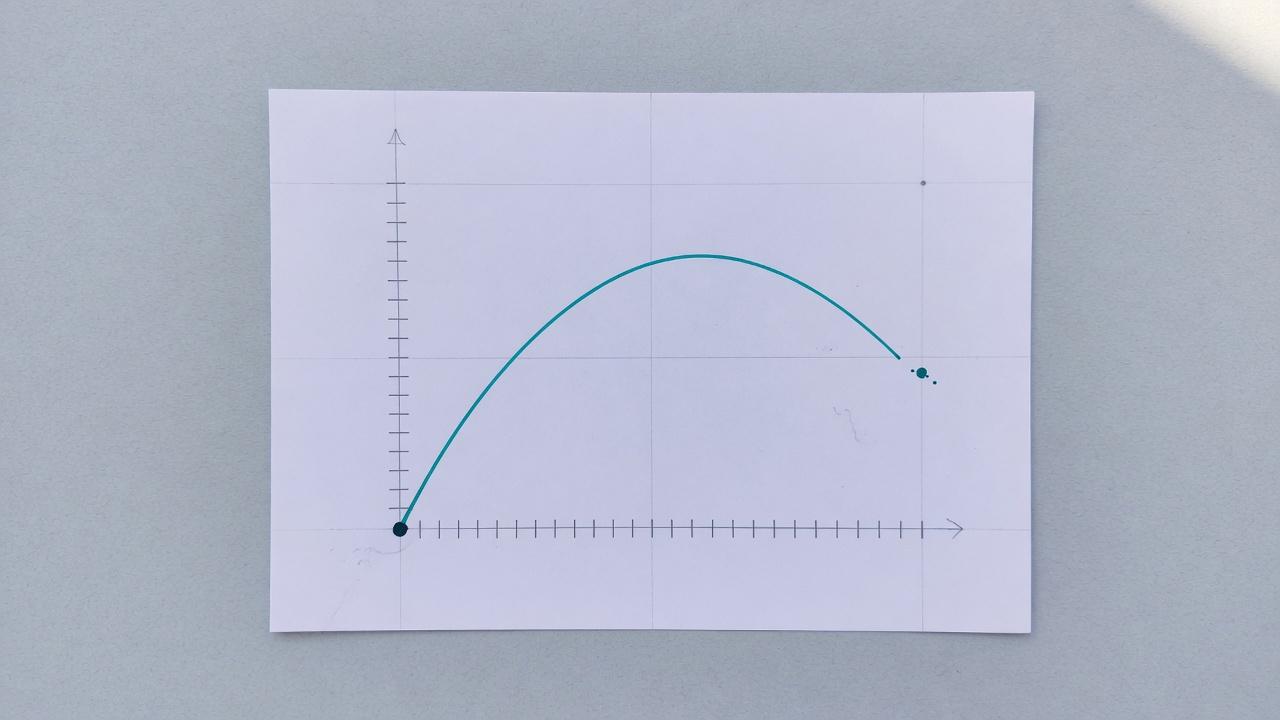
A launch at an angle looks two-dimensional. The trick is to refuse that framing. Split the initial velocity into a horizontal piece and a vertical piece. Horizontal acceleration is zero (no air resistance). Vertical acceleration is downward. The two motions share a clock and nothing else.
Flight time comes from the vertical motion: the projectile returns to the same height when the vertical displacement is zero. Range is then horizontal velocity times that time. Maximum height is a vertical problem with final vertical velocity zero. Once the split is made, you are doing the same constant-acceleration work you already know, as these projectile motion equations with worked examples show for launches from level ground and from a cliff.
The usual trap is letting a vertical result leak into a horizontal equation, or using the launch speed as if it were the horizontal component. Write and as separate symbols. The extra letters pay for themselves.
What Kinematics Is For
Kinematics will not tell you why the object moved. That is dynamics, Newton's laws, friction, and inclines. What it will do is keep you honest about the motion itself, so that when a force finally appears you already know what "faster," "stopped," and "turned around" actually mean.
The loop is the same as the rest of physics. See a situation. Choose a model (constant velocity, constant acceleration, free fall, projectile). Solve. Check. If the numbers are fresh every time, you learn the model instead of an answer. That is the point of generated kinematics practice.
Common questions
- What is kinematics in physics?
- Kinematics describes how an object moves. Position, velocity, and acceleration over time, without yet asking what force produced the motion. Dynamics is the next topic, where Newton's laws supply the cause.
- What is the difference between speed and velocity?
- Speed is how fast. Velocity is how fast and in which direction. A car that turns a corner at a steady 20 m/s has constant speed and changing velocity, because the direction changed.
- Why do projectile problems split into two axes?
- Without air resistance, horizontal velocity is constant while vertical acceleration is due to gravity. Solve both axes using the same time variable; the landing height determines which vertical equation to solve.
- Which value of g should I use?
- Use the value the problem quotes. Physics Zen uses 9.8 m/s² on the AP Physics 1 path and 9.81 m/s² on the A-Level path. A theory card that sits outside a problem does not pick one for you.