Understanding Work and Energy Intuitively (The Bookkeeping Shortcut)
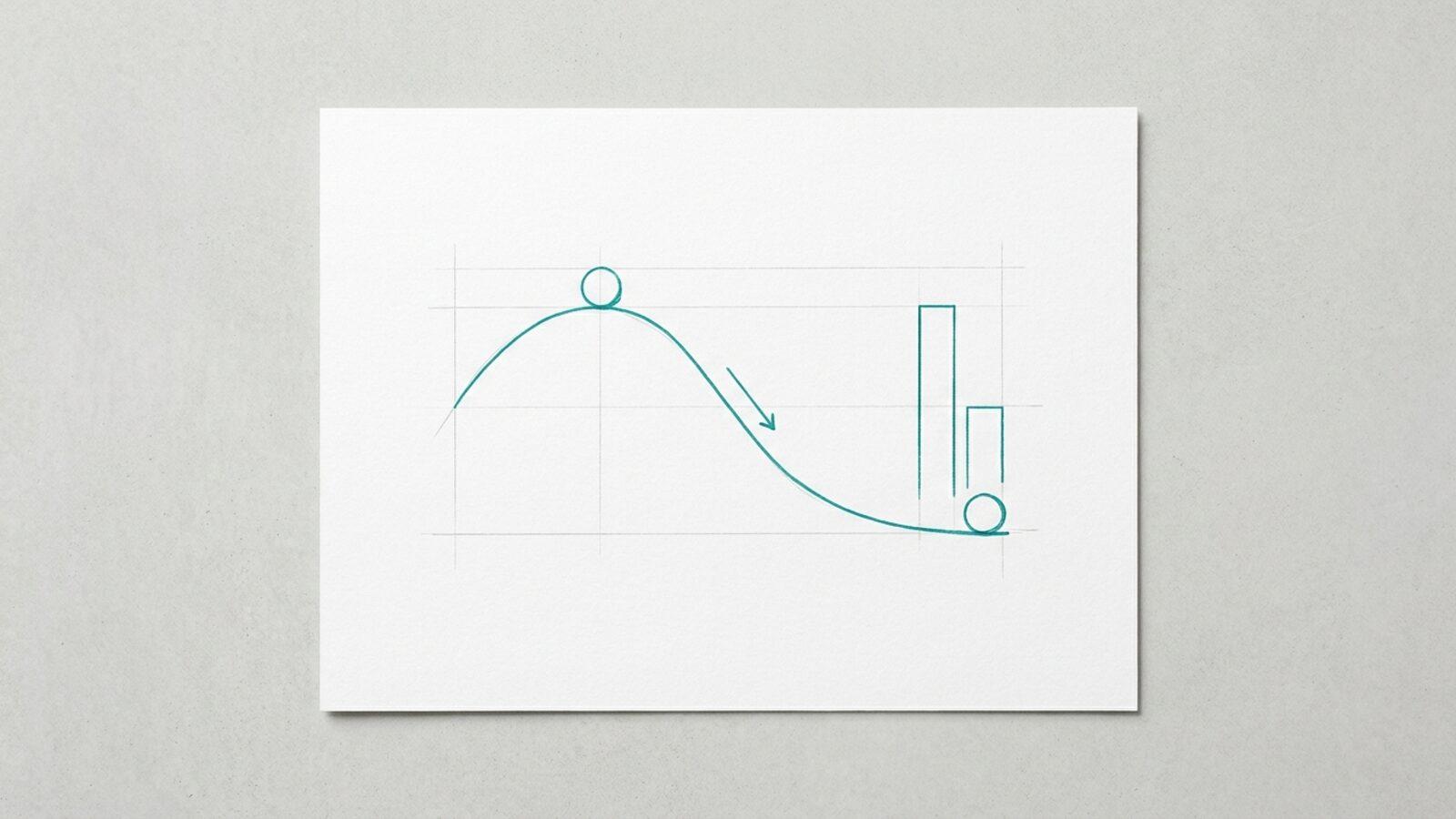
Newton's second law tells you the acceleration at every instant. That is more than most questions need. Drop a ball from the top of a curved slide and ask how fast it is going at the bottom, and the second law wants the force at every point of the curve, which changes direction as the slide bends. You would have to integrate the whole path.
Work and energy is the shortcut that skips the path. It keeps a ledger with two columns, motion and position, and it says that between any two moments the ledger balances once you count what was paid in and taken out along the way. You never find the acceleration. You compare the balance at the top with the balance at the bottom.
This is the third article in the mechanics series, after Understanding Kinematics Intuitively and Understanding Newton's Laws Intuitively. It covers what work actually counts, where kinetic and potential energy come from, why conservation is bookkeeping rather than magic, how friction enters the ledger, what power measures, and the rule for deciding when to use energy and when to go back to Newton.
Energy Is a Number You Track, Not a Thing You See
Nobody has ever seen energy. What you see is a ball moving or a ball sitting at a height, and energy is the number physics assigns to those situations so that a certain sum stays constant. That is the whole reason the idea exists. Over the nineteenth century, physicists noticed that if you define a quantity for motion and a quantity for position in the right way, then no matter how complicated the motion in between, the total at the end equals the total at the start, plus or minus what outside forces put in or took out.
So treat energy as an account. Kinetic energy is the balance held as motion. Potential energy is the balance held as position. Work is a deposit or a withdrawal. Conservation of energy is the bank statement adding up.
Work Is Force Times the Distance It Acts Through
Work is what a force does while the object it acts on moves. A force that pushes an object through a distance along the direction of the push does work
measured in joules: one newton acting through one metre. If the force is not along the motion, only its component along the motion counts:
where is the angle between the force and the displacement. Three cases carry most of the exam:
- Force along the motion, . The force helps, , and the work is positive. You are depositing.
- Force against the motion, . The force resists, , and the work is negative. You are withdrawing. Kinetic friction always does this.
- Force perpendicular to the motion, . The work is zero. The normal force on a flat floor, the tension in a string swinging a ball in a circle, gravity on an object moving horizontally: none of them does work, however large they are.
The perpendicular case surprises people because the force feels like it should count. It does not, and the reason is the definition. Work measures energy moved along the motion. A force at right angles changes the direction of motion but not its energy, which is why an orbiting satellite keeps the same speed forever.
Work is a scalar. It has a sign but no direction, which is what makes the bookkeeping possible: you add the deposits and withdrawals as plain numbers.
Kinetic Energy Is Work Made Visible
Push a block of mass from rest with a constant net force over a distance . Newton gives the acceleration, , and kinematics gives the final speed from . Substitute and rearrange:
The left side is the work done. The right side is what the block now has, and it is worth naming: the kinetic energy,
The same algebra with a nonzero starting speed gives the work-energy theorem:
Read it as a definition of what kinetic energy is for. The net work done on an object, by every force added together with signs, equals the change in its kinetic energy. Positive net work speeds it up. Negative net work slows it down. Zero net work, however violent the forces, leaves the speed unchanged.
Two things to notice. Kinetic energy depends on , so doubling the speed quadruples the energy, which is why a car at 100 km/h needs four times the stopping distance of a car at 50 km/h. And it is never negative. An object moving backward has the same kinetic energy as one moving forward at the same speed.
Potential Energy Is Work You Can Get Back
Lift a book of mass through a height at constant speed. You do work against gravity, but the book's kinetic energy is the same at the end as at the start, so where did the work go?
It went into position. Let go, and gravity does of work on the way down, and the book arrives with exactly of kinetic energy. The work you did was not lost; it was stored, and the storage is gravitational potential energy:
with on the AP path and on the A-Level path. Use the value the problem quotes.
The same story with a spring gives elastic potential energy. Compress or stretch a spring of stiffness by a distance from its natural length and the stored energy is
The half is there because the spring force grows from zero to as you compress it, so the average force is half the final one.
Potential energy exists only for forces with a particular property: the work they do depends only on where you start and where you finish, not on the route. Gravity has it. A spring has it. Friction does not, because a longer path costs more friction, so friction has no potential energy and must be handled differently. Forces with the property are called conservative, and every one of them can be turned into a column in the ledger.
One freedom worth using: you choose where is. Only changes in potential energy matter, so put the zero at the lowest point in the problem and every height becomes positive.
Conservation: The Ledger Balances
Put the columns together. If the only forces doing work are conservative ones, gravity and springs, then the total mechanical energy does not change:
This is the equation that skips the path. A ball rolling down a curved slide from height arrives at the bottom with , so , and the shape of the slide never entered the calculation. A pendulum released from a height above its lowest point reaches the bottom at regardless of the string length. A roller coaster at the top of a second hill, lower than the first by , is moving at if it started from rest.
The mass often cancels. That is not a coincidence; it is the same fact as everything falling at the same rate, seen through the energy lens.
Friction breaks the equality in a controlled way. Kinetic friction does negative work on the sliding object, where is the friction force and is the distance actually slid. Add it to the ledger:
The term is the energy that left the mechanical accounts and became heat. It is not lost from the universe, but it is lost to the problem. A block sliding down a rough incline of length arrives with less than of kinetic energy, and the shortfall is exactly , with from the friction section of the Newton article.
The same term explains the block that slides across a rough floor and stops. All its kinetic energy became , so the stopping distance is , which does not depend on the mass at all.
Power Is the Rate
Work says how much energy moved. Power says how fast:
in watts, which are joules per second. A 60 W bulb moves 60 joules of energy every second. A 1 kW kettle moves a thousand.
For a force pushing an object at a steady speed there is a more useful form. Work is , the distance in time is , so
This is the equation behind every car problem. A car cruising at constant speed has zero net force, so the engine's forward force equals the total resistance, and the engine power is that resistance times the speed. Double the speed on the motorway and, because air resistance grows roughly with , the power needed grows roughly with .
One unit trap: the kilowatt-hour is energy, not power. It is 1000 W sustained for 3600 s, which is joules. Electricity bills count energy; the number on the kettle is power.
When to Use Energy and When to Use Newton
The two methods answer different questions, and choosing the wrong one is the most common source of wasted time in mechanics.
Reach for energy when:
- You know the situation at two points and want the speed or the height at one of them.
- The path curves, or the force changes direction along it.
- Nobody asked for the time, the acceleration, or the force.
- The only non-conservative force is friction over a known distance.
Reach for Newton when:
- The question asks for a force, a tension, a normal force, or an acceleration.
- You need the time, since energy has no clock in it.
- A non-conservative force varies along the path in a way you cannot summarize as .
- The motion is circular and you need the centripetal requirement.
Many problems use both. Energy gives the speed at the bottom of the loop; Newton then gives the normal force there. The handoff runs in either direction, and the skill is noticing which quantity the question actually wants.
What Work and Energy Are For
Kinematics describes motion. Newton's laws explain it. Work and energy let you skip the middle, comparing the start and the end without following every step in between. The cost is information: energy cannot tell you how long anything took or what force acted at a given instant. The gain is that the shape of the path stops mattering, which is exactly the problem Newton's laws made hard.
Everything later in mechanics reuses the ledger. Momentum is a second conserved account, kept in the same spirit. Simple harmonic motion is energy sloshing between the kinetic and spring columns. Thermodynamics is the same bookkeeping with heat given its own column at last.
The way to make it stick is the loop from How to Study Physics Effectively: identify the two moments, write the balances, add the work of every force that is not conservative, solve, then check the units and the limits. The Work & Energy topic in Physics Zen runs that loop with fresh numbers on work at an angle, kinetic and potential energy, and conservation with and without friction, with power in the last skill on Premium, so the ledger is what you remember, not a particular answer.
Common questions
- What is the difference between work and energy?
- Work is a transfer. It is the amount of energy a force moves into or out of an object while the object travels some distance. Energy is the balance: the amount an object has stored as motion (kinetic) or as position (potential). Work changes the balance; energy is the balance.
- Why does the normal force do no work on a flat surface?
- Work counts only the part of a force along the direction of motion. On flat ground the normal force points straight up while the object moves horizontally, so the angle between them is 90 degrees, its cosine is zero, and the work is zero. On an incline the same rule holds: the normal force is perpendicular to the slope and the motion is along it.
- Is work done by friction always negative?
- Kinetic friction always opposes the sliding, so it always removes kinetic energy from the sliding object and its work is negative. Static friction can do positive work on an object, for example the friction that pushes a car forward at its driving wheels, because the surfaces do not slide.
- When should you use energy instead of Newton's second law?
- Use energy when you know the situation at two points and want a speed or a height, and you do not care about the time or the acceleration in between, especially when the path curves. Use Newton's laws when the question asks for a force, an acceleration, or a time, or when a force that is not conservative varies along the path in a way you cannot integrate simply.
- What are the units of work, energy, and power?
- Work and energy share the joule, which is one newton times one metre, or one kilogram metre squared per second squared. Power is the rate of doing work, measured in watts, which are joules per second. One kilowatt-hour is a unit of energy, not power: it is 1000 watts sustained for one hour, or 3.6 million joules.