Circular Motion Intuitively: Why Constant Speed Needs Force
A car rounds a bend while its speedometer stays steady. The driver has not accelerated in the everyday sense of pressing harder on the accelerator. In physics, however, the car is accelerating throughout the turn.
The reason is visible in the road: the direction of motion keeps changing. Speed tells you how fast. Velocity tells you how fast and in which direction. A circle changes the second part continuously.
That is the starting point for circular motion. The rest follows from asking what acceleration changes the direction, and what real force provides it. You can connect this directly to the distinction between speed and velocity in our kinematics guide.
Draw the velocity along the tangent
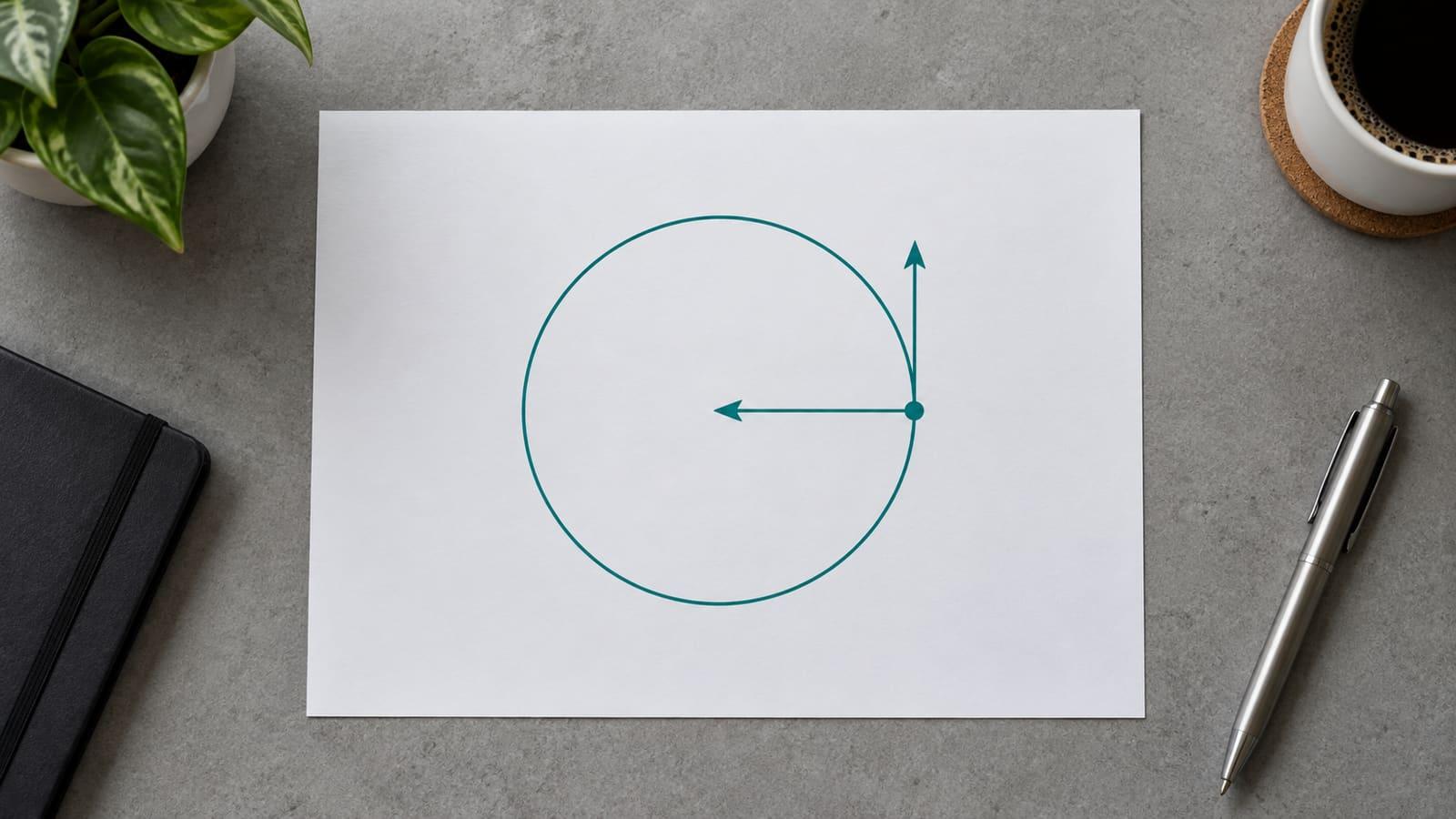
Imagine an object moving counterclockwise around a circle. At the rightmost point, it moves upward. At the top, it moves left. Its velocity lies along the tangent, the straight line that just touches the circle at its current position.
The velocity does not point inward. An inward velocity would take the object toward the center rather than along the edge. This is the first distinction to keep on your sketch: velocity is tangent to the path; for uniform circular motion, acceleration is toward the center.
If the force keeping an object on a circular path disappears and no other net force acts, it continues along that tangent. It does not keep curving because it remembers the circle. If gravity or another force remains, that force determines the later path.
The American Physical Society's circular motion activity uses this change of direction to introduce the same idea. Your drawing is enough to start; you do not need to swing an object around to test it.
Inward acceleration changes direction
Take two velocity arrows separated by a short time. They have equal lengths when speed is constant, but their directions differ. The change between the arrows points approximately inward. As the time interval shrinks, that direction approaches the center exactly.
The magnitude of this centripetal acceleration is:
Here is speed and is the radius of the path. “Centripetal” means center-seeking. It describes the direction, not a new kind of interaction.
The units check the formula. Speed squared has units of square meters per second squared; dividing by meters leaves meters per second squared, the units of acceleration.
Two consequences are useful before you calculate anything. At fixed radius, doubling speed requires four times the inward acceleration. At fixed speed, doubling radius halves it. A faster, tighter turn requires more directional change per second.
Centripetal force is the inward net force
Newton's second law connects the required acceleration with net force:
The left side is the sum of the real forces' inward components. It might be supplied by tension in a string, gravity in an orbit, or friction in a level road turn. It can also come from more than one force.
Do not draw gravity, tension, and an extra “centripetal force” arrow just because the motion is circular. That would count the same job twice. Draw the actual interactions first, then identify their net inward component.
Our Newton's laws guide explains how to construct that force diagram. Circular motion adds a geometric requirement to the same law; it does not replace the law.
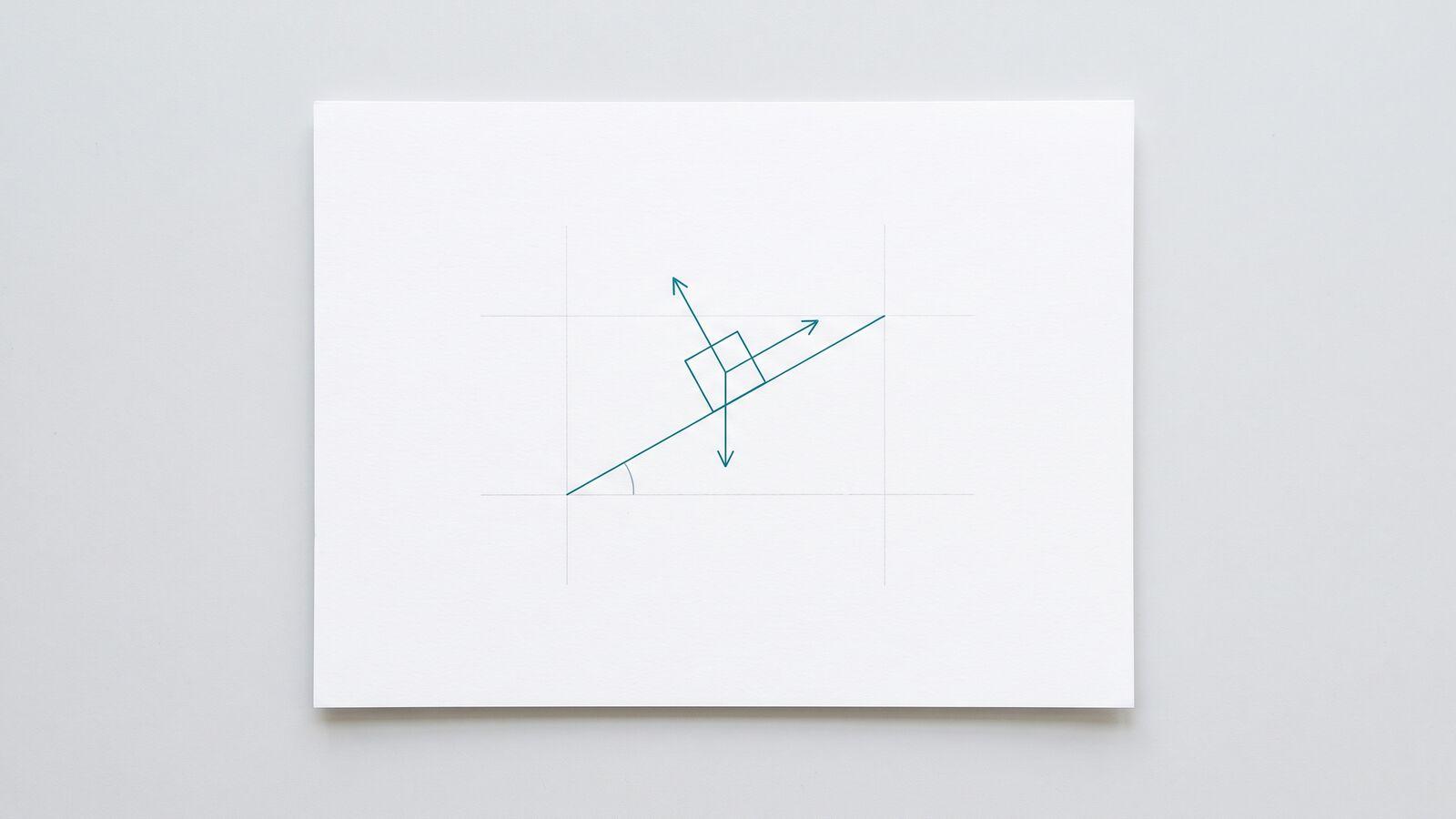
On a flat road, a simplified car model has weight downward, a normal force upward, and lateral static friction toward the turn's center. The vertical forces balance if there is no vertical acceleration. The horizontal net force changes the direction of motion.
A worked turn: keep speed and radius separate
Consider an illustrative 1,000 kg car following a level circular path of radius 50 m at 10 m/s. Treat it as a particle and ignore other horizontal effects.
The inward acceleration is:
The required inward net force is:
At 20 m/s on the same radius, acceleration becomes eight meters per second squared and the required force becomes 8,000 N. The speed doubled; the force quadrupled.
These are idealized calculation examples, not safe driving recommendations. The real force available depends on the vehicle, surface, tires, conditions, and other factors. The model's lesson is the squared dependence, which is easy to underestimate if you think only in terms of speed doubling.
Now change only the radius from 50 m to 100 m while keeping speed at 10 m/s. The required acceleration becomes one meter per second squared. A wider path at the same speed changes direction more gradually.
Period connects the circle to a stopwatch
The period is the time for one complete revolution. A circle's circumference is , so uniform speed is distance divided by time:
Substitute that into the acceleration formula:
For example, an object completing a circle of radius two meters in four seconds travels at meters per second. Its inward acceleration is meters per second squared, approximately 4.93.
Be explicit about what stays fixed. At fixed speed, a larger radius reduces the required acceleration. At fixed period, a larger radius increases it, because the object must cover a longer circumference in the same time. These statements are consistent; they hold different quantities constant.
Angular speed offers another description: in radians per second, so . Choose the version matching the information you are given rather than converting everything by habit.
What changes when the object speeds up?
Uniform circular motion means constant speed. Circular motion itself does not require that restriction.
If an object speeds up while remaining on a circle, it has an inward acceleration that changes the velocity's direction and a tangential acceleration that changes its magnitude. These components are perpendicular. Their vector sum is the total acceleration.
This also explains an energy question. In uniform circular motion, a purely inward net force is perpendicular to the instantaneous velocity and does no work on the object. Its kinetic energy stays constant while its direction changes.
A tangential force can change speed and kinetic energy. The connection is covered more fully in our work and energy guide. A force can change velocity without changing kinetic energy because direction and speed are different information.
A problem-solving checklist that prevents double counting
Draw the path and mark the object's current position. Add a tangent velocity arrow and an inward radial direction. Then draw a separate free-body diagram with only real forces.
Resolve those forces along the inward direction and set their sum equal to the required mass times inward acceleration. Handle perpendicular directions separately. In a vertical circle, gravity's radial component changes with position, so one equation for the bottom is not automatically the equation for the top.
Finally, check your result against the scaling. More mass requires proportionally more force for the same motion. More speed at fixed radius raises the requirement quadratically. If your answer says otherwise, inspect the algebra and the quantities held fixed.
Practice these steps in Physics Zen's circular motion topic. Start with uniform horizontal examples, then add vertical geometry once the force diagram is comfortable. The recurring question is simple: which real forces supply the inward acceleration this path requires?
Common questions
- Why does an object accelerate if its speed is constant?
- Velocity includes direction. An object following a circle continually changes direction, so its velocity changes even if its speed does not. In uniform circular motion the acceleration points toward the center.
- Is centripetal force a separate force?
- No. Centripetal describes the inward net force needed for a circular path. Friction, tension, gravity, or a combination of real forces can provide it. Do not add another centripetal force to a free-body diagram.
- What happens if the inward force disappears?
- With no remaining net force, the object continues along the tangent at its instantaneous velocity. If other forces such as gravity remain, they determine its subsequent path.
- Does doubling speed double centripetal force?
- No. At fixed mass and radius, the required inward force is proportional to speed squared. Doubling speed requires four times the inward force.
- What changes in nonuniform circular motion?
- There is still an inward acceleration associated with the changing direction, and there is also a tangential acceleration when the speed changes. The total acceleration is the vector sum of those components.