Elastic Collision Problems: Worked Examples and Checks
 Ivan Terekhin
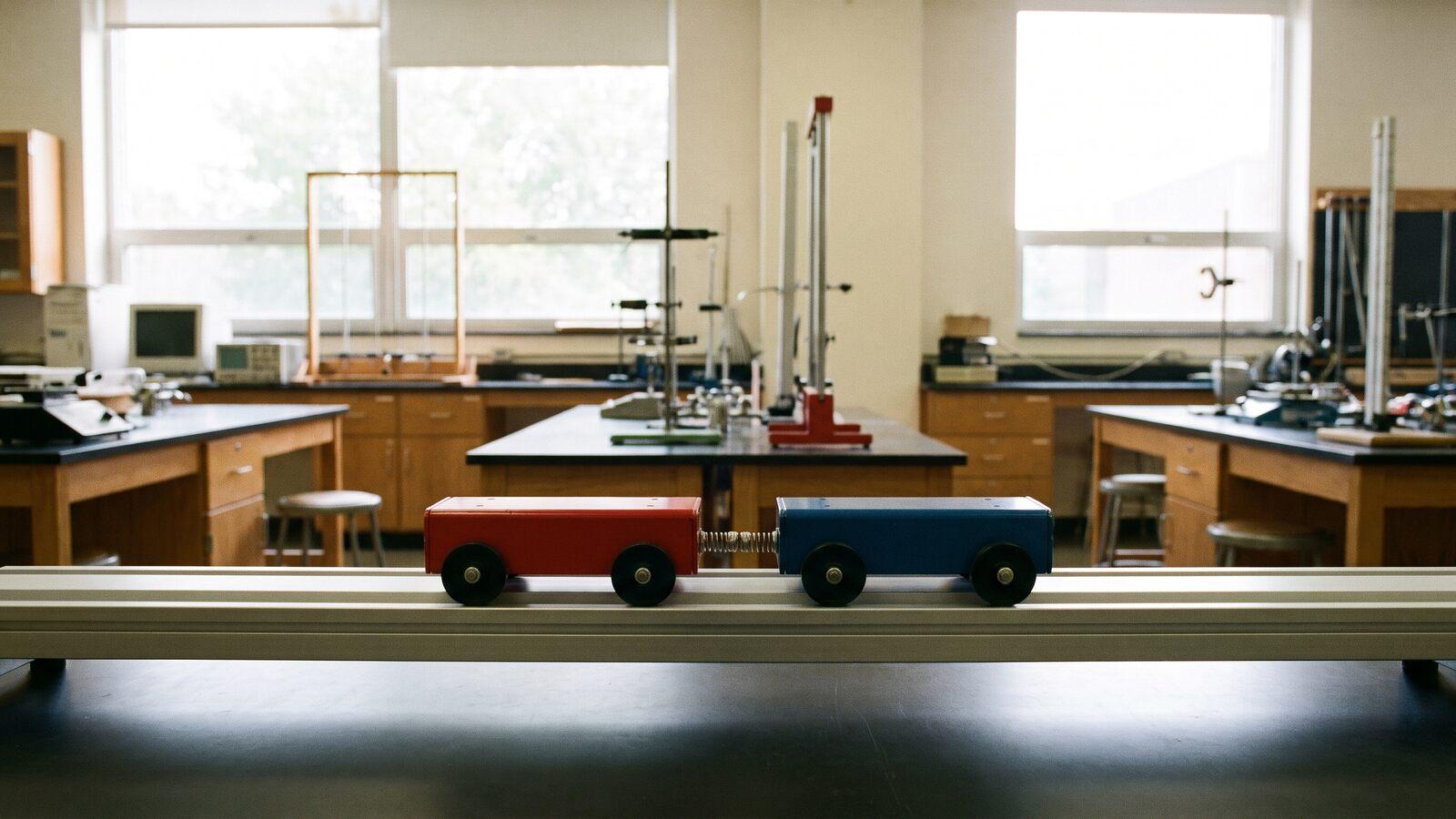
Two carts meet on a straight track. After an elastic collision, the total momentum and total kinetic energy of the two-cart system are unchanged. That gives two constraints for the two final velocities. It does not mean either cart keeps its own speed or direction. In the first example below, equal masses exchange velocities. In the next, the lighter cart reverses.
This is a worked problem set, with the sign convention and both conservation checks shown for every numerical result. For the meaning of momentum and impulse, read the momentum guide. OpenStax University Physics Volume 1, section 9.4 distinguishes elastic from inelastic collisions and derives the one-dimensional strategy used here.
Write the two constraints before substituting
Choose right as positive. For masses , initial velocities and final velocities , an ideal one-dimensional elastic collision satisfies
and
For two bodies in one dimension, the same pair can be solved using the relative-velocity relation , provided the collision is elastic. This is useful because it gives a linear equation alongside momentum. Do not use it for a collision where the objects stick together. The work and energy guide explains the kinetic-energy expression.
| Before solving | Write down |
|---|---|
| Direction | One positive direction for all four velocities |
| System | Both objects during the short collision |
| Constraint | Momentum always for the isolated system; kinetic energy too if elastic |
| Final check | Recompute total momentum and kinetic energy on both sides |
Example 1: equal masses, one cart initially at rest
Question. A 0.50 kg cart moves right at 4.0 m/s toward an identical cart at rest. Find both final velocities after an ideal elastic collision.
The relative-velocity equation gives , so . Momentum, after dividing through by 0.50 kg, gives . Solving the pair yields and . The first cart stops and the second moves right.
Momentum check. Initially . Finally .
Energy check. Initially . Finally the second cart alone has . The equality of masses makes this velocity exchange especially simple; it is not a rule for every collision.
Example 2: unequal masses and a reversal
Question. A 1.0 kg cart moves right at 3.0 m/s toward a stationary 2.0 kg cart. Find their final velocities if the collision is elastic.
Momentum gives . Relative velocity gives . From the second equation . Substitute into momentum: . Therefore and . The minus sign means the lighter cart moves left after the collision.
Momentum check. Before: . After: .
Energy check. Before: . After: . Squaring removes the velocity sign in energy, but the sign is essential in momentum.
Example 3: objects approach from opposite directions
Question. A 1.0 kg cart moves right at . An identical cart moves left at . What happens in an elastic head-on collision?
For equal masses in this ideal one-dimensional case, the carts exchange velocities. Thus and . Verify the shortcut rather than relying on it blindly. Initial momentum is . Final momentum is . Initial energy is . Final energy is also .
The relative velocity changes sign: initially , while finally . If you erase the minus sign on the left-moving cart at the start, you get the wrong system momentum.
Example 4: test whether a reported collision is elastic
Question. A 1.0 kg cart initially moves at 3.0 m/s and a 2.0 kg cart rests. A report claims final velocities of 1.0 and 1.0 m/s to the right. Could that be the elastic outcome?
Initial momentum is . Final momentum is , so the momentum check passes. Initial kinetic energy is 4.5 J, but final kinetic energy is . It is not elastic. The reported common final velocity is consistent with a perfectly inelastic, sticking result for these inputs, assuming the carts actually move together. Passing only one check cannot establish elasticity.
Diagnose a plausible wrong answer
| Proposed step | Problem | Repair |
|---|---|---|
| Put for a cart moving left | Direction sign lost | Set when right is positive |
| Reject because speed cannot be negative | Velocity and speed confused | Interpret the sign as direction; speed is 1 m/s |
| Use for sticking carts | Elastic-only relation used outside its condition | Use momentum and the shared final velocity |
| Check momentum alone | An inelastic outcome can also conserve momentum | Check kinetic energy separately |
Self-check. In Example 2, swap the labels of the carts without changing the physical setup. The equations and answer must describe the same motion, with the values attached to the newly labelled objects. A label is not a physical direction. If you get a different collision by renaming carts, inspect your signs and equations.
Practise collisions by writing the sign of every velocity beside a sketch, solving the two constraints, then recomputing both totals. Physics Zen's momentum topic covers conservation, elastic collisions and related problems. When an algebra step becomes the obstacle, the guide to physics mistakes that are really math mistakes helps separate the equation from the arithmetic.
Edited by Ivan Terekhin, drafted with AI tools.