Physics Mistakes That Are Really Math Mistakes (and How to Fix Each One)
Open a worked solution after a wrong answer and look at where the two paths separate. The free-body diagram is fine. The equation is the right one. Then, one line later, the friction force has the wrong sign, or the time came out negative and was kept, or the answer is exactly 3.6 times too large.
None of those are physics errors. They are math errors happening inside a physics problem. That matters because the fix is different: rereading the chapter on forces will not stop you writing where belongs.
Below are the seven math failures we see most often in Physics Zen solutions, what each one looks like on the page, a quick test that catches it, and the specific skill to practise. For the math practice we point to our sister app Math Zen, which generates fresh problems for each skill the same way Physics Zen does for physics.
1. Sign errors: pick a direction and keep it
A ball is thrown upward at . Taking up as positive, the acceleration is for the whole flight, including the way down. The velocity after two seconds is
The negative sign is information: the ball is moving downward. It does not mean the ball is "slowing down" and it is not an error to be corrected by dropping the minus.
Sign errors come from changing the positive direction halfway through a problem, or from treating a negative number as a smaller positive one. The test is simple: write the axis direction at the top of the page and read every sign against it. If a quantity points the other way, it is negative, and it stays negative in every later line.
The underlying skill is arithmetic with negative numbers, which the negative numbers guide on Math Zen builds from scratch. Practise it, then return to free fall in Kinematics, where the sign of matters in every problem.
2. Rearranging a fraction or a square
Centripetal acceleration is . Asked for the speed, a surprising number of solutions produce and stop. The correct rearrangement multiplies by and then takes a square root:
The same thing happens with kinetic energy, , where the speed is . Solutions that forget the factor of two, or forget the root, are algebra failures.
The test is to substitute the answer back into the original formula with the given numbers. If the two sides do not match, the rearrangement is wrong. This takes twenty seconds and catches nearly every case.
Rearranging is drilled in Math Zen's algebra topic, and the algebra guide explains why each step is allowed. On the physics side, circular motion and work and energy use these two rearrangements constantly.
3. Sine and cosine on the wrong component
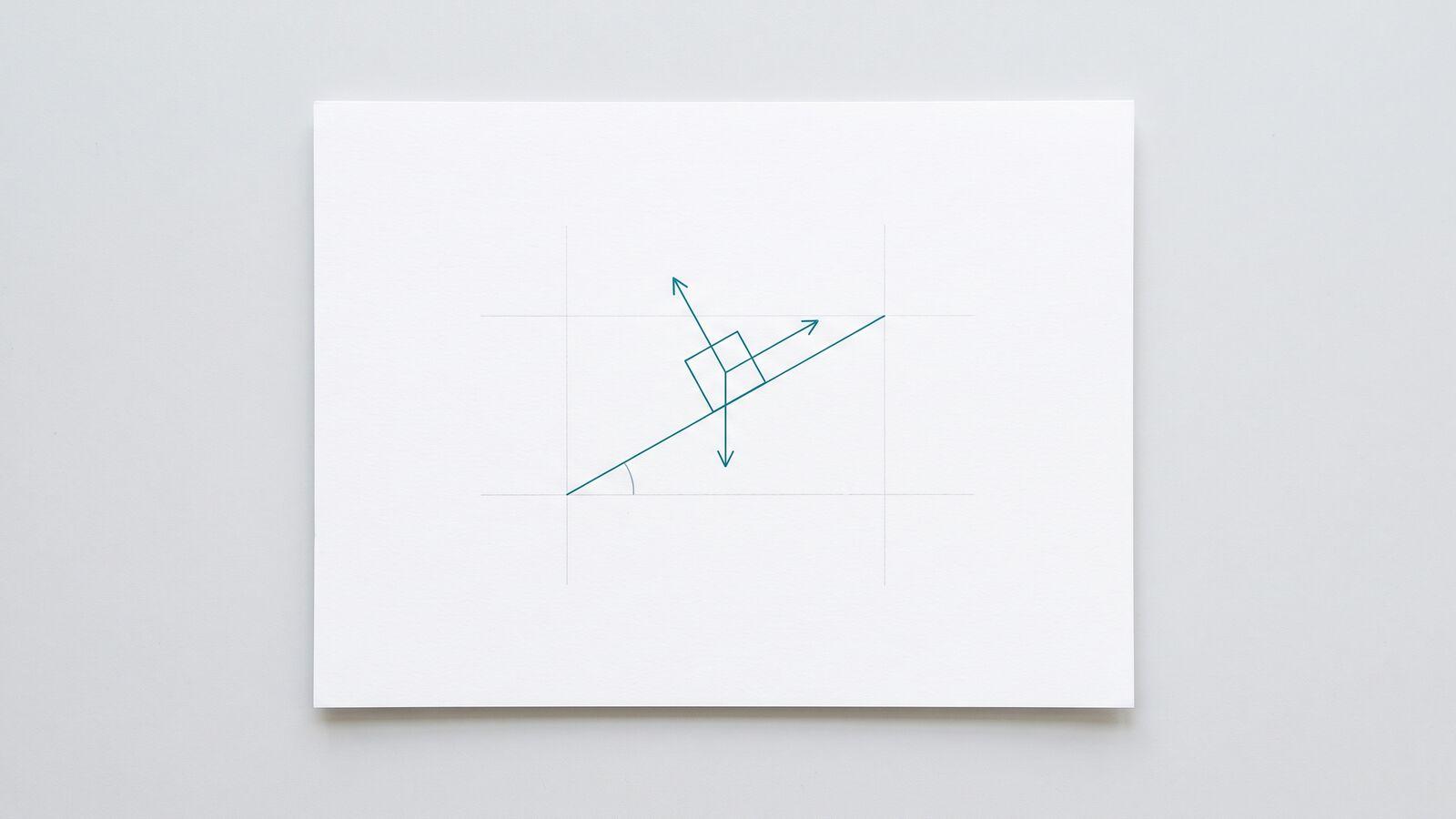
On an incline of angle , the weight component along the slope is and the component into the slope is . Swap them and the normal force, the friction, and the acceleration are all wrong, even though the free-body diagram was right.
The rule: the component adjacent to the known angle gets cosine, the component opposite it gets sine. On an incline, the angle at the bottom of the slope is the same as the angle between the weight vector and the normal direction, which is why the normal component is the cosine one.
The test is a limit. Set . The surface is flat, so nothing should pull the block along it. , so the sine version passes. Had you written for the along-slope component, the flat case would give a full sideways, which is nonsense. Run the same check at if you are still unsure.
This is right-triangle trigonometry and nothing more advanced. The trigonometry guide on Math Zen shows sine and cosine as coordinates on a circle, which makes the adjacent-opposite rule obvious, and the trigonometry topic drills it. Then come back to the inclined plane in Dynamics, or read our Newton's laws guide for the physics around it.
4. Quadratics and the root you throw away
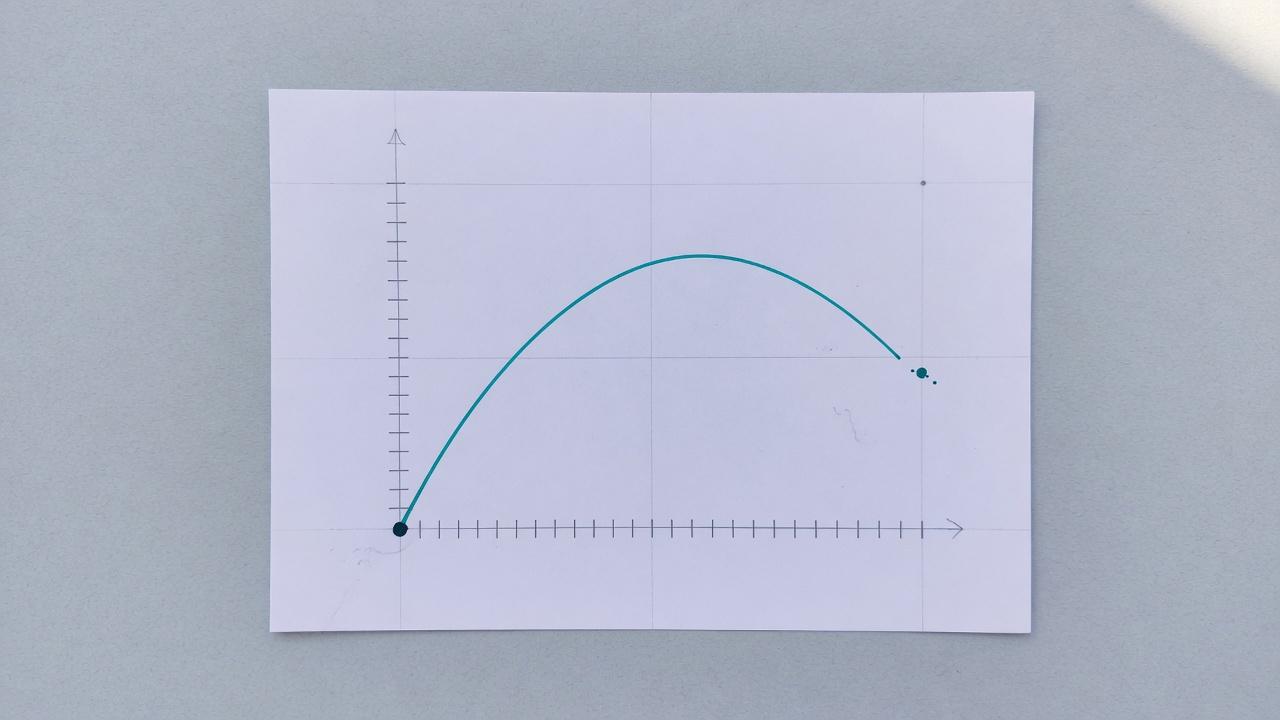
A stone is thrown upward at from a bridge above the water. When does it hit the water? Taking up as positive and the bridge as the origin:
This is a quadratic in . The formula gives roughly and . The negative root is not wrong mathematics; it is the time at which a stone following the same parabola would have passed the water on the way up, before the throw. Physics rejects it. Algebra has to find both first.
Errors here are sign slips inside the quadratic formula, using instead of , and arithmetic under the square root. The test is to substitute the chosen root back into the equation; it should give to within rounding.
Math Zen's quadratic equations guide explains where the formula comes from, and the solving skill inside its algebra topic generates new ones each time. Projectile problems in Kinematics, which is free in Physics Zen, use this every time the unknown is a time.
5. Units, prefixes, and powers of ten
A car at brakes to rest in . If the speed is used as , the deceleration comes out as , which would throw the driver through the windscreen. Converted to , the answer is a believable .
Dividing by is not a physics fact. It is metres per kilometre divided by seconds per hour, and it is a ratio problem. The same family of errors includes converting centimetres to metres but forgetting to square the factor for an area, and reading as a large number because the exponent looked big.
The test is the sanity check: an acceleration larger than for an ordinary car, a speed larger than sound for a thrown ball, or an energy in the millions of joules for a tennis ball, means a unit went wrong. Look for the factor before you look for a physics mistake.
The ratios and proportions guide and the exponents guide on Math Zen cover both halves, and its arithmetic topic drills them. Uniform motion, the first free skill in Physics Zen, asks for the km/h conversion in most problems.
6. Graphs: slope is not height
On a velocity-time graph, the slope is acceleration and the area between the line and the axis is displacement. A common answer to "when is the acceleration greatest" points at the tallest part of the graph. The tallest part is the greatest velocity. The greatest acceleration is where the line is steepest.
The second common error is ignoring the sign of an area. Area below the time axis is negative displacement. A graph that goes above and then below the axis can have a large distance travelled and a displacement of zero.
The test: before answering, say out loud which of slope, height, or area the question is asking for. Then find it. This sounds too simple to help and it works.
Reading slopes and areas without any physics attached is exactly what Math Zen's graph analysis topic practises. Our own kinematics guide then explains why slope and area carry these particular physical meanings.
7. Two unknowns, one equation
An elastic collision conserves both momentum and kinetic energy, so it produces two equations in two final velocities. A circuit with two batteries needs the loop rule written twice. A projectile problem has a horizontal and a vertical equation that share the flight time.
The error is trying to solve one equation that contains two unknowns, or substituting into the same equation you just used. The test: count unknowns, count independent equations, and do not start solving until they match.
This is simultaneous equations, drilled as linear systems in Math Zen's algebra topic. In Physics Zen the structure appears in momentum and collisions and in circuits, and our momentum guide shows why collisions need both equations.
The fix: a short math detour, then back to physics
Each row below is a mistake, the math skill behind it, and the physics topic to return to once the math is solid.
| Mistake | Math skill to practise (Math Zen) | Physics topic to return to (Physics Zen) |
|---|---|---|
| Dropped or flipped sign | Negative numbers | Kinematics, free fall |
| Fraction or square rearranged wrongly | Rearranging equations | Circular motion, work and energy |
| Sine and cosine swapped | Trigonometry, vectors | Dynamics, inclined plane |
| Wrong quadratic root, or a formula slip | Solving equations | Kinematics, projectiles |
| Unconverted unit, power of ten | Ratios, powers and roots | Uniform motion, gravitation |
| Slope read as height | Graph analysis | Kinematics graphs |
| Two unknowns, one equation | Linear systems | Momentum, circuits |
The routine that works is short. When a worked solution shows a math step you got wrong, spend ten minutes on that skill with fresh generated problems, then come back and solve three more physics problems from the same topic. Do not reread theory you already understand.
Math Zen is built by the same team as Physics Zen and follows the same loop of generated problem, instant check, and worked solution. It is available for iPhone and Android. The Math Zen blog has the mirror image of this article, the math you need for physics, organised by physics topic rather than by mistake.
A dropped sign is not a sign that you do not understand forces. It is a sign that one small skill needs five minutes of its own, and then the physics you already understand gets the mark.
Common questions
- Why do I get physics problems wrong when I understand the concept?
- Most lost marks happen after the physics is set up correctly: a formula rearranged wrongly, a sign dropped, sine used where cosine belongs, or a unit left unconverted. These are algebra and trigonometry errors, and they respond to separate math practice.
- How do I know whether to use sine or cosine for a component?
- The component adjacent to the known angle uses cosine; the component opposite the angle uses sine. Check with a limit: at zero degrees the along-slope component of weight should vanish, and sin of zero is zero.
- Which root of a quadratic do I keep in a projectile problem?
- The one that makes physical sense, usually the positive time after launch. The negative root corresponds to a moment before the motion you are describing began. Both roots must be computed correctly before you can reject one.
- Does a negative velocity mean the object is slowing down?
- No. A negative velocity means motion in the negative direction of your chosen axis. Slowing down means velocity and acceleration have opposite signs. Keep one axis direction for the whole problem and read signs against it.
- What math should I practise for physics?
- Rearranging formulas, solving linear and quadratic equations, right-triangle trigonometry, powers and scientific notation, ratios and unit conversion, and reading slopes and areas on graphs. Calculus is not needed for AP Physics 1 or A-Level Physics.