Half-Life Formula: Worked Examples for Decay Problems
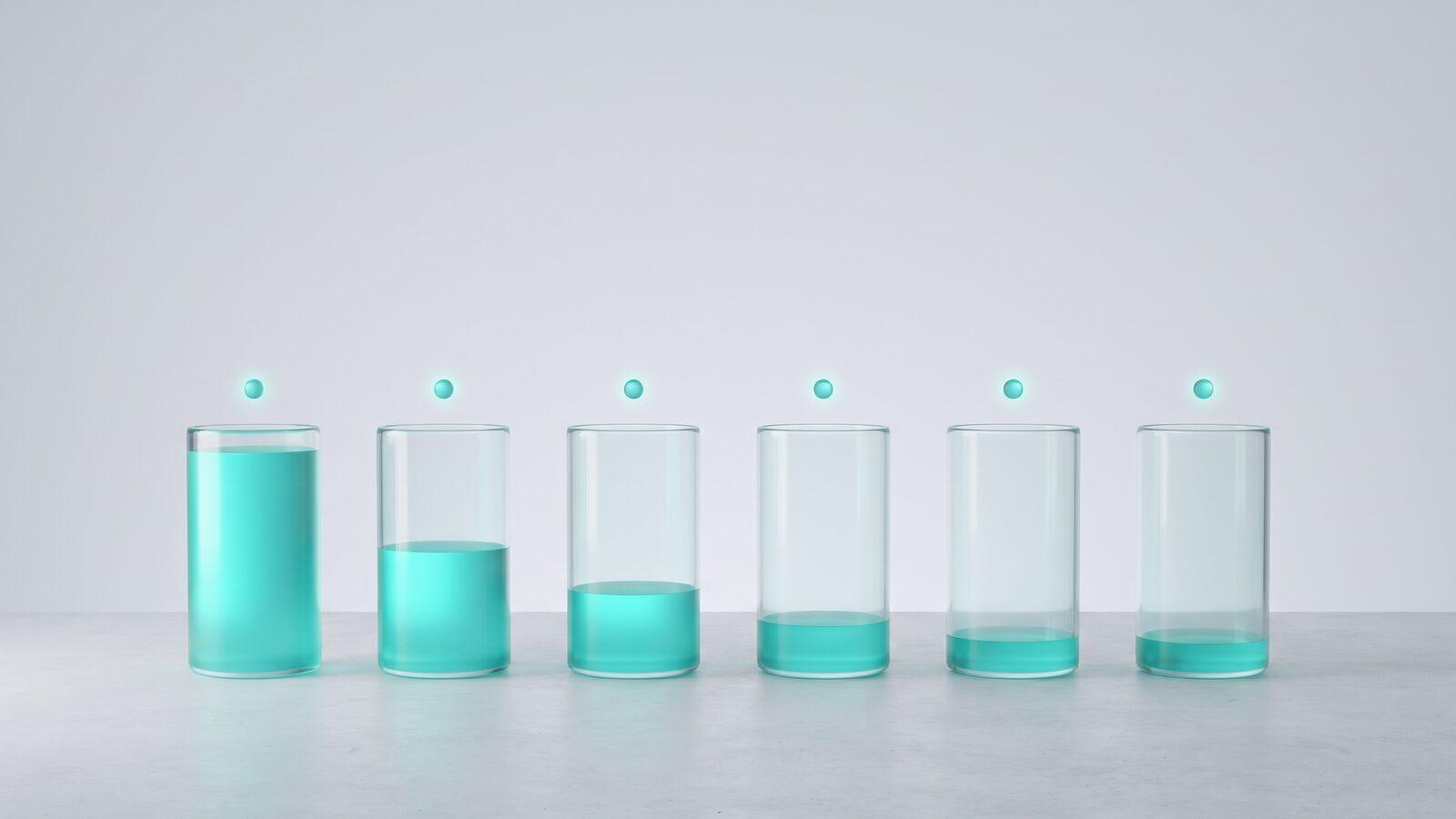
A sample's activity reads 1200 becquerels at noon. The isotope has a half-life of 6.0 hours. What will the detector read at 6 a.m. the next day? The answer is not 1200 minus three equal steps. Each half-life removes half of what is left, so the readings run 1200, 600, 300, 150. That multiplicative pattern is the whole content of the half-life formula.
This guide works the formula from the simple whole-number case to the cases that trip people up on exams: a fractional number of half-lives, finding the half-life from two measurements, switching to the decay constant, computing activity from a number of nuclei, and dating a sample from its remaining carbon-14. The Nuclear Physics topic lists the decay skills these examples practise.
Two forms of the same decay law
Radioactive decay is random for one nucleus but very regular for a large number of them. If undecayed nuclei are present at the start and the half-life is , the number left after time is
The exponent is simply the number of half-lives that have passed. It does not have to be a whole number.
Textbooks also write the law with the decay constant . OpenStax University Physics, Volume 3, §10.3 gives
The two forms agree because . Use the half-life form when the question talks in half-lives, and the exponential form when it gives or asks for . The same relation holds for the mass of the parent isotope and for its activity, because each is proportional to .
Before any arithmetic, put and in the same unit. Hours divided by days gives a number that looks reasonable and is wrong.
Example 1: a whole number of half-lives
Return to the opening sample: and . From noon to 6 a.m. is 18 h, which is half-lives.
A quick table makes the pattern visible and catches arithmetic slips:
| Time after noon | Half-lives passed | Activity |
|---|---|---|
| 0 h | 0 | 1200 Bq |
| 6 h | 1 | 600 Bq |
| 12 h | 2 | 300 Bq |
| 18 h | 3 | 150 Bq |
The tempting wrong answer subtracts 600 Bq every 6 h and reaches zero after 12 h. Decay is proportional to what remains, so the steps shrink.
Example 2: a fractional number of half-lives
A hypothetical isotope has a half-life of 8.0 days, and a source starts with 40 mg of it. How much of that isotope remains after 20 days?
The number of half-lives is . The formula handles that directly:
Check the size: after 2 half-lives there would be 10 mg, after 3 half-lives 5 mg. A result between 5 and 10 mg is right, and it is closer to 5 than to 10 because the curve falls fastest at the start of each interval. Halfway between 10 and 5, 7.5 mg, would be a linear guess, not the decay law.
The 7.1 mg is the remaining parent isotope. The sample does not lose 33 mg of total mass; most of the decayed atoms are still there as daughter nuclei.
Example 3: find the half-life from two readings
A detector shows 800 Bq for a pure source, and 3.0 h later it shows 500 Bq after background has been subtracted. What is the half-life?
Solve the half-life form for the number of half-lives:
Then
Sanity check: the activity fell by less than half in 3.0 h, so the half-life must be longer than 3.0 h. If you get a negative half-life, or one shorter than the elapsed time while the reading has not yet halved, the ratio was inverted.
When the drop is a clean power of two, skip the logarithm. A fall from 960 Bq to 240 Bq in 10 h is a factor of 4, which is 2 half-lives, so .
Example 4: decay constant and activity from a number of nuclei
A source contains nuclei of an isotope with days. What is its activity in becquerels?
Activity is decays per second, so convert the half-life to seconds first: . Then
Had you left the half-life in days, the result would come out in decays per day, about 86 400 times larger than the number of becquerels. The unit of decides the unit of .
Example 5: carbon dating with a non-round answer
OpenStax gives carbon-14 a half-life of 5730 years. A wooden object has 30% of the carbon-14 activity per gram of comparable living wood. Assuming that starting ratio, how old is it?
The object is roughly 10 000 years old. Check the bracket: 25% remaining would mean exactly 2 half-lives, 11 460 years. Thirty percent is a little more than 25%, so the age must be a little less, and it is.
The answer depends on the assumption that the starting ratio matched living material. Real radiocarbon laboratories calibrate for changes in atmospheric carbon-14, so treat this as a physics exercise, not a laboratory date.
Mistakes that cost marks
- Subtracting equal amounts. Each half-life halves the current amount. Linear steps reach zero; the decay law never does.
- Mixed time units. and must match, and must be in if you want activity in becquerels.
- Mixing up log and ln. , while . If you take of the ratio, divide by , not by 0.693. Our article on physics mistakes that are really math mistakes has more of these.
- Confusing parent and sample. The formula tracks the undecayed parent nuclei, not the total mass of the sample.
- Ignoring background. Count rates measured in a lab include background radiation. Subtract it before taking ratios.
Three practice problems with answers
Problem 1. An isotope with starts at 6400 Bq. What is the activity after 60 h? Four half-lives: .
Problem 2. What fraction of a sample remains after 1.5 half-lives? , about 35%, not 25%.
Problem 3. A count rate falls from 1000 to 125 counts per minute, background already removed, in 36 min. What is the half-life? The ratio 8 is 3 half-lives, so .
Half-life questions appear in almost every school physics course; our A-level Physics guide shows where radioactive decay sits among the other modern physics skills. Whatever the course, the routine is the same: match the units, count half-lives as , let the exponent be fractional when it needs to be, and check that the answer falls between the whole-half-life values around it.
Common questions
- What is the half-life formula?
- The amount left after time t is N = N0 (1/2)^(t/T), where N0 is the starting amount and T is the half-life. The same law can be written N = N0 e^(-λt) with decay constant λ = ln 2 / T.
- How do I find the half-life from two measurements?
- Divide the starting value by the later value, take log base 2 of that ratio to get the number of half-lives, then divide the elapsed time by that number. For 800 Bq falling to 500 Bq in 3.0 h, the ratio 1.6 gives 0.678 half-lives, so T is about 4.4 h.
- Is anything left after ten half-lives?
- Yes, in the model a fraction (1/2)^10 remains, about 0.098 percent of the original nuclei. The amount never reaches exactly zero in the formula, though for a small sample the count eventually becomes so low that the statistics of individual decays matter.
- Does activity have the same half-life as the number of nuclei?
- Yes. Activity is A = λN, and λ is constant for a given nuclide, so activity falls by the same factor as N. If the number of undecayed nuclei halves, the count rate from that nuclide halves too, apart from background and detector effects.