How to Prepare for the Common Test: Physics and Basic Physics
The University Entrance Common Test (大学入学共通テスト, usually just 共通テスト) is the shared first-stage exam for Japanese universities, set by the National Center for University Entrance Examinations (大学入試センター). The 2027 sitting is on 16 and 17 January 2027, and science is on the second day.
Physics appears twice on that day. 『物理』 (Physics) is a subject of its own. 「物理基礎」 (Basic Physics) is one of four ranges inside the combined Basic Science subject. This guide covers both, because the Physics paper is written on top of Basic Physics and the Physics Zen Common Test: Physics path drills both. Physics Zen is independent exam-style practice. It is not official material and is not affiliated with the National Center.
What the Exam Looks Like
The National Center's 2027 subjects and question format document (出題教科・科目の出題方法等) sets out two separate science subjects that contain physics.
『物理』 (Physics). 100 points in 60 minutes, covering the whole high-school course 物理.
『物理基礎/化学基礎/生物基礎/地学基礎』 (Basic Science). One subject with four ranges: Basic Physics, Basic Chemistry, Basic Biology and Basic Earth Science. You answer two of the four in a single 60-minute sitting, 50 points each, in whatever order and time split you like.
At application you register how many science subjects you will sit, one or two, and that sets your start time on 17 January: 9:30 to 11:40 for two subjects, 10:40 to 11:40 for one, according to the 2027 exam guide. Which subjects you need at all is decided by the universities you apply to, so their admission guidelines (募集要項) settle it.
Every answer is marked on an answer sheet. The 2027 question-writing policy (問題作成方針) says items are multiple choice or answered with numbers or symbols, and that linked items, where the answers to consecutive questions are combined and more than one combination counts as correct, may appear. For Physics (in a passage shared with Chemistry, Biology and Earth Science) the same policy asks for analysis and interpretation of observation and experiment results with mathematical methods, and for reasoning about material candidates have not seen before, with the content of Basic Physics taken into account. In practice: read the setup, find the physics in it, compute, then choose.
The 2026 Papers, Question by Question
The National Center publishes every past paper and its answer key, with the points for each answer. The 2026 Physics paper had four large questions (大問) of 25 points each and 22 answer cells. Basic Physics had three, worth 16, 16 and 18 points, with 14 answer cells. Here is what each asked and where it lands on the path.
| Paper | Question (points) | What it asked | On the path |
|---|---|---|---|
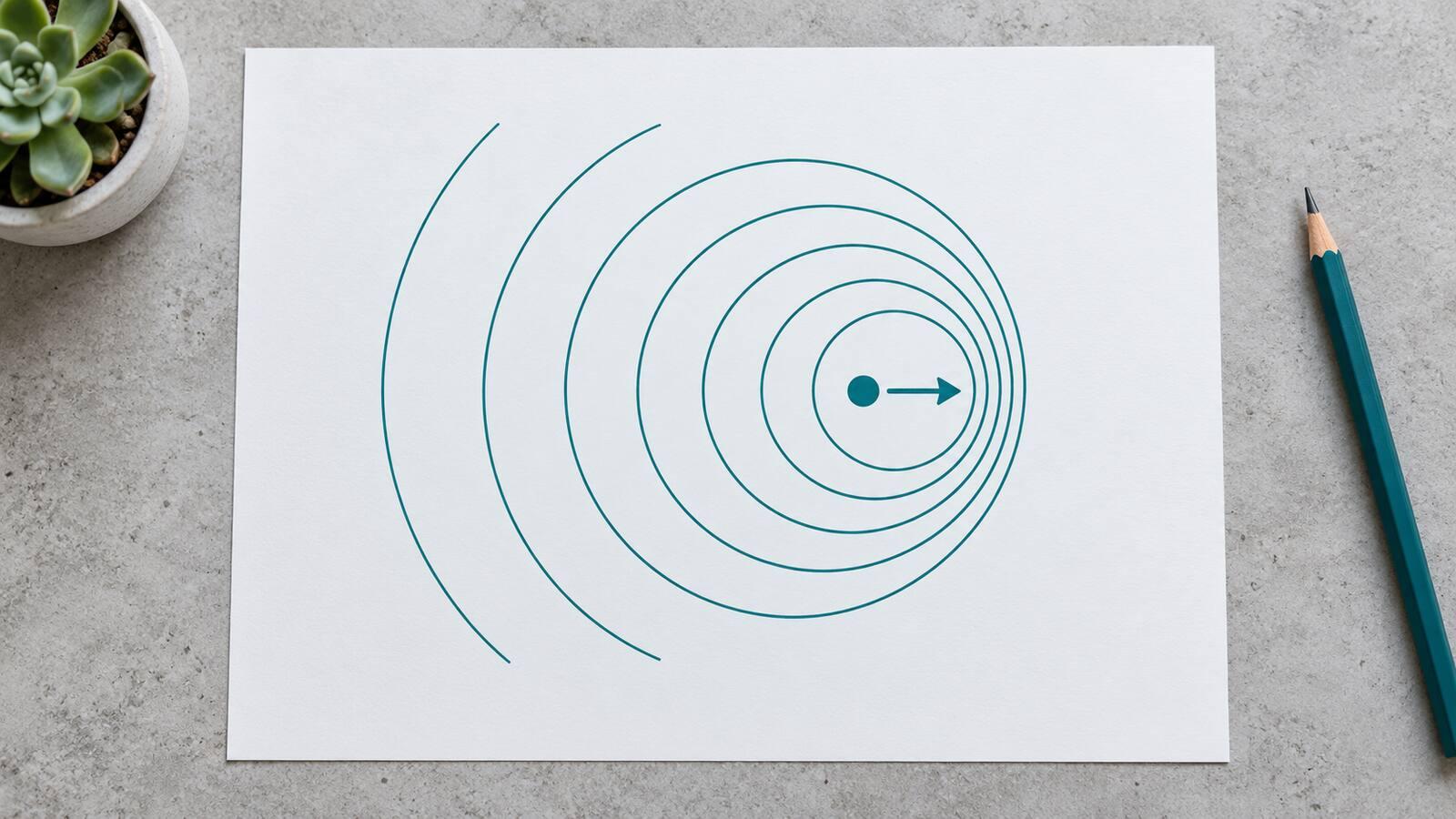
| Physics | 第1問 (25) | Five short items: an approaching siren and the Doppler effect, circuit elements on a wiring board, two balloons in an accelerating bus, an X-ray photon colliding with an electron, two containers of monatomic gas | Sound & Doppler, Newton's Laws (the inertial-force item) and Gas Laws & Kinetic Theory, yes; the X-ray collision (the Compton effect), no |
| Physics | 第2問 (25) | Collisions on a line: a body against a wall, then a body striking a block, then a block joined by a spring to a second block, with the coefficient of restitution and the energy lost | Yes: Coefficient of Restitution in Momentum & Collisions |
| Physics | 第3問 (25) | A: a cycle of a monatomic ideal gas on a pV diagram, with heat and work; B: interference of a circular wave and a plane wave | Yes: Gas Laws & Kinetic Theory, the first-law skill, Wave Graphs & Interference |
| Physics | 第4問 (25) | A charged particle through a uniform electric field, then a uniform magnetic field | Yes: Electric Field, Magnetic Force in Magnetism & Induction |
| Basic Physics | 第1問 (16) | Four short items, among them a floating iceberg and a conversation about radiation and its units | Buoyancy, yes; radiation units, no |
| Basic Physics | 第2問 (16) | A cart on a track, tracked with a phone's magnetic-field sensor, then a velocity-time graph | Uniform Acceleration and v-t graphs, yes; reading the sensor trace, no |
| Basic Physics | 第3問 (18) | A: heating and cooling, specific heat and latent heat; B: a resistor whose resistance changes with temperature, used as a thermometer to measure specific heat | Specific Heat, Phase Changes and circuits, yes; the measurement design, no |
Two patterns stand out. The physics inside every question is standard syllabus physics, and most of it is something you can drill until it is automatic. And the paper wraps that physics in an experiment, a conversation or a graph that has to be read before any formula helps. The path trains the first part. Past papers train the second.
What the Physics Zen Path Contains
Fifty-eight skills, grouped into the same six units as on the path page. Problems use .
Basic Physics: motion and energy (12 skills). Uniform motion, uniform acceleration and free fall; Newton's laws, friction and the inclined plane; work, kinetic and potential energy, conservation and power; density and pressure, and buoyancy.
Physics: various motions (14 skills). Horizontal and angled launches; momentum and impulse, conservation of momentum, elastic collisions, the coefficient of restitution and the centre of mass; uniform circular motion, centripetal force and gravitation, including gravitational potential energy and escape speed; springs, pendulums and energy in simple harmonic motion; and torque for the balance of a rigid body.
Heat and gases (5 skills). Specific heat, phase changes, the gas laws with kinetic theory (pressure from molecular motion, , internal energy of a monatomic gas), the first law of thermodynamics, and engines and efficiency.
Waves (9 skills). Wave speed, wave graphs and interference, the electromagnetic spectrum, sound and the Doppler effect, standing waves and end reflection, reflection and refraction, lenses and mirrors, double-slit and thin-film interference, and diffraction gratings.
Electricity and magnetism (13 skills). Charge, field and potential; Ohm's law, series and parallel (including turning a meter into an ammeter or voltmeter with a shunt or a multiplier), power, and Kirchhoff's rules with internal resistance; capacitors, their combinations and a capacitor in a DC network; the field of a current, magnetic force on a wire and on a moving charge, induction, AC and transformers, and self and mutual inductance with reactance, impedance and resonance.
Atoms (5 skills). Photons and the photoelectric effect, matter waves and X-rays, atomic energy levels, radioactive decay, and mass-energy.
Twenty-four items on the path are written in Common Test style, and most of them ask for the answer in the paper's digit cells, in the form ア.イ × 10^ウ, so two significant figures become a habit. Every skill generates fresh values on each attempt, checking is instant, and a full worked solution opens once you have answered. The theory for the skill is one tap away from the problem. Five mastery levels per skill decide when you are done with it. The path is Premium; the Kinematics topic is free end to end, and the app runs on iPhone and Android.
What the Path Does Not Do
Be clear about the gaps, because the 2026 papers hit several of them: the Compton item, the radiation units, a "choose every one that applies" combination in 第1問 and two "choose the graph" items in Basic Physics.
Content not drilled: semiconductors and the pn junction, the specific charge of the electron and Millikan's experiment, the Compton effect, elementary particles, radiation units such as the sievert and penetrating power, the centrifugal-force framing of circular motion, tipping conditions, the Wheatstone bridge and Kepler's third-law ratio. Learn these from your textbook and past papers.
Format not drilled: choosing the correct graph from a set of graphs, "choose every statement that applies" combinations, answers written as an expression in given letters, and long experiments built on measured data. On the paper you pick an option number from a list that can run to eight or more choices; most items on the path offer four.
Left out on purpose: rotational dynamics, rotational energy, fluid flow and RC time constants are taught elsewhere in the app but are not in the national curriculum for Physics, so they are not on this path.
And it is not a mock paper. Timing yourself on 60 minutes of real questions is a separate job, and the past papers are the right material for it.
Twelve Weeks to 17 January
From the last week of October, twelve weeks remain. If you start in early November, you have about ten: give the Basic Physics unit one week instead of two and the waves unit one week instead of two. Here is the plan week by week.
Weeks 1 and 2: Basic Physics motion and energy. Twelve skills. Quick if your Basic Physics is sound, but do not skip it: the Physics paper assumes every one of them, and Basic Physics candidates are examined on them directly.
Weeks 3 and 4: various motions. Fourteen skills, and the heaviest unit in the Physics paper. Restitution and the energy lost in a collision deserve extra time, since a full 25-point question in 2026 was built on them.
Week 5: heat and gases. Five skills. Work through a pV cycle until you can say, for each step, which of heat, work and internal energy is zero.
Weeks 6 and 7: waves. Wave graphs first: read a y-x graph and a y-t graph without mixing them up. Then standing waves, Doppler, refraction and the interference family.
Weeks 8 and 9: electricity and magnetism. Thirteen skills. A charged particle crossing an electric field and then a magnetic field joins two skills in one question, as it did in 2026, so practise both until each feels routine.
Week 10: atoms. Five skills. Then write out the list from the section above and cover each item from your textbook.
Weeks 11 and 12: past papers. Sit the National Center's papers in 60 minutes: Physics, or Basic Physics together with your second basic subject. After each one, go back to the skills that cost you points.
Conventions That Matter
Digit cells. Many numeric answers go into cells such as ア.イ × 10^ウ. Round to two significant figures only at the end, and make sure the exponent cell gets the power of ten you actually have.
Letters stay letters. When the paper writes the acceleration due to gravity as , as the 2026 Basic Physics iceberg question did, the answer is an expression in , not a number. The path gives numbers, so keep the symbolic habit separately when you do past papers.
Units. Kelvin in every gas calculation, electronvolts and joules kept apart in atomic physics, and the speed of sound the question gives, not the one you remember.
Read every option. In linked items and combination answers, a correct first half does not save a wrong second half.
Physics or Basic Physics?
Your universities decide. Basic Physics is half of a 60-minute sitting shared with another basic science; Physics is a full hour on its own. If you sit only Basic Physics, the first unit of the path is your core, together with Specific Heat, Phase Changes, wave speed, wave graphs and standing waves, Ohm's law, series and parallel circuits and power, transformers, the electromagnetic spectrum, radioactive decay and mass-energy. If you sit Physics, use the whole path.
For the mathematics papers in the same exam, Math Zen has a companion guide for the Common Test maths papers. If the Doppler item worries you, the Doppler effect worked examples cover the sign choices. And if the problem is the studying rather than the content, start with how to study physics effectively, then come back to the path.
Common questions
- When is the 2027 Common Test, and when are the physics papers?
- The main sitting is on 16 and 17 January 2027. Science is on the second day, 17 January: 9:30 to 11:40 if you registered for two science subjects, 10:40 to 11:40 if you registered for one. Check the National Center's own pages before the day, since the Center publishes the timetable and any changes there.
- What does the Physics Zen Common Test path cover?
- Fifty-eight skills in six units that follow the national curriculum for Basic Physics and Physics: motion and energy, various motions, heat and gases, waves, electricity and magnetism, and atoms. Twenty-four items are written in Common Test style, most answered in the paper's digit cells.
- Is this a mock Common Test?
- No. It is focused skill practice, not a timed paper. It does not drill semiconductors, the specific charge of the electron, the Compton effect, elementary particles or radiation units, and it does not ask you to pick a graph or choose all statements that apply. Past papers from the National Center cover that part.
- Is Physics Zen official Common Test material?
- No. Physics Zen is an independent practice tool and is not affiliated with the National Center for University Entrance Examinations or the Ministry of Education. The problems are not past papers.
- Which value of g does the path use?
- g = 9.8 m/s². Common Test papers often write the acceleration due to gravity as the letter g; when they do, keep it as a letter in your working and in your answer.
- Is the path free?
- The path is Premium. The Kinematics topic is free end to end, so you can try the solving loop first. Physics Zen runs on iPhone and Android.