Archimedes' Principle: Buoyancy Explained with Examples
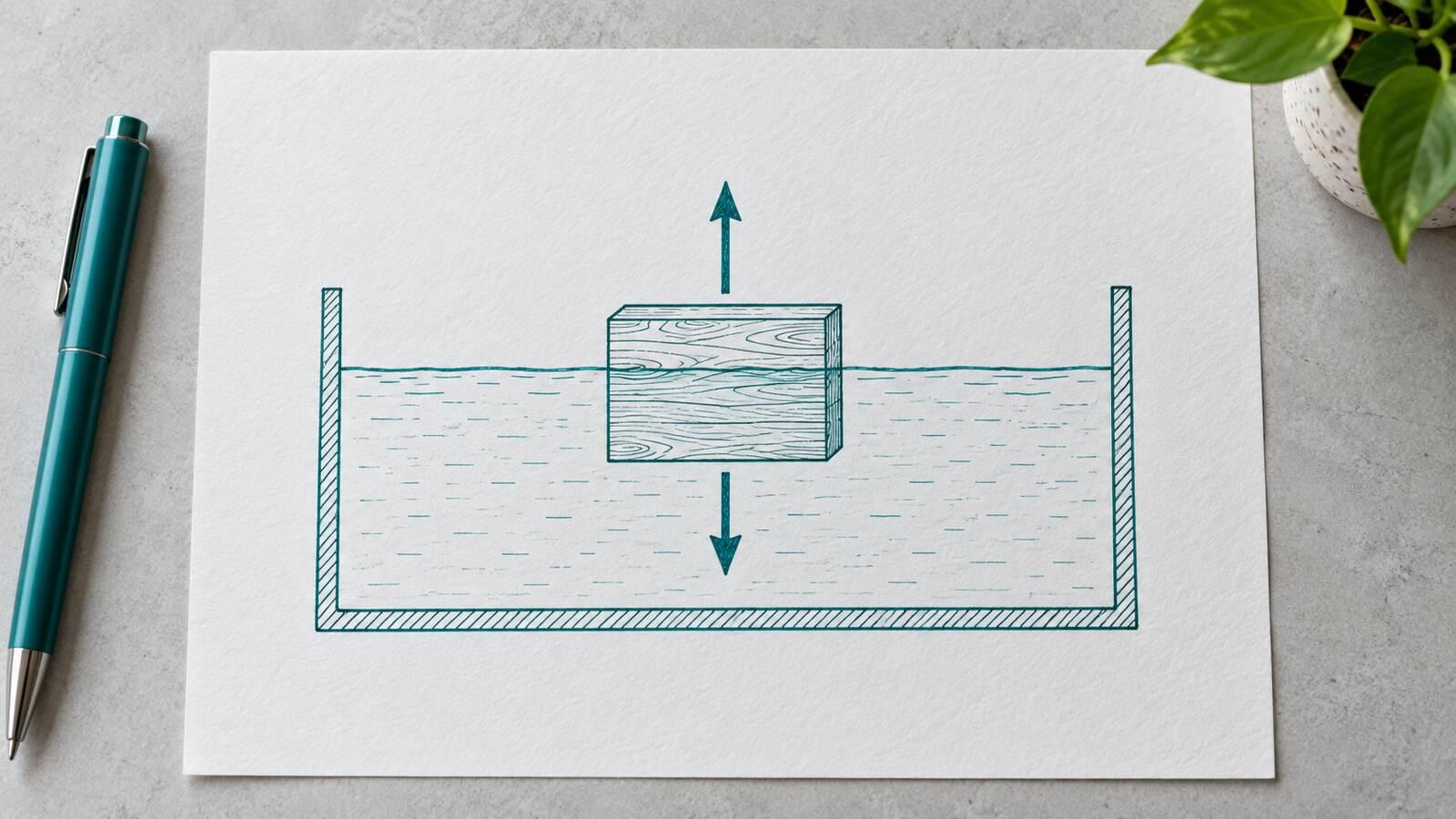
Push an empty sealed bottle beneath the surface of a pool. Your hand feels it push back. Release it and the bottle rises until only part remains underwater. Now drop a metal key into the same pool. It sinks, yet the water still pushes upward on it. The difference is whether that upward push can balance the object's weight.
Archimedes' principle gives the size of the push: the buoyant force equals the weight of the fluid displaced by the object. It works for things that float, things that sink, and things held underwater. The bookkeeping changes with the amount of the object that is immersed. Most errors in buoyancy problems come from using the object's entire volume when only part of it displaces fluid.
We will use water with density and gravitational acceleration in the examples. These are rounded model values. Assume the water's density is uniform, the objects do not soak it up or change volume, and the examples are at rest unless a release is explicitly discussed.
Why the force points upward
Water presses on all sides of an immersed object. Pressure increases with depth, so water pushes harder on the lower surface than on the upper surface. In a simple symmetric setup the horizontal pushes balance, leaving a net upward force. OpenStax's buoyancy section develops this pressure picture and states Archimedes' principle for partial and full immersion.
There is another way to picture the same result. Remove the object mentally and put the displaced water back in its place. That water would be supported by pressure from the surrounding water. Replace it with the object again: the surrounding water still supplies the same upward support for that occupied volume. Therefore the upward force equals the weight of the displaced water. The object's own weight determines whether that support is enough to hold it up, not whether the support exists at all.
With a fluid of uniform density, the displaced fluid has mass . Multiply by to get its weight:
The units check the formula: . Buoyancy is a force in newtons, not a mass in kilograms. UC Santa Barbara's Archimedes demonstration shows the formula and compares a scale's lost reading with water collected from a submerged sphere.
Which volume belongs in the formula?
Use the volume of fluid displaced. That is exactly the volume of the object's part inside the fluid, provided the fluid cannot pass through it.
- For a solid object entirely underwater, displaced volume equals the object's total external volume.
- For an object floating partly above the surface, displaced volume equals only its submerged volume.
- For an object being lowered into water, displaced volume grows as more of it enters, until it is fully submerged.
The formula does not ask for the object's mass or density to calculate buoyant force directly. Those quantities matter when you compare buoyancy with weight or solve for the floating position. Draw the waterline, then use only the volume below it.
Worked example: a sinking object held underwater
Take a compact object with mass and external volume . Lower it completely into water on a thin scale hook, keep it suspended, and make sure it does not touch the bottom. Ignore the small buoyancy from air when calling its weight in air .
Its weight is:
Because the object is fully submerged, it displaces of water. Its buoyant force is:
The force of gravity still pulls down with . Water pushes up with . The scale provides the remaining upward force, so its reading is:
That reading is the object's apparent weight while suspended underwater. NASA's buoyancy lesson uses the same force subtraction in a different unit system. The object has not lost mass. The water supports part of its weight. If you unhook it, its weight exceeds the buoyant force and it accelerates downward. If it reaches the bottom, the bottom adds a contact force, so the suspended-scale equation no longer describes the full force balance.
Draw the forces before deciding whether it floats
The free-body diagram method is especially useful here. Draw only forces acting on the object. For the suspended object, draw weight downward, buoyancy upward, and scale tension upward. At rest, . If the scale releases it, erase and use Newton's second law for the remaining net force.
For a freely floating object at rest, there is no supporting scale and no bottom contact. Only weight and buoyancy balance:
This equality is a result of equilibrium. It does not mean the water somehow knows the object's weight in advance. The object moves until enough of it is submerged to displace water of equal weight. More load makes a floating object settle deeper; less load lets it rise. Our guide to Newton's laws explains why zero net force describes rest or steady motion, while an unbalanced force changes motion.
Worked example: how much of a block is submerged?
Consider a sealed block of total volume and average density . Its mass is , so its weight is:
Let it float freely. At rest, the displaced water must weigh . Solve for the water volume:
Thus , or 60 percent of the block's volume, is submerged. The remaining 40 percent is above the surface in this ideal model. This also follows directly from the density ratio:
That shortcut assumes a freely floating object at equilibrium, a uniform fluid, and average object density calculated using the object's external volume. It is not a formula for the fraction submerged of a sinking object held up by a rope or resting on the bottom. The ratio also cannot exceed one for a freely floating equilibrium in this simple situation: if the object's average density exceeds the fluid's, it cannot displace enough of that fluid while remaining afloat.
Now push the same block fully underwater and hold it there. It displaces the full , so buoyancy becomes . Its weight is still . Before the restraining force is applied, the net force would be upward. This is why you must push down to keep it immersed. Do not use as the buoyancy when it floats freely; the freely floating value is because only is submerged.
Physics Zen's fluids topic gives displaced volume and force balance a dedicated place in the course. Work the volume in cubic meters first, then compare forces in newtons.
Try two short problems
Problem 1. A fully submerged rigid object displaces of water. Using the model values above, find its buoyant force. The answer is upward. You do not need its mass for this step. You would need its mass to decide whether it rises when released.
Problem 2. A freely floating sealed object has average density in the modeled water. What fraction of its volume is submerged? The answer is , or 75 percent. If its external volume were , the submerged volume would be . Check by mass: , equal to the mass of of modeled water.
Common mistakes to catch
Using total volume for a partly floating object. Only the submerged portion displaces liquid. Solve for that portion from equilibrium instead of assuming it equals the whole block.
Thinking sinking means no buoyancy. The sinking object's upward force can be substantial; it simply does not balance weight when the object is released.
Treating apparent weight as changed gravity. The object's weight remains . A scale reads less because water supplies another upward force.
Mixing liters and cubic meters. One liter is . Convert before multiplying by a density expressed per cubic meter.
Using the floating density ratio outside its assumptions. A held-down object, a bottom-supported object, or a changing-density fluid needs its actual force balance. Draw the diagram and return to displaced volume.
Frequently asked questions
Does buoyant force increase with depth?
In this constant-density model, moving an already fully submerged rigid object deeper does not change its displaced volume, so stays the same. While the object is entering the water, buoyancy increases because its submerged volume increases. Different conditions, such as a compressible object or a fluid whose density varies with depth, require a different analysis.
Why can a heavy ship float while a small metal key sinks?
Weight alone is not the criterion. A ship's hull encloses space and has a low enough average density, counting that enclosed volume, to displace water equal to its weight before the waterline reaches the top. A compact key's average density is greater than water's, so full immersion does not provide enough buoyant force to balance its weight.
Is displaced water the same as water that spills out?
Displaced volume is the volume from which the object excludes water. In an overflow container, an equal amount may spill out. In a pool, the water level rises instead. The buoyant force depends on the excluded fluid's weight, not on whether you collect a spill.
Common questions
- What does Archimedes' principle say?
- The upward buoyant force on an immersed object equals the weight of the fluid it displaces. With uniform fluid density, calculate it as fluid density times g times displaced volume.
- Does a sinking object still have buoyancy?
- Yes. It displaces fluid and receives an upward buoyant force even if its weight is larger. A scale holding it suspended underwater reads its weight minus the buoyant force.
- How do I find the fraction of a floating object below water?
- For a freely floating object at equilibrium in a uniform fluid, divide its average density by the fluid density. A block averaging 600 kilograms per cubic meter in water modeled at 1000 kilograms per cubic meter has 60 percent of its volume submerged.