Snell's Law Explained: Refraction with Worked Examples
A straw standing in a glass of water can look displaced at the waterline. The straw has not bent. Light from its underwater part changes direction as it travels from water to air, so the eye traces those rays back along a direction they did not follow below the surface. That change of direction is refraction.
A ray can also bounce off the surface: that is reflection. In a refraction problem, follow the ray that crosses the boundary. Snell's law tells you its direction once you know the incoming angle and the two materials. The calculation is short; keeping the drawing and angle labels honest is the real work.
Draw the boundary and its normal first
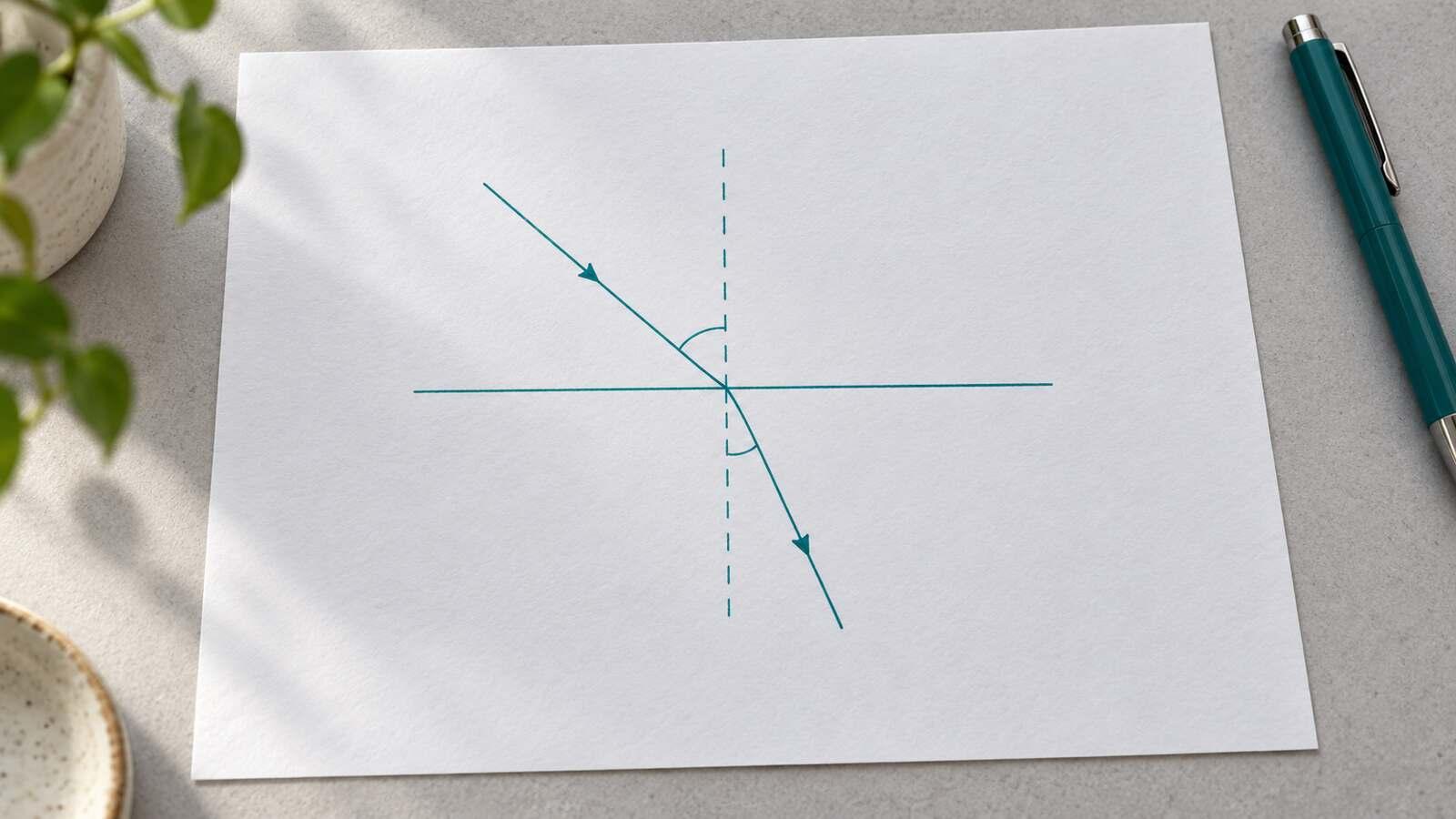
The normal is an imaginary line perpendicular to the surface at the point where the ray meets it. Both the incident angle and the refracted angle are measured between their rays and this normal, never between a ray and the surface. Here is a schematic for an air-to-water ray; its horizontal spacing is illustrative, and the numerical angles are established below.
                  air, n1 = 1.00
 incoming ray  ↘  |  normal
                 \| θ1
------------------+---------------- surface
                   |\ θ2
                   | ↘ transmitted ray
                 water, n2 = 1.33
At the plus sign, draw a short dashed normal if you are working on paper. Label the incoming side and the transmitted side . Then write beside the incoming ray and beside the transmitted ray. A good diagram prevents a frequent mistake: using an angle given from the surface directly in Snell's law. If that surface angle is , the angle from the normal is .
OpenStax's law of refraction section uses this same normal-line convention. Its drawings also distinguish the reflected ray, which stays on the incident side, from the refracted ray, which enters the second material.
What refractive index means
The refractive index compares the speed of light in vacuum, , with its speed in a material, :
A larger index means a lower speed in this model. We will use and , rounded values from OpenStax's refraction treatment. The values of a material's index can vary with wavelength. For the calculations below, follow one fixed-frequency ray and treat these indices as constant. The frequency remains unchanged at the boundary, while speed and wavelength change, as explained in OpenStax Physics on refraction.
The relation between the two directions is Snell's law:
Its angle variables are from the normal. The indices have no units, so the sine values must also be unitless. Keep a calculator in degrees for the degree angles in this article; switching it to radians will give the wrong numerical answers.
Before calculating, predict the direction. When the second index is larger, must be smaller, so the transmitted angle is smaller and the ray bends toward the normal. When the second index is smaller, the transmitted ray bends away, if it exists. At normal incidence, , the transmitted ray continues along the normal without a directional bend even though its speed changes.
Worked example: air into water
Suppose a ray in air meets a flat water surface at from the normal. We want its angle inside water. First record the sides: , , and . Since the index rises, expect .
Solve Snell's law for the unknown sine before inserting numbers:
Take the inverse sine, still in degree mode:
That is smaller than , so the direction check passes. Substitute back to catch a mistyped calculator entry: and . The small difference is rounding. If your result were , it would contradict the prediction for entry into the larger-index material.
There is no length unit to attach to . This problem asks for a direction, and degrees are the output unit. If an exam also asks for speed, calculate it separately from rather than treating the angle as a speed.
Worked example: water into air
Now send a ray upward through water toward the water-air boundary at from the normal. The side labels reverse: for water, for air. Because the index falls, predict an angle greater than in air.
Thus:
The transmitted ray bends away from the normal, as predicted. Back-substitution gives and . The values match to the shown precision.
Notice what changed between examples: the direction of travel, the order of the indices, and the specified incident angle. Do not exchange and while keeping the old . Medium 1 always means the medium the ray starts in for that calculation.
Check impossible answers and the critical angle
The sine of a real angle cannot exceed one. If rearranging Snell's law gives , that is not a request to force a calculator answer or round it back down. For light traveling from a higher index to a lower one, it marks the total internal reflection region of this ideal ray model. There is then no transmitted refracted ray at that incident angle.
At the limiting incident angle, the transmitted ray would run along the boundary, with . Set in Snell's law and solve for the critical angle:
For our rounded water-to-air indices, . That is an independently rounded calculation using the values chosen here; OpenStax's total internal reflection section gives the rule and illustrates the boundary. Our example lies below the critical angle, so it produces a transmitted ray. At from the normal, the same calculation asks for , which is impossible. The ray is totally internally reflected in this model.
The equality case matters. At the critical angle the refracted direction is , along the surface. For incidence greater than that angle, total internal reflection occurs. It cannot occur when a ray travels from air into water, because that trip starts with the smaller index. Also keep ordinary partial reflection separate from this limiting case: a boundary can reflect some light even when a transmitted ray exists.
Three practice questions, with answers
1. An angle is given from the surface. A ray arrives from air at to a flat water surface. What incident angle belongs in Snell's law, and what is the refracted angle? The normal is perpendicular to the surface, so . Then:
The answer is measured from the normal and is smaller than , as entry into water requires.
2. The ray is normal to the surface. A ray goes from water to air at from the normal. Snell's law gives , so . The transmitted direction stays straight. It does not mean the two materials have equal refractive indices.
3. Can a transmitted ray exist? A water-to-air ray has from the normal. The calculation gives . Because this exceeds one, no transmitted-ray angle exists in this model. Equivalently, exceeds the approximately critical angle. Do not report as a real angle.
Once you can label the normal and predict the bend before calculating, try the Physics Zen optics topic, which includes reflection, refraction and critical-angle practice. The same habit helps with diagram-heavy exam questions: A-level physics preparation, Abitur physics preparation, and bac physique preparation cover broader revision plans. In each new refraction problem, name the incident medium first, measure both angles from the normal, and check the sine before pressing inverse sine.
Frequently asked questions
Why does Snell's law use sine?
The sine captures how much of a ray's direction runs along the boundary. The wave geometry at a flat interface links that component on the two sides, producing . For solving a ray problem, the practical point is to use angles from the normal and keep each index with the angle in its own medium.
Does the frequency change when light refracts?
No. In this boundary model, frequency remains the same. Speed and wavelength change with the medium. A material's refractive index can also vary with wavelength, so a broad mixture of colors may separate; our numerical examples follow one ray using one chosen pair of indices.
Is a larger refractive index always a larger bending angle?
No. Compare the two indices and the incident angle. For a fixed incident angle in medium 1, a larger produces a smaller angle from the normal in medium 2. At incidence, the direction does not bend at all. Always state which angle you mean before comparing numbers.