Electric Potential vs Electric Field: Height, Slope, and Charge

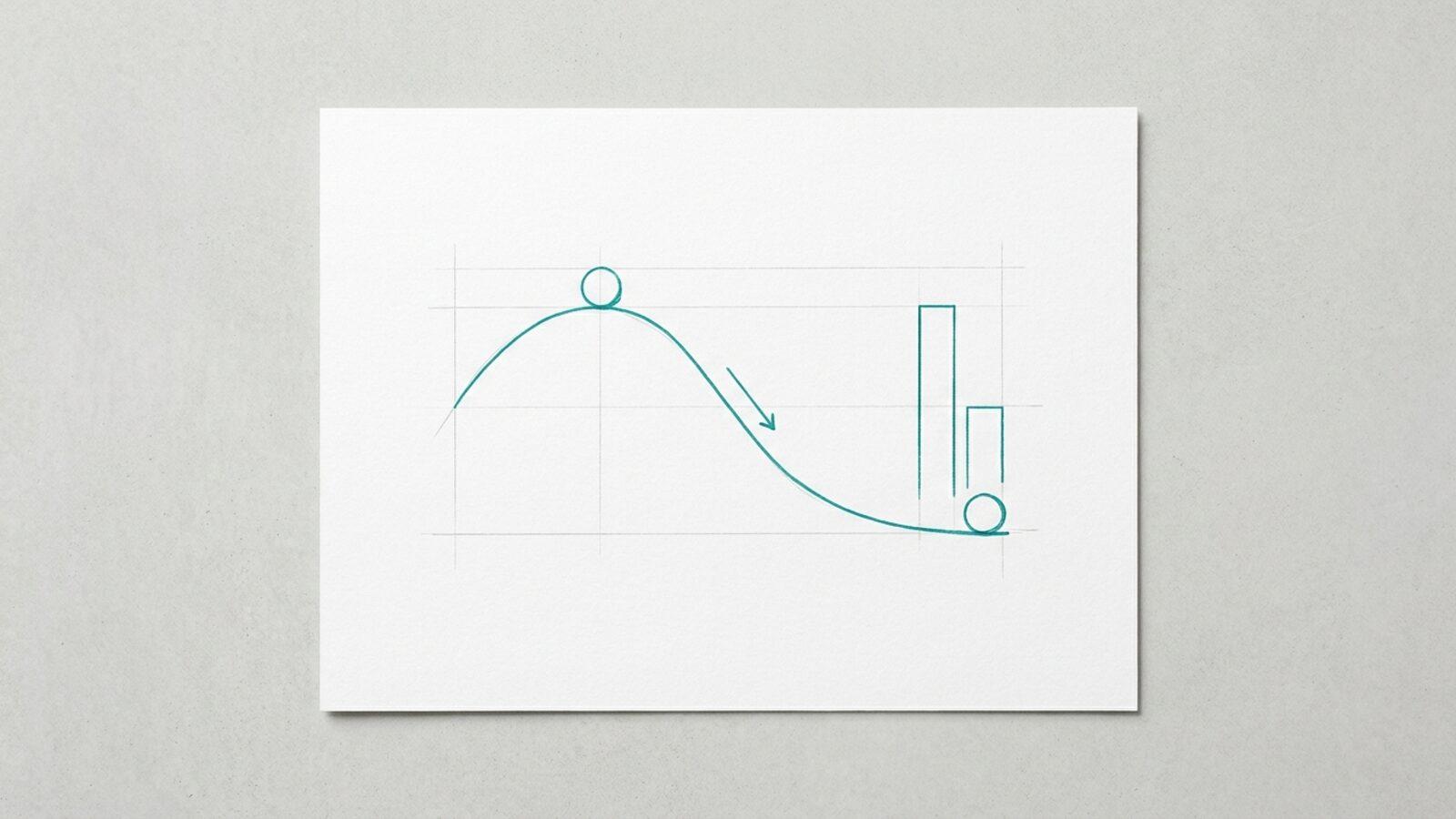
Two points can both be high on a mountain while the ground between them is almost flat. A third point can be much lower but sit on a steep hillside. Height and slope describe different things about the same landscape.
Electric potential and electric field have a similar relationship. Potential gives a value at each location. The field tells you how that value changes as you move, including the direction of its steepest decrease. A large potential does not automatically mean a strong field.
This guide deals with electrostatics: charges and fields that are not changing with time. That is the setting where a single potential landscape gives the full electric field.
Four quantities, two useful pairs
Start with the quantities a particular charge experiences. An electric force acts on it, and it has electric potential energy in the arrangement of charges.
Divide each by the test charge :
The field and potential describe the environment. Put a different small test charge there and the force and energy change, but the environment does not, provided the test charge does not appreciably disturb the source charges.
| Quantity | Meaning | Unit |
|---|---|---|
| Electric force | Push or pull on a particular charge | newton, N |
| Electric field | Force per charge | N/C, equivalent to V/m |
| Electric potential energy | Energy associated with the charge's position | joule, J |
| Electric potential | Potential energy per charge | volt, V, equivalent to J/C |
The field is a vector: direction is part of the answer. Potential is a scalar: it has a signed value but no direction. OpenStax's introduction to potential develops the distinction between energy and energy per charge.
Our Coulomb's law guide explains how source charges produce force and field. Potential gives another route through the same problem.
Voltage compares two locations
A voltage is a potential difference:
For a charge moving from A to B, the potential-energy change is
Take a charge of moving from 10 V to 4 V. The change in potential is , so
It loses 18 microjoules of potential energy. The electric field does positive work of 18 microjoules on it. If only the electric force does work, its kinetic energy increases by that amount. The bookkeeping is the same as in our work and energy guide.
Choosing a different zero changes neither result. If both potentials are increased by 100 V, the charge goes from 110 V to 104 V, still a drop of 6 V. A statement such as “this point is at 10 V” always depends on a reference.
The field is the downhill slope of potential
Along one coordinate, the electrostatic relationship is
The minus sign gives the direction: the field points toward decreasing potential. Richard Fitzpatrick's University of Texas notes derive this from work and energy. You can understand a uniform field without calculus: divide the potential change by the distance, and reverse the sign.
Suppose potential falls from 18 V at to 6 V at , at a constant rate:
The positive sign says the field points in the positive x-direction. Across the same 4 cm, a drop of only 3 V would give 75 V/m. What matters is the drop per metre.
The shortcut assumes a uniform field and a distance measured along it. Between large parallel plates, away from the edges, that can be a useful approximation. Around a point charge the field changes with distance, so one voltage difference divided by a finite distance gives an average along that path, not the field at every point.
For a changing potential, OpenStax's field-from-potential chapter shows the derivative version and its three-dimensional extension.
Negative charges reverse the force
The field direction is defined using a positive test charge. The force on any charge is
A negative reverses the direction. In the 300 V/m field above, a charge of experiences
Its electric force points toward negative x, where potential is higher. That does not mean it is gaining potential energy: multiplying an increase in by a negative charge produces a decrease in .
Be precise about motion. Force determines acceleration, not necessarily the direction a particle is already travelling. A negative charge launched toward lower potential can continue that way while slowing down. “Negative charges go uphill” describes the force, or the initial acceleration from rest, rather than every possible trajectory.
Zero potential and zero field are different claims
Place two equal positive point charges on a line. At the midpoint, their fields have equal magnitudes and opposite directions, so the net field is zero. With zero potential chosen at infinity, each charge contributes a positive potential and the potentials add. The potential there is positive even though the field is zero.
Now replace one source charge with an equally large negative charge. At the midpoint, the positive and negative potentials cancel. But both field contributions point from the positive charge toward the negative charge, so they add rather than cancel.
These examples expose the common mistake: adding field magnitudes as though they were scalar potentials. To combine fields, keep the directions. To combine potentials, keep the algebraic signs.
A zero field at one point also does not mean the potential is constant throughout the surrounding region. It can be a stationary point of a varying landscape, just as a hillside can have a locally level spot.
Equipotentials are contour lines
On a contour map, points on the same contour have equal height. On an equipotential surface, points have equal electric potential.
Moving a charge along that surface changes its electric potential energy by zero. The electric field does no work on that movement, even though a field can be present. Where the field is nonzero, it meets the equipotential surface at right angles.
Closely spaced contours represent a stronger field only when the neighbouring contours represent equal potential steps. A drawing with unequal voltage intervals needs its labels checked before you compare the spacing.
Choose the equation from the question
Asked for force? Find the electric field at the charge, then multiply by its signed charge. Include direction.
Asked for energy or speed? Use the potential difference to find . If other forces do work, include them before turning that energy change into a speed.
Given a potential graph? Read its slope to find the field component along the graph's coordinate. A higher graph is not automatically a steeper graph.
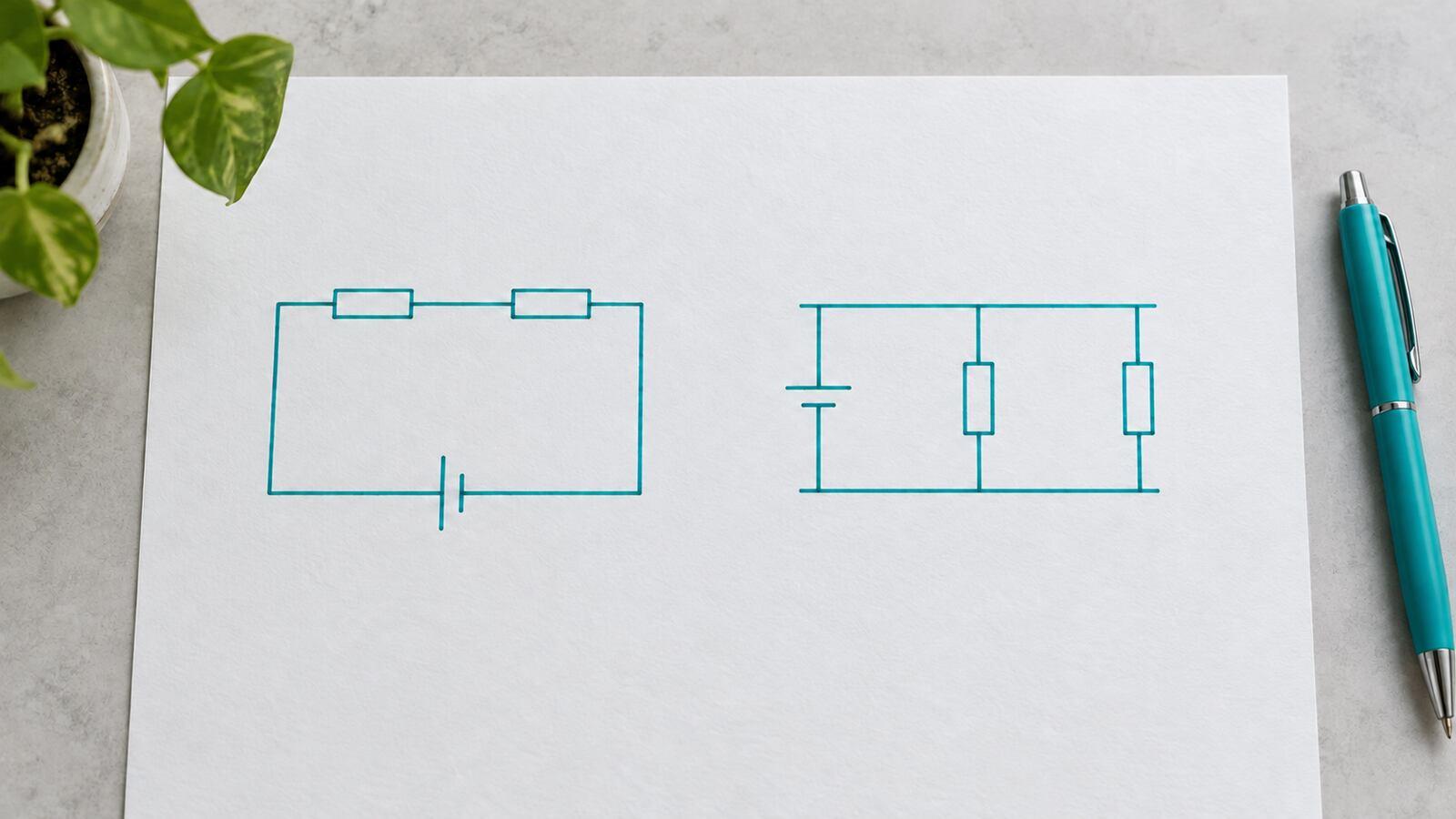
Working on a circuit? Track potential differences between nodes. Our series and parallel circuits guide explains why voltage differences add around a path while parallel branches share the same pair of endpoints.
For practice in Physics Zen, keep a four-column note beside the problem: field, force, potential, energy. Write the units in the appropriate column before substituting numbers. That small separation makes a sign error or a missing charge much easier to see.
Common questions
- What is the difference between electric potential and electric field?
- Electric potential is potential energy per unit charge, measured in volts. Electric field is force per unit charge, measured in newtons per coulomb or volts per metre. Potential is a scalar; field has both magnitude and direction.
- Is voltage the same as electric potential?
- Voltage usually means a potential difference between two points. Saying a point is at 12 volts implies a reference point assigned zero volts. Changing the reference does not change the field or any potential difference.
- Can potential be zero while the electric field is not?
- Yes. At the midpoint between equal and opposite point charges, their potentials cancel if zero is chosen at infinity, but their fields point in the same direction and add.
- Does a negative charge move toward higher potential?
- The electric force on a negative charge points toward higher potential. If it is released from rest and only the electric force acts, it initially accelerates that way. Its potential energy decreases because its charge is negative.
- When can you use electric field equals voltage divided by distance?
- Use the magnitude relation E = absolute voltage difference divided by distance for a uniform field and a separation measured along the field direction. It does not give a general local field from an arbitrary voltage and distance.