Coulomb's Law Intuitively: Charge, Force, and the Electric Field
Rub a balloon on your hair and it clings to a wall. Run a plastic comb through dry hair and it can lift scraps of paper off a desk. Nothing visible connects comb and paper, yet something pulls across the gap, harder as the comb comes closer.
That pull is the electric force. Coulomb's law puts a number on it: how it depends on the amount of charge and, most sharply, on distance. The examples assume small charges at rest in vacuum or air.
Charge is something you count
Electric charge comes in two kinds, positive and negative. Like charges repel; unlike charges attract. A proton carries one unit of positive charge, an electron one unit of negative. That unit is the elementary charge:
Since the 2019 revision of the SI, this value is exact by definition. The charge on any object is a whole-number multiple of it, and one coulomb is about elementary charges.
Charge is also conserved. Rubbing a balloon on hair creates no charge; it moves electrons, and whatever one gains, the other loses. A neutral object still holds charge: equal amounts of both kinds.
Coulomb's law: the formula and its units
In 1785, Charles-Augustin de Coulomb published torsion-balance measurements of the repulsion between two small charged balls. As APS News recounts, the force varied inversely with the square of the distance between their centres.
In modern form, for point charges and a distance apart:
is in newtons, the charges in coulombs, and in metres, measured centre to centre. The Coulomb constant turns coulombs and metres into newtons:
Here is the vacuum permittivity; to four figures, . OpenStax's section on Coulomb's law gives the same form.
The absolute value bars make the formula a size only. The signs decide between repulsion and attraction, and the force always acts along the line joining the charges.
Why distance matters so much
The makes distance the strongest lever in the formula. Double the separation and the force drops to a quarter; triple it and the force falls to a ninth.
Here is an intuition, not a derivation. Imagine the charge's influence spreading evenly in every direction. At distance it is shared over a sphere of area . Double and the sphere has four times the area, so each patch gets a quarter as much. The in is that same sphere.
The square also explains the balloon on the wall. The neutral wall's charges shift slightly, opposite charge toward the balloon and like charge away. With a force this sensitive to distance, the nearer attraction beats the farther repulsion, and the balloon sticks.
Worked example: two equal charges
Two small spheres each carry and sit apart. A microcoulomb is , so substitute for each charge:
Both charges are positive, so the force is repulsive. Each is pushed straight away from the other with about 0.40 N, roughly the weight of a 40-gram mass.
Move them to . The distance has doubled, so the force drops to a quarter, , with no new calculation.
Worked example: how strong is the electric force?
Take the electron and proton in hydrogen, one Bohr radius apart: , the typical separation in the atom's ground state. Each carries a charge of size :
For gravity between the same pair, use , and :
The electric force is about times larger. Both fall off as , so the ratio holds at any separation.
So why does gravity hold you to the floor and the Moon in orbit? Because matter is almost perfectly neutral. Protons are matched by electrons, so the huge electric attractions and repulsions cancel almost exactly. Mass has no negative version, so gravity never cancels: every kilogram of a planet adds to its pull.
Decide the direction, then add
With several charges, each pair interacts as if the others were absent, and the net force is the vector sum: the superposition principle.
Put three charges on a line:
- at
- at
- at
Find the net force on , from each of the others. Settle the directions before touching numbers. Charges and are both positive, so pushes away, toward . Charge is negative, so it pulls toward itself, also toward .
The two results will be added, so keep four figures, with :
Both act in the same direction, so their sizes add:
The net force on is about 4.49 N to the right. Physics settled the directions; the formula supplied only sizes.
From force to field
Coulomb's law describes a pair of charges. The electric field describes the space around one of them. It is the force per unit charge on a small positive test charge :
Its unit is newtons per coulomb, and it points the way a positive charge would be pushed. Divide the test charge out of Coulomb's law to get the field of a point charge :
At from a charge:
The field exists whether or not a test charge is there. Work it out once, and gives the force on any charge placed there: a second charge feels the 0.40 N of the first example. A negative charge is pushed opposite to the field.
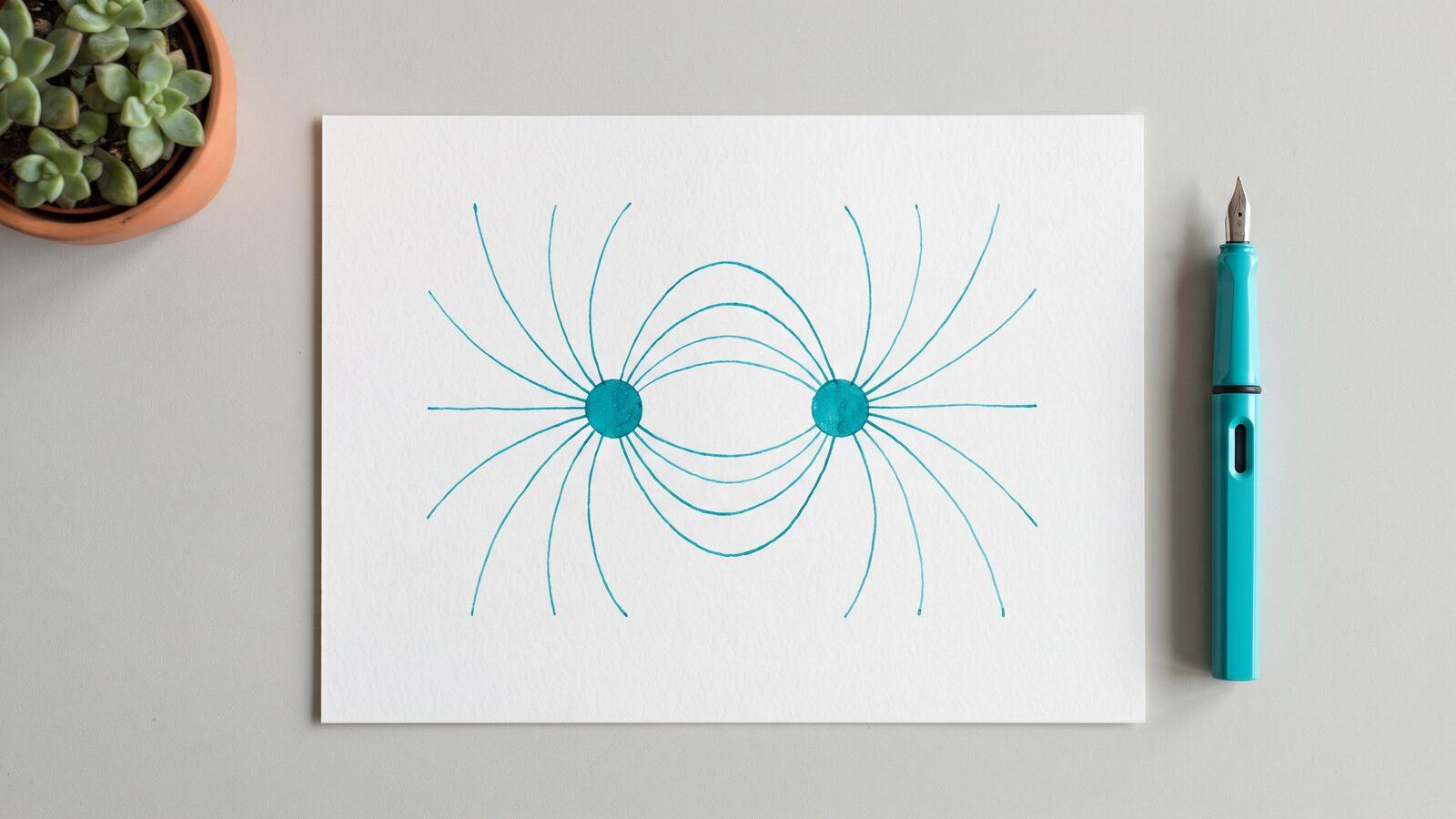
Electric field lines start on positive charges and end on negative charges or run out to infinity. The field at a point is tangent to the line through it, and where lines crowd together, the field is stronger. Lines never cross, because the field has one direction at each point. Around a single charge, the same number of lines crosses every sphere, so their density falls as : the inverse square again.
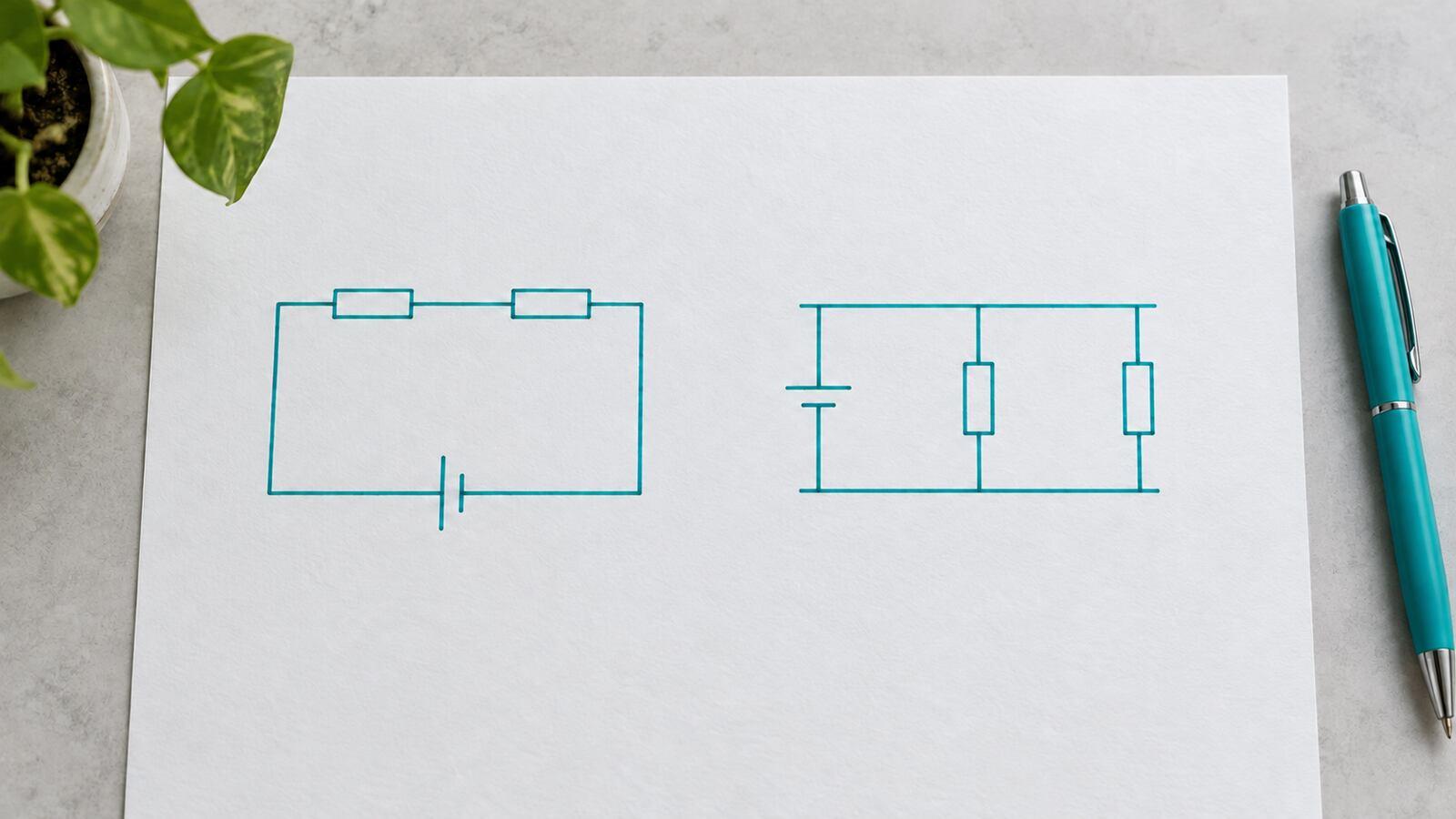
The next step is electric potential, energy per unit charge, measured in volts. The voltage in our series and parallel circuits guide is a difference in potential.
Coulomb and Newton side by side
Here are the two laws:
Both scale with the product of two source quantities and fall off as the inverse square. The difference is sign: charge comes in two kinds and mass in one, so electric forces can attract or repel while gravity only attracts. Strength differs by the factor of about found above.
Newton's laws turn a Coulomb force into an acceleration like any other force, and the third law holds: in the three-charge example, pushes back on with the same 2.696 N, even though carries three times the charge. Our circular motion guide shows gravity supplying the inward force for an orbit; in the Bohr model of hydrogen, the Coulomb attraction does that job for the electron.
Mistakes that cost marks
- Forgetting to square the distance. Dividing by 0.30 instead of 0.090 in the first example gives 0.12 N, not 0.40 N.
- Skipping conversions. Micro means , nano means , and 30 cm is 0.30 m. Leaving both charges in microcoulombs makes the force times too large.
- Reading a sign as a direction. With signs included, the product for and is negative, which looks like "left". It means attraction, and attraction toward points right. Treating it as left gives about 0.90 N, not 4.49 N.
- Adding sizes that point different ways. Sizes add directly only when forces point the same way. Opposite forces on a line subtract, and forces at an angle need components.
- Mixing up E and F. A field in N/C belongs to a point in space; a force in newtons belongs to a particular charge.
The first two are math slips; our guide to physics mistakes that are really math mistakes covers prefixes and powers of ten.
Turn the law into practice
Physics Zen's Electrostatics topic has three skills: Charge & Coulomb's Law, Electric Field, and Electric Potential. It is part of Premium on iPhone and Android. Electrostatics also appears in the A-Level, Abitur and Bac paths; our guides to A-Level physics, the Abitur and the Bac show where it fits.
Decide which way each force points before calculating. Then check the distance: it is squared, it must be in metres, and nothing else in Coulomb's law moves the answer as much.
Common questions
- What is Coulomb's law in simple words?
- Two charged objects push or pull on each other with a force proportional to the product of their charges and inversely proportional to the square of the distance between them. Like charges repel and unlike charges attract. Doubling the distance cuts the force to a quarter.
- What are the units in Coulomb's law?
- Force is in newtons, charge in coulombs, and distance in metres. The Coulomb constant k is about 8.99 × 10⁹ N·m²/C², which makes the result come out in newtons. Convert microcoulombs, nanocoulombs and centimetres before substituting.
- Who discovered Coulomb's law?
- Charles-Augustin de Coulomb published it in 1785. He measured the repulsion between two small charged balls with a torsion balance and found that the force varies inversely with the square of the distance between their centres.
- What is the difference between electric force and electric field?
- Force acts on a particular charge and is measured in newtons. The electric field is force per unit charge, measured in newtons per coulomb, and describes what any charge placed at that point would feel. Multiply the field by a charge to get the force on that charge.
- Is the electric force stronger than gravity?
- Between an electron and a proton, the electric attraction is about 2.3 × 10³⁹ times the gravitational attraction. Gravity still dominates at the scale of people and planets because ordinary matter is almost exactly neutral, so electric forces cancel, while mass only ever adds.