Series and Parallel Circuits: Understand Current and Voltage
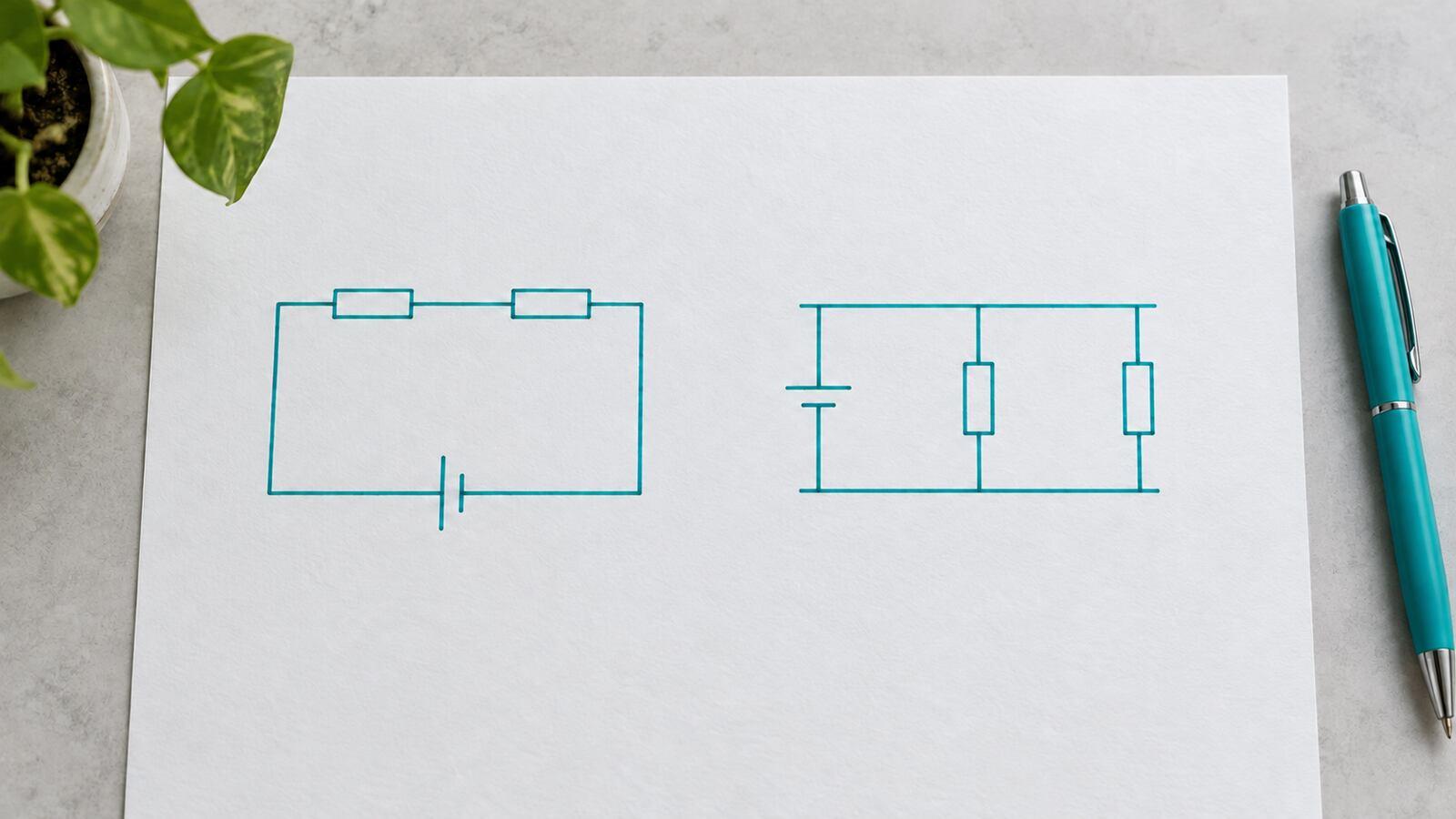
Two resistors can sit next to each other on a diagram without being in parallel. They can sit on opposite sides of the page and still be in series. The picture's shape is a distraction. What matters is which points are connected and whether the current has a place to split.
Start by tracing the paths. Once you know which components share a current and which share a voltage, the resistance formulas follow naturally. This guide uses ideal wires, an ideal constant-voltage source, and fixed positive resistances in a steady direct-current circuit.
Current flows through; voltage is measured across
Current measures the rate at which charge passes a point, in amperes. Voltage is an energy difference per unit charge between two points, in volts. A resistor with resistance , in ohms, obeys Ohm's law in the model used here:
The voltage in that equation must be the voltage across that resistor. The current must be the current through that resistor. Mixing a whole-circuit voltage with a single branch's current is a common way to get a plausible-looking wrong answer.
Charge does not vanish in a resistor. Electrical energy is transferred, usually into heat, while the same amount of charge per second enters and leaves in steady operation. The distinction between energy and its transfer is also useful in our work and energy guide.
Series means one unbranched path
Imagine a battery connected to one resistor, then a second resistor, then back to the battery. There is no junction between the resistors where current can leave along another path. Both therefore carry the same current.
The voltage drops add to the supply voltage. Using Ohm's law for each resistor:
So the equivalent series resistance is:
More resistors in the same path mean more resistance. For a fixed supply voltage, the current decreases. The voltage is not necessarily shared equally: the larger resistor gets the larger voltage drop because both carry the same current.
A checked series example
Connect 4-ohm and 8-ohm resistors in series across a 12-volt source. The total resistance is 12 ohms, giving:
The individual voltage drops are:
Check the loop: 4 volts plus 8 volts equals the 12-volt supply. Check the current: both resistors carry 1 ampere. Neither gets 12 volts individually, and the current does not become smaller after the first resistor.
Parallel means the same two nodes
A node is a group of points connected by ideal wire with no intervening component. Those points share a potential. Two resistors are parallel when both of their ends connect to the same pair of nodes.
Because they span the same two potentials, both have the same voltage across them. Current can divide between the paths. At a junction, the total incoming current equals the total outgoing current:
Dividing by the shared voltage gives the parallel-resistance rule:
For two resistors only, this can also be written:
Adding another path allows more total current at the same voltage. That is why the equivalent resistance is smaller than the smallest branch resistance. Current does not take only the easiest path; it flows through every conducting branch, with more flowing through the lower resistance.
The same resistors, now in parallel
Connect the same 4-ohm and 8-ohm resistors across the same 12-volt source, this time in parallel. Each resistor now has 12 volts across it:
The source supplies the sum:
The equivalent resistance is:
Check with the whole circuit: 12 volts divided by 8/3 ohms gives 4.5 amperes. The equivalent resistance is less than 4 ohms, as expected. Equal voltage across the branches did not mean equal branch current.
Reduce a mixed circuit, then work backward
Suppose a 2-ohm resistor is in series with a parallel pair of 6-ohm and 3-ohm resistors, all supplied by 12 volts. Do not combine all three in one series sum. Identify the inner parallel pair first:
That equivalent resistance is in series with the first 2-ohm resistor. The total is 4 ohms, so the source current is 3 amperes. The voltage drop across the first resistor is:
The parallel section has the remaining 6 volts across it. Its branch currents are therefore:
They add to the 3 amperes entering the junction. The sequence matters: reduce inward to find the source current, then expand outward to recover each component's voltage and current.
Some networks cannot be reduced through simple series and parallel pairs. A bridge circuit may require Kirchhoff's rules directly. Do not force the two-resistor formula onto components that do not share both nodes.
Use power as an independent check
For a resistor in this model, power can be written in three equivalent ways:
In the series example, the two resistors dissipate 4 watts and 8 watts. Their total is 12 watts, matching the source power of 12 volts times 1 ampere.
In the parallel example, they dissipate 36 watts and 18 watts. Their total is 54 watts, matching 12 volts times 4.5 amperes. Rearranging the same resistors changed the current drawn from the source and the power in each component.
This also explains a useful comparison. At the same current, the larger resistance dissipates more power. At the same voltage, the smaller resistance dissipates more power. Before deciding which resistor gets hotter, identify which quantity is shared; real temperature also depends on cooling and construction.
A short method for unfamiliar diagrams
- Mark nodes connected by uninterrupted ideal wire.
- Identify components sharing one unbranched path or the same two nodes.
- Find equivalent resistance, starting with the simplest group.
- Find the source current with Ohm's law.
- Work back to each voltage drop and branch current.
- Check current at junctions, voltage around loops, and total power.
Keep units visible. A value of 500 milliamperes is 0.5 amperes. A resistance in kilohms needs the matching conversion. Our guide to physics mistakes that are really math mistakes shows why those small conversions matter.
OpenStax's treatment of resistor combinations covers the same ideal-circuit relationships. Real batteries have internal resistance and current limits, and real components have power ratings. These numerical examples are calculation exercises, not instructions to assemble a high-current circuit or work on mains wiring.
Turn the picture into practice
Physics Zen's Circuits topic includes Ohm's law, series and parallel resistors, electrical power, and Kirchhoff's rules. It is part of Premium on iPhone and Android. Start with identifying nodes before increasing the calculation difficulty.
When an answer looks wrong, redraw the connections instead of reaching for a different formula. Shared current identifies series; shared endpoints identify parallel. Those two observations do most of the work.
Common questions
- What is the difference between series and parallel circuits?
- Components in series share one unbranched path and carry the same current. Components in parallel connect across the same two nodes and have the same voltage across them. Their appearance on the page does not decide the connection.
- Why is parallel resistance smaller?
- Adding a finite positive resistance in parallel creates another conducting path. At the same applied voltage, more total current flows, so the equivalent resistance is smaller than either branch resistance.
- Does current get used up by a resistor?
- No. In a steady circuit, charge is conserved. A resistor transfers electrical energy into thermal energy, but current entering a series resistor equals current leaving it.