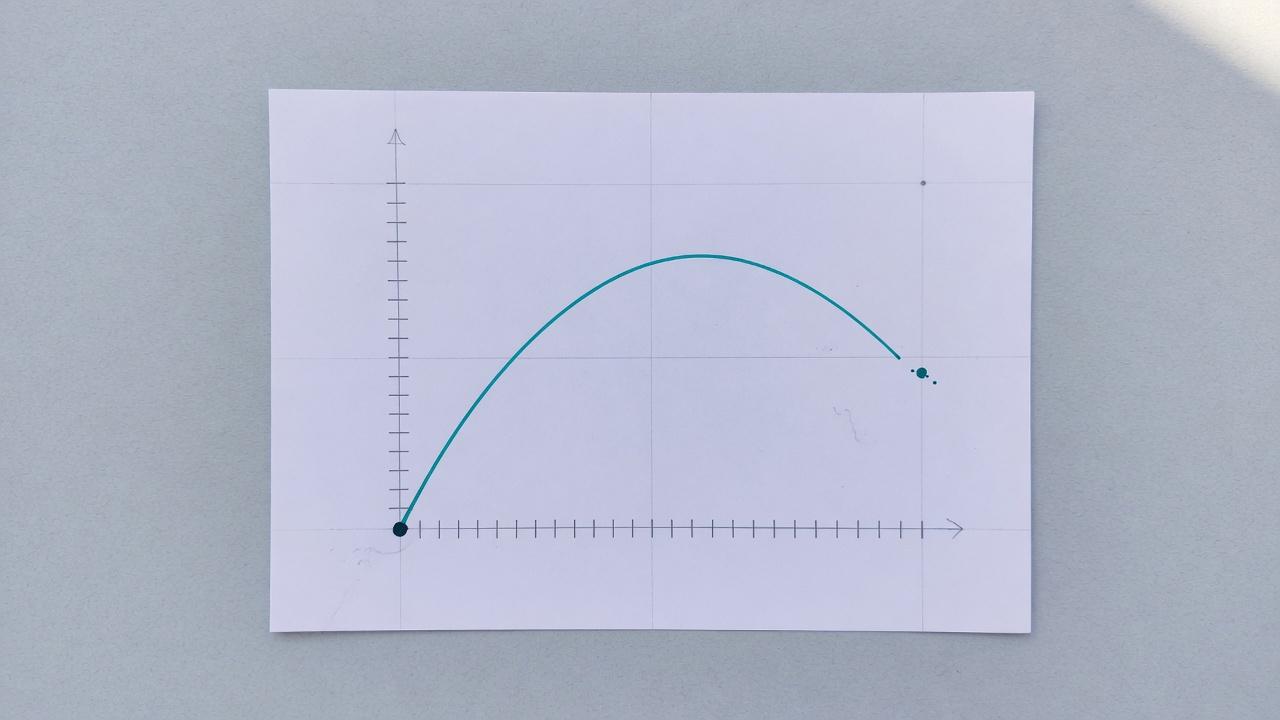
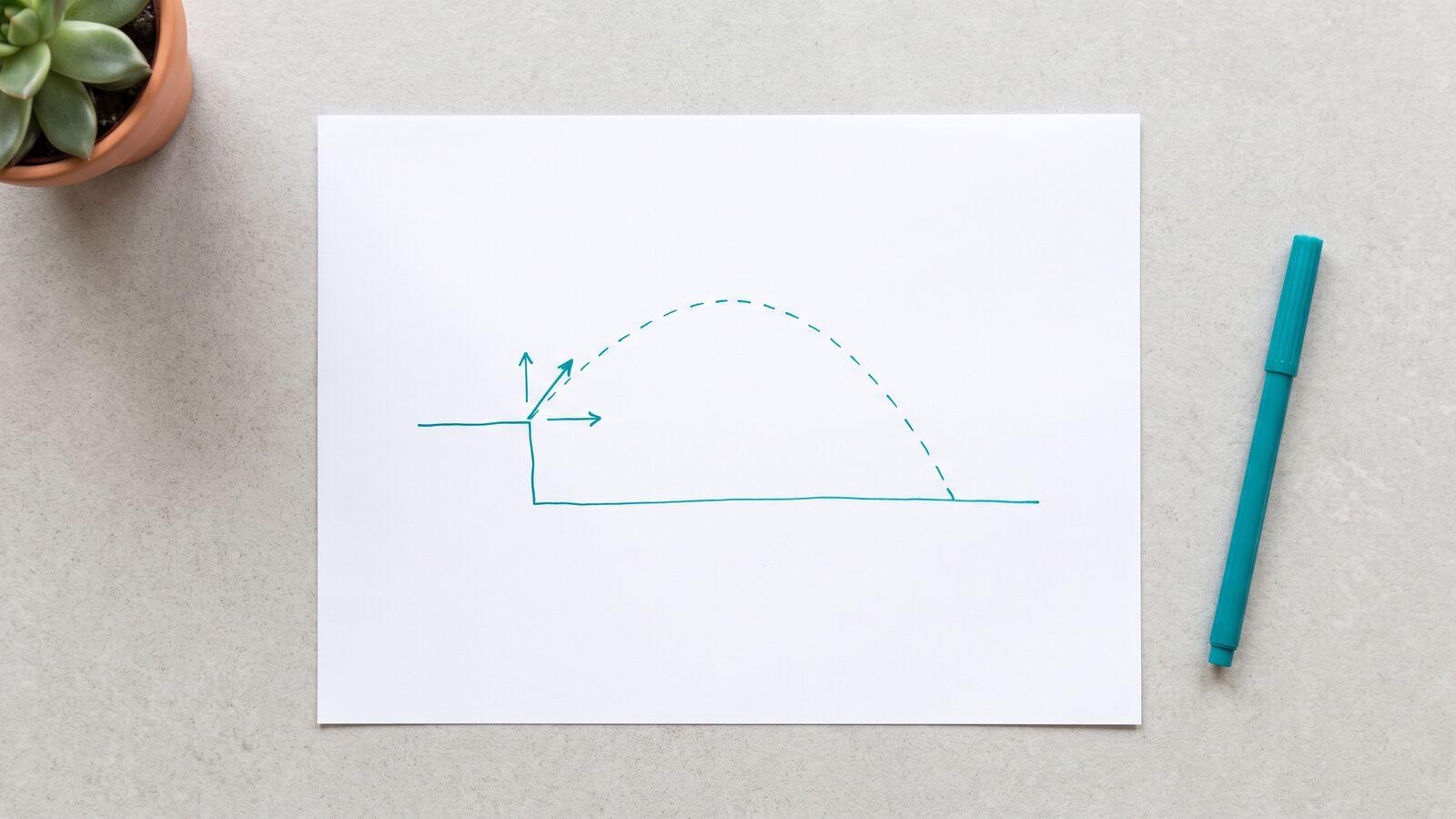
Kinematics Practice Problems: Signs, Stops and Two-Stage Motion
 Ivan Terekhin
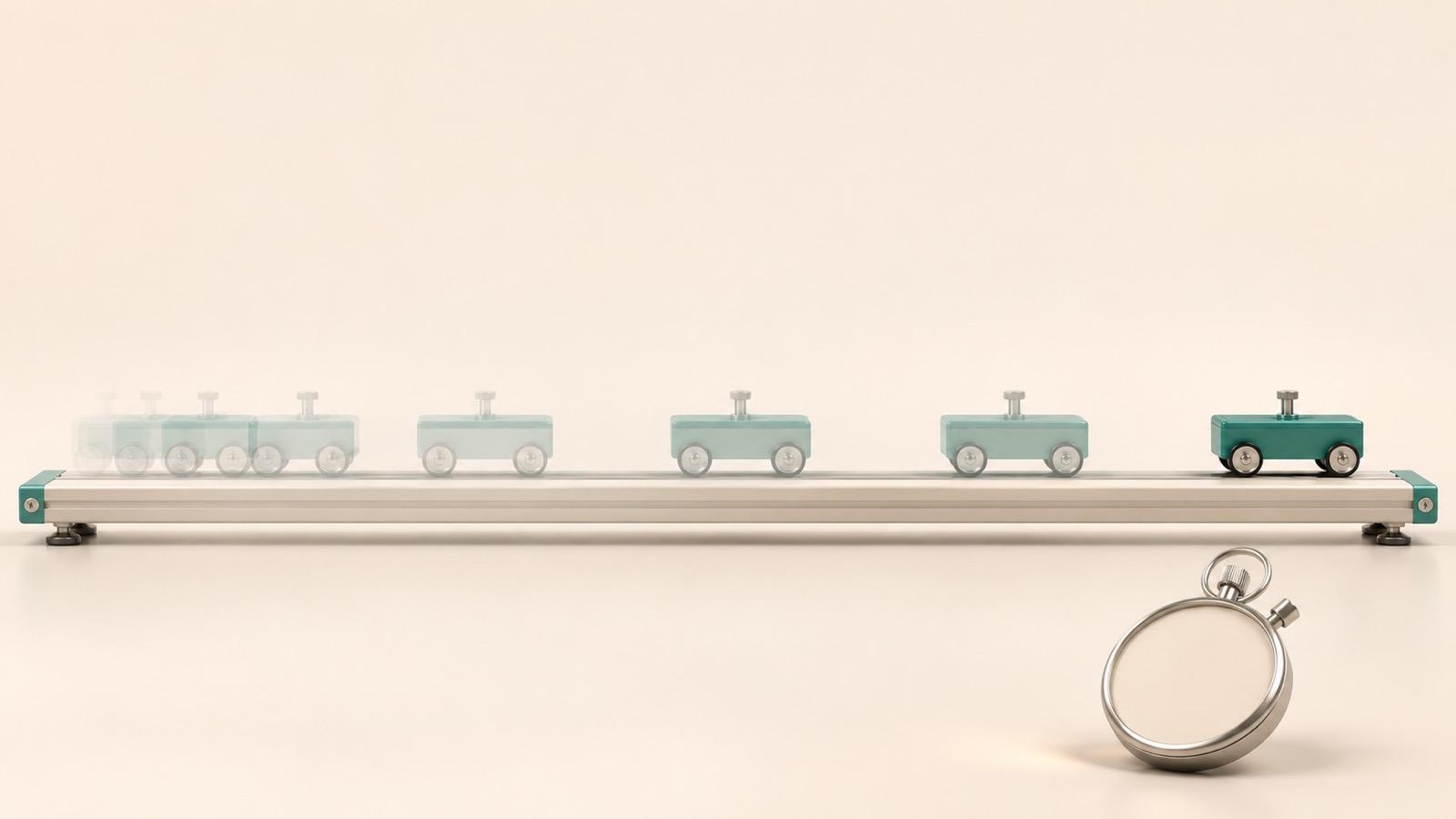
A car slows from 18 m/s at a constant 3 m/s². How far does it travel in eight seconds? Substituting eight into gives 48 m, but that is not the distance of a car that brakes to a stop and stays there. It stops after six seconds and travels 54 m. The equation was right; the interval was wrong.
These problems focus on that kind of decision. You will choose signs, identify when a motion model ends, join two stages and keep different clocks separate. Each solution includes a check. For definitions of position, velocity and acceleration, start with the kinematics introduction; this page is a practice set for using them.
Before the numbers: draw a line and choose a clock
For each stage, write the positive direction, initial position, initial velocity and elapsed time. Here means initial velocity, final velocity, constant acceleration and displacement during that stage. The equations are
They assume constant acceleration over the interval where you use them. OpenStax's constant-acceleration chapter also describes splitting motion into stages when the acceleration changes. A new stage can have a new initial velocity without changing the direction of your coordinate axis.
Use SI units throughout this set. Treat the supplied values as idealised problem data. For the vertical example, use and neglect air resistance. Write the sign of acceleration separately from its magnitude.
Problem 1: negative velocity does not mean negative speed
Question. A cart starts at position and moves at constant velocity for 4.0 s. Find its final position, displacement and distance travelled.
Constant velocity means acceleration is zero. The displacement is
The final position is . Because the cart does not reverse direction, the distance travelled is .
Check: the final position is still on the positive side of the origin, even though the velocity is negative. The cart moved toward smaller x-values without reaching zero. A negative velocity describes direction, not a requirement that the object already be to the left of the origin. The speed is 2.5 m/s throughout.
Problem 2: braking ends at the stop
Question. A car initially travels at 18 m/s. It brakes with acceleration until it stops, then remains at rest. Find the distance travelled during the first eight seconds.
First find the end of the braking stage:
During those six seconds,
The remaining two seconds are a different stage, with zero velocity and zero displacement. Total distance is 54 m.
Check: during constant deceleration the average velocity before the stop is . Multiplying by six seconds again gives 54 m. Continuing to eight seconds would make the model reverse the car's velocity. That is a different physical story from the question's “remains at rest.”
Problem 3: accelerate, then cruise
Question. A train starts from rest, accelerates at 1.2 m/s² for 10 s, then continues at its attained velocity for another 15 s. Find the total displacement and average velocity for the whole journey.
In the accelerating stage,
The second stage starts at 12 m/s and has zero acceleration:
Total displacement is over , so average velocity is .
Check: a velocity-time graph has a triangle of area followed by a rectangle of area . Their sum is the same displacement. Averaging the two stage-average velocities, 6 and 12 m/s, without weighting their unequal durations would give 9 m/s and the wrong result.
Problem 4: an upward launch returns through its starting point
Question. A ball is thrown vertically upward from height zero with velocity 14.7 m/s. Using , find the time to the highest point, its maximum height and its velocity when it returns to the launch height.
Take upward as positive, so and . At the highest point, velocity is zero:
The maximum height is
For the return, set displacement to zero:
There are two roots: is the launch; is the return. Its velocity then is , directed downward.
Check: the ball spends 1.50 s rising and 1.50 s falling back to the same height in this model. Its total displacement is zero, but its travelled distance is , about 22.1 m. At the top, acceleration is still downward; zero instantaneous velocity does not switch off gravity. OpenStax's free-fall section uses the same sign convention for ascent and descent.
This is one-dimensional vertical motion. For a simultaneous horizontal component, use the projectile-motion worked examples.
Problem 5: two objects with different start times
Question. Runner A leaves a point at constant speed 3.0 m/s. Runner B leaves the same point four seconds later at constant speed 5.0 m/s in the same direction. When and where does B catch A?
Let be time since A started. A's position is . B's elapsed running time is , so for its position is .
At the catch,
The catch occurs 10 s after A starts, 6 s after B starts, at .
Check: when B starts, A is 12 m ahead. B closes that gap at , taking six seconds. The two methods agree once their clocks are labelled. Writing would erase the delayed start and describe a different problem.
The mistake map
| Wrong answer or step | What went wrong | What to write first |
|---|---|---|
| Final position −10 m in Problem 1 | Displacement was used as position | x = x₀ + s |
| Distance 48 m in Problem 2 | Braking equation continued beyond the stop | Solve v = 0 for the stage boundary |
| Average velocity 9 m/s in Problem 3 | Unequal stage durations were averaged equally | Total displacement divided by total time |
| Acceleration zero at the top in Problem 4 | Velocity and acceleration were confused | a = −g throughout free fall |
| Catch time 6 s without a label in Problem 5 | The clock origin was left ambiguous | State whose start defines t = 0 |
These mistakes are often algebra or interpretation errors rather than missing formulas. The math mistakes in physics guide gives another way to identify the step that needs practice.
Two checks to try yourself
A. A vehicle moving at 20 m/s decelerates at 4.0 m/s² until it stops. How far does it travel before stopping? Solution: the stopping time is ; the average velocity is 10 m/s, so the distance is 50 m. Check with .
B. A walker starts three seconds before a cyclist. Both start at the same point and travel in the same direction at constant speeds of 2.0 and 8.0 m/s. When does the cyclist catch the walker? Solution: the initial gap is 6.0 m and the closing speed is 6.0 m/s. The catch is 1.0 s after the cyclist starts, or 4.0 s after the walker starts, at 8.0 m.
For the next session, use Physics Zen's kinematics practice and write one extra line before each calculation: the positive direction, the time origin, or the boundary where the current stage ends. Choose the line that would have prevented your last mistake.
Edited by Ivan Terekhin, drafted with AI tools.