Projectile Motion Equations: Worked Examples from Ground and Cliff
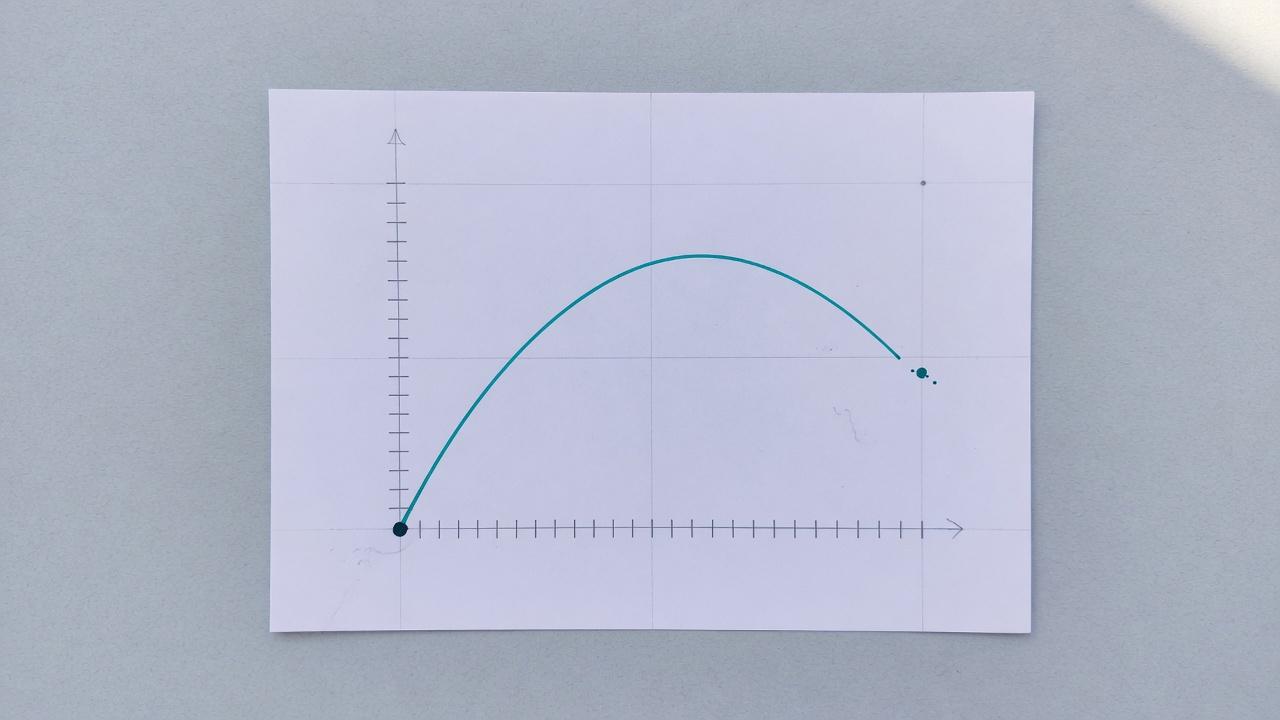
A ball leaves the ground at 20 m/s, 30 degrees above the horizontal, and lands about 35 m away. Throw the same ball the same way from the top of a 15 m cliff and it lands about 53 m out. Plenty of students get 35 m for the cliff too, because they reached for the range formula without checking what it assumes. The projectile motion equations are not hard. Knowing which ones apply to the launch in front of you is the whole skill.
This guide sets up one sign convention, puts every equation in one table with the condition it needs, and then works the same launch from level ground and from a cliff, plus a horizontal launch from a table. All numbers use and no air resistance.
Split the launch into two motions
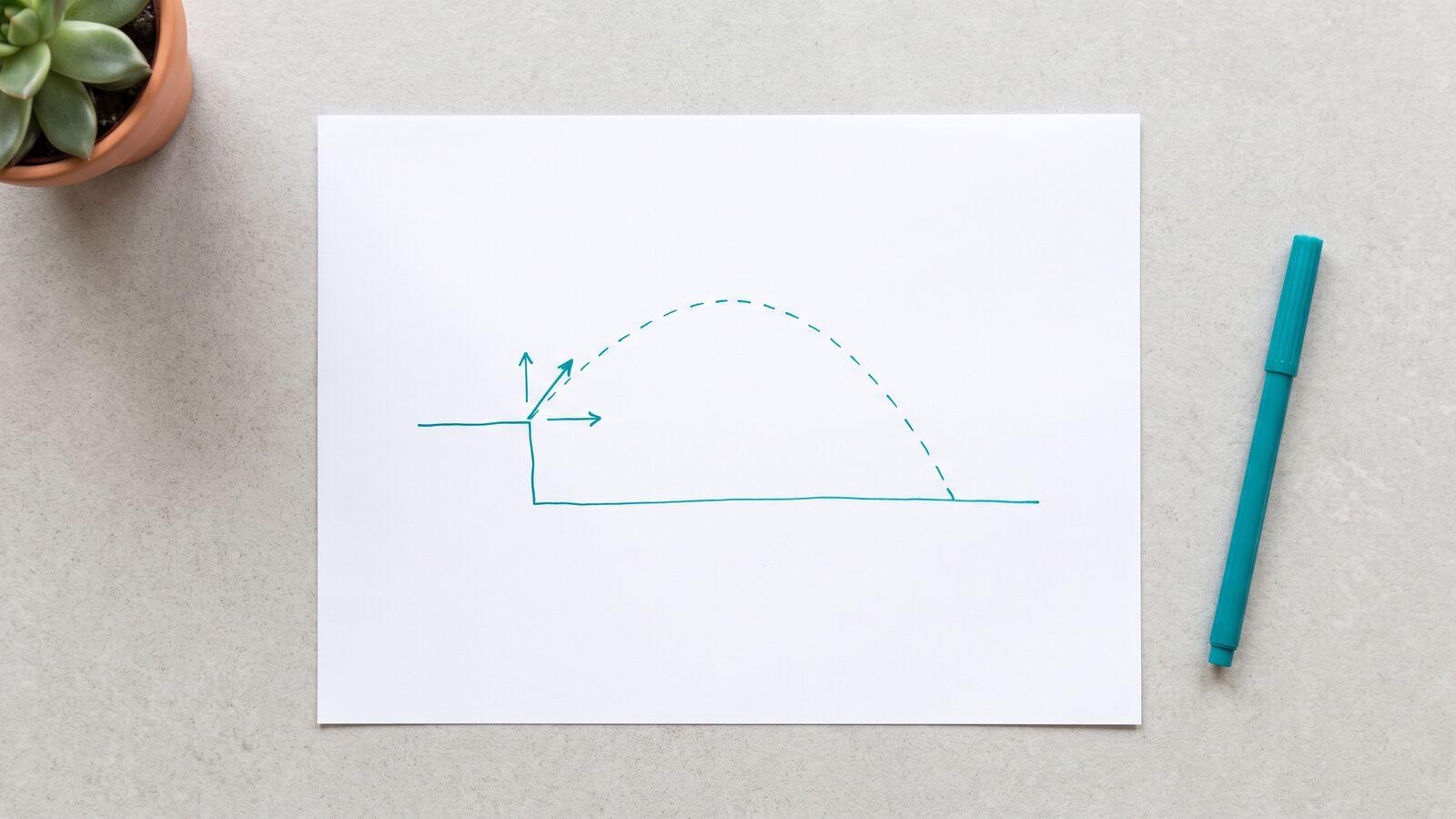
Sketch first. Draw the launch point, the ground, and an arrow for the initial velocity at angle above the horizontal. Put the origin at the launch point, take up as positive and forward as positive. Then resolve the launch velocity:
From here on, the problem is two one-dimensional problems that share a clock. Horizontally, nothing pushes the ball once it is released, so and stays at . Vertically, gravity gives a constant . OpenStax's projectile motion section builds the topic on exactly this independence of perpendicular motions, with air resistance neglected. The AP Physics 1 course framework says the same thing in one line: projectile motion is two-dimensional motion with zero acceleration in one direction and constant, nonzero acceleration in the other (College Board, AP Physics 1 CED, topic 1.5).
If the split itself still feels shaky, our kinematics guide covers the one-dimensional constant-acceleration work that each axis uses.
Which equation is valid here?
Four equations describe any projectile in this model. Three more are shortcuts derived from them, and each shortcut carries a condition that is easy to forget.
| Equation | What it gives | Valid when |
|---|---|---|
| horizontal position | always (no air resistance) | |
| height at time | always | |
| horizontal velocity | always | |
| vertical velocity | always | |
| time of flight | lands at the same height it left | |
| maximum height | measured above the launch point; holds at any landing height | |
| range | lands at the same height it left |
OpenStax states both limits directly: the time-of-flight result does not apply when the projectile lands at a different elevation, and the range equation is valid only for launch and impact on a horizontal surface. The maximum height formula survives a cliff because it only uses the vertical motion up to the top of the arc, where . It tells you how high the ball rises above where it started, not above the ground below.
Eliminating from the first two rows gives the trajectory, a parabola:
It is handy as an independent check, as you will see in the cliff example.
Example 1: level ground at 20 m/s and 30°
Components first: and .
Time of flight. Launch and landing are at the same height, so the shortcut is allowed:
Check another way: the ball reaches the top when , at . The way down mirrors the way up on level ground, so the total is twice that, 2.04 s.
Maximum height.
Check by substituting the peak time into the height equation: .
Range.
Check without the shortcut: . Two methods, same answer, which is what you want before moving on. If your course uses (AP Physics 1 practice in Physics Zen does), the answers shift only in the third figure: 2.04 s, 5.10 m and 35.3 m all round the same.
Example 2: the same launch from a 15 m cliff
Now launch at the same 20 m/s and 30°, but from the edge of a cliff 15 m above flat ground. With the origin at the launch point, landing happens at . The range shortcut is off the table, because the ball lands lower than it started. Use the general height equation:
Rearranged, . The quadratic formula gives
so or . The negative root is a moment before the throw, when a ball on the same parabola would have been passing through ground level on its way up. It is valid algebra and irrelevant physics, so reject it. Substitute the kept root back to confirm: . Root choice is one of the math slips we cover in physics mistakes that are really math mistakes.
Range from the cliff.
Second check with the trajectory equation: at , . The ball is exactly at the ground.
What the shortcut would have cost. Reusing here gives 35.3 m, the level-ground answer. The true range is 52.7 m. The shortcut is 17.4 m short, about 33 percent of the real distance, and nothing in the formula warns you. The maximum height is still 5.10 m above the launch point, which is 20.1 m above the ground below.
Impact velocity. At landing, and is still 17.32 m/s. So
directed below the horizontal. Energy gives the speed independently: . Our work and energy guide explains why that shortcut works.
Is 45° still the best angle? Not from a cliff. Keeping 20 m/s and the 15 m drop, we solved the same quadratic at several angles:
| Launch angle | 30° | 35° | 37° | 40° | 45° |
|---|---|---|---|---|---|
| Range from the 15 m cliff | 52.7 m | 53.6 m | 53.7 m | 53.6 m | 52.4 m |
The best of these is 37°, and 45° lands shorter than 30°. A raised launch already buys extra time in the air, so a flatter, faster horizontal launch pays more.
Example 3: a ball rolling off a table
A ball rolls off a table 0.90 m high at 3.0 m/s. Here , so and . Again the landing height differs from the launch height, so only the general equations apply.
Time to fall. With , the height equation becomes :
This is the same fall time as a ball dropped straight down from the table edge. The horizontal speed does not slow the fall.
Where it lands. from the foot of the table. LibreTexts' projectile motion page treats the horizontal launch from height the same way, with fall time .
Speed and angle at impact. , so
below the horizontal. Energy agrees: .
Two practice problems, with answers
1. Level ground. A ball is kicked at 15 m/s, 60° above level ground. Find the flight time, maximum height and range. Answers: , , , . All three shortcuts are allowed here; check the range with .
2. Horizontal launch. A stone is thrown horizontally at 12 m/s from a ledge 20 m above the water. How long is it in the air, how far out does it land, and how fast is it going on impact? Answers: , , at below the horizontal. No shortcut from the level-ground rows applies.
Practice the split until it is automatic
Projectiles appear early in every major course: AP Physics 1 places them in Unit 1, and our AP Physics 1 guide shows where kinematics sits in a full study plan. The method above does not change between exams; only and the numbers do.
The Kinematics topic in Physics Zen, free end to end on iPhone and Android, includes a projectile motion skill with fresh launch speeds, angles and heights each time, instant checking, and a worked solution after every answer. Do a handful, and before each one ask the question from the table: does this ball land at the height it left? If not, skip the shortcuts and solve for time.
Common questions
- What are the main projectile motion equations?
- With up as positive and no air resistance: x = v0x t, y = y0 + v0y t - g t²/2, vx = v0x and vy = v0y - g t, where v0x = v0 cos θ and v0y = v0 sin θ. The flight time, maximum height and range formulas are shortcuts derived from these for level ground.
- Why does 45 degrees give the maximum range?
- The range formula R = v0² sin 2θ / g is largest when sin 2θ = 1, which happens at 45 degrees. That formula assumes launch and landing at the same height and no air resistance. From a raised launch point the best angle is lower: for 20 m/s from a 15 m cliff, 37 degrees beats 45.
- Can I use the range formula when the projectile lands lower than it started?
- No. The range formula is only valid when launch and landing heights are equal. Solve the vertical equation for the landing time instead, keep the positive root, and multiply by the horizontal velocity.
- What changes with air resistance?
- Drag acts against the velocity, so the horizontal velocity is no longer constant and the clean equations stop being exact. Real throws fall short of the ideal-model numbers. Introductory problems, like every example in this guide, neglect it unless they say otherwise.