Moment of Inertia: Worked Examples for Rods, Disks and Axes
 Ivan Terekhin
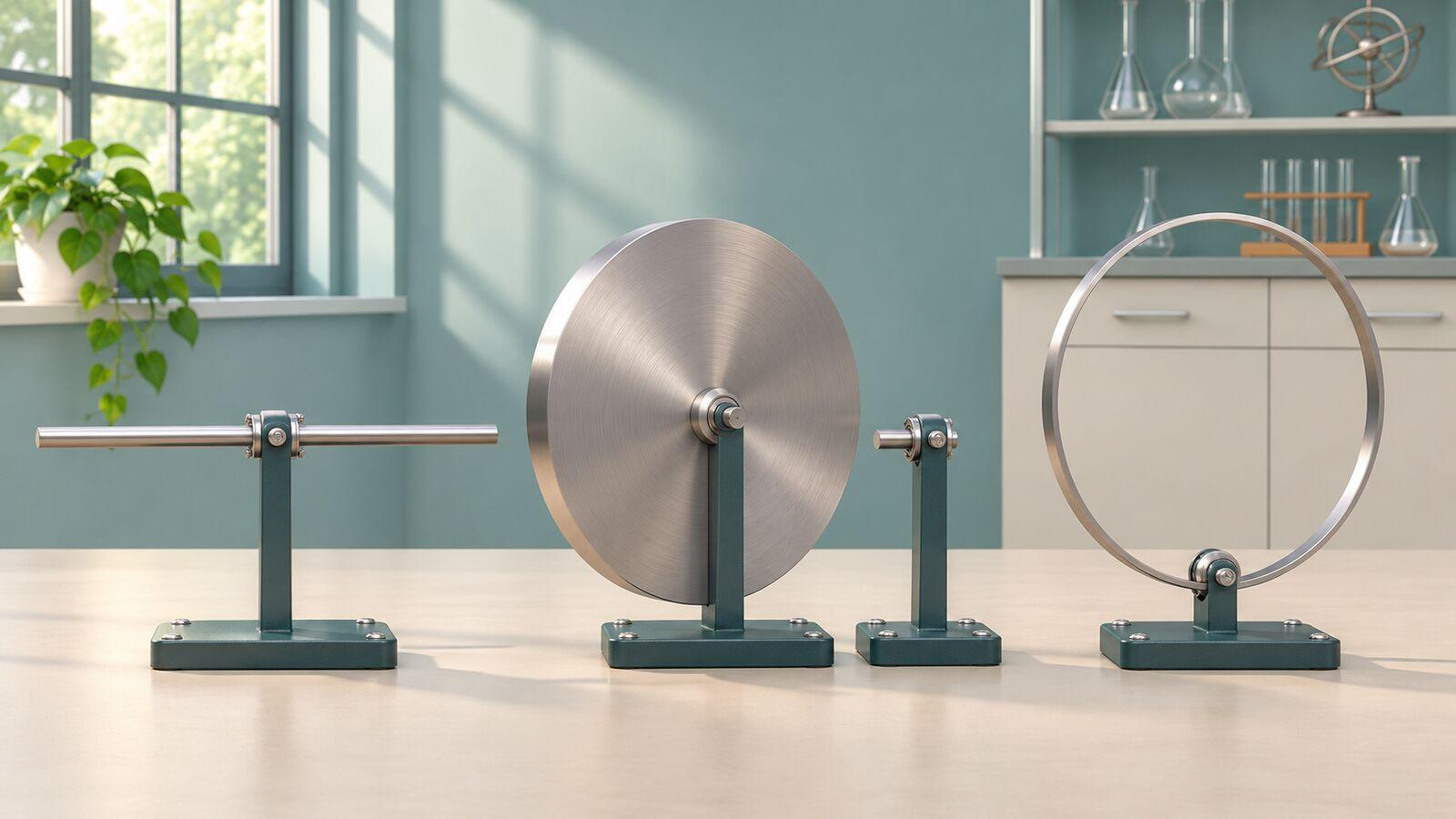
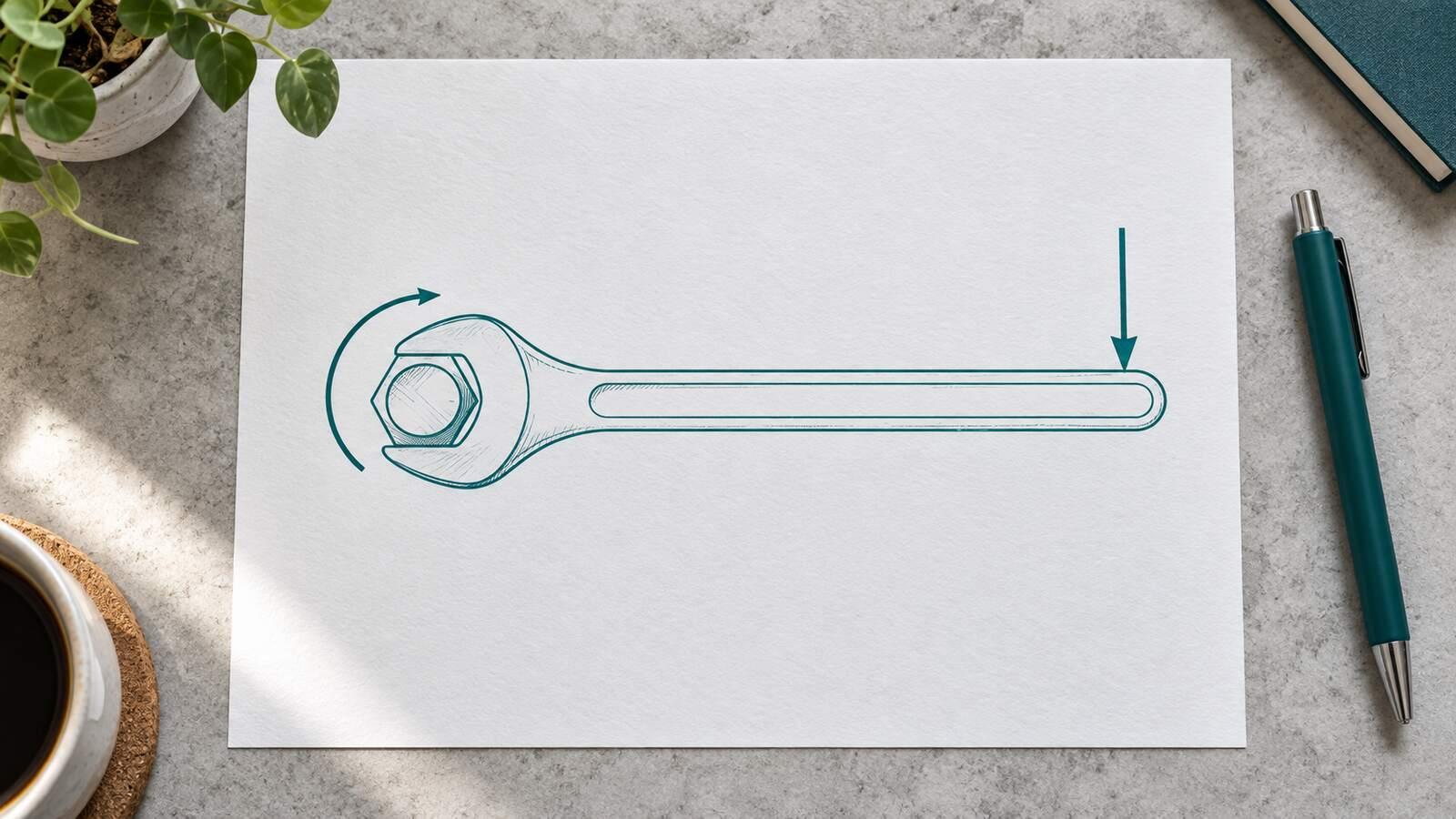
A rod does not have one moment of inertia. The answer changes when the rotation axis moves from its centre to an end, although the rod's mass and length stay exactly the same. For a uniform thin rod, the end-axis value is four times the centre-axis value. Forgetting to name the axis is therefore a bigger error than a missed decimal place.
This practice set calculates rotational inertia rather than introducing torque again. It works through point masses, a rod about two axes, a solid disk versus a thin hoop, an off-centre disk and a composite rod-and-disk system. Every result carries the axis and SI unit. The torque guide explains how a net torque changes rotation once is known; here the job is to find itself.
Start with the axis, then the mass distribution
For point masses, multiply each mass by the square of its perpendicular distance to the chosen axis and add the contributions. For a continuous body, the sum becomes an integral, as shown in OpenStax University Physics 1, section 10.5:
The unit is , not . A distance must be measured from the axis, not from the nearest edge or from a convenient point on the page. Because distance is squared, moving a mass twice as far gives four times its contribution. OpenStax section 10.4 relates this mass distribution to rotational kinetic energy .
Before choosing a formula, write the shape, mass, dimensions and precise axis. Standard formulas assume a uniform object and a specified axis. A real object with a different mass distribution needs its own integral or a measured inertia. All numbers below describe idealised rigid bodies.
Example 1: three point masses at different radii
Three small masses are fixed to a negligible-mass frame about a perpendicular axis. Their masses and distances are 0.50 kg at 0.20 m, 0.25 kg at 0.40 m, and 0.20 kg on the axis. Find the total moment of inertia.
Write every contribution, including the zero one:
Check. The smaller 0.25 kg mass contributes twice as much as the 0.50 kg mass because it is twice as far from the axis. The mass on the axis adds nothing to this idealised calculation. If you used 20 and 40 as though centimetres were metres, the numerical answer would be 10,000 times too large; convert length before squaring it.
Example 2: one rod, two axes
A uniform thin rod has mass 1.20 kg and length 0.80 m. First rotate it about an axis through its centre, perpendicular to the rod. Then move the axis to one end, parallel to the first. Calculate both inertias and compare them.
For the centre axis, the standard thin-rod formula from OpenStax 10.5 is
The new axis is a distance from the centre of mass. The parallel-axis theorem says , so
Independent check. Direct integration along the rod about its end gives . The ratio . Same object and same mass, but more of it lies far from the end axis. The shifted-axis result must exceed the centre-of-mass result because .
Example 3: disk and hoop share mass and radius, not inertia
A uniform thin solid disk and a thin hoop each have mass 2.00 kg and radius 0.30 m. Both rotate about an axis through their centre, perpendicular to their plane. Which has the larger moment of inertia?
The OpenStax shape formulas give and for those axes. Substitute the same mass and radius:
The thin hoop has twice the inertia: all its idealised mass is at radius , while the disk has material closer to the axis. This comparison assumes the same axis direction. A hoop about a diameter or a disk about an edge needs a different formula. Shape names alone do not define .
Example 4: shift a disk's axis without changing its shape
Use the same 2.00 kg, 0.30 m disk, but move the rotation axis 0.15 m from its centre while keeping it parallel to the central axis. Find its new inertia.
The centre-axis result is already . Add the parallel-axis term:
Check. The added term is positive, so the shifted-axis inertia exceeds 0.090. Do not replace the disk's radius with 0.15 m in its centre formula. The radius still describes the disk; describes the offset between parallel axes. The theorem only applies to parallel axes, with one through the centre of mass, as OpenStax 10.5 specifies.
Example 5: add a rod and disk about one common axis
A 1.20 kg, 0.80 m uniform thin rod is joined to the centre of a 2.00 kg, 0.30 m uniform thin disk. The pivot is at the rod's opposite end. The disk and rod lie in one plane; the axis through the pivot is perpendicular to it. The disk's centre is therefore 0.80 m from the pivot. Treat the joint and pivot as massless. Find the compound object's inertia.
The rod rotates about its end, so Example 2 gives . The disk's central inertia is . Shift the disk's central axis by 0.80 m, then add only after both terms refer to the pivot axis:
OpenStax 10.5 explains why contributions for a compound object must share an axis. Adding 0.256 and 0.090 directly would ignore the disk centre's distance from the pivot. As a check, the total must exceed the shifted disk's 1.370 because the rod has positive inertia.
Find the wrong step with units and axes
| Answer or method | What it missed | First check to make |
|---|---|---|
| in Example 1 | The squared metre belongs in the numerator | Mass times distance squared gives |
| A huge point-mass answer using 20 and 40 | Centimetres were not converted before squaring | Write 0.20 m and 0.40 m beside the axis |
| for the rod's end axis | Centre-axis formula used for a different axis | Add with |
| for the hoop | Disk formula used for rim-only mass | Check whether mass fills the disk or sits at |
| for the compound object | Rod end and disk centre inertias were added across different axes | Shift the disk to the pivot axis before adding |
The last wrong answer is , a plausible number with correct units but the wrong axis. Always draw the axis for each term on one sketch. When your later task asks for angular acceleration, the torque article uses the resulting inertia. When it asks for rotational energy, connect it to the work and energy guide. For motion along a circle, the circular-motion guide keeps speed and radius distinct.
Two quick self-checks
A. Two 0.40 kg point masses sit 0.25 m on either side of a central axis, with a massless connector. Find about that axis and about a parallel axis through one mass. Solution: at the centre, . Through one mass, the distances are 0 and 0.50 m, so . The second value is twice the first.
B. A 1.50 kg solid disk has radius 0.20 m. Find its inertia about its central perpendicular axis and a parallel axis 0.10 m away. Solution: ; shifted, . Both answers have the same unit, and the shifted value is larger.
Practise the axis choice before memorising another shape formula. Physics Zen's rotation practice includes rotational inertia alongside torque and energy. For each problem, write the axis first, then the perpendicular distances, then the formula and unit. If two answers disagree, compare their axes before comparing their arithmetic.
Edited by Ivan Terekhin, drafted with AI tools.