Torque Explained Intuitively: Levers, Angles, and Balance
Push a door beside its hinge, then push equally hard at the handle. The force is the same, but the turning effect is very different. A force describes a push or pull. Torque describes how that push or pull tends to rotate an object about a chosen pivot.
Three questions determine the answer: where is the pivot, where does the force act, and which way does it point? Start with those questions and the torque formula becomes a compact description of the picture.
A force needs room to turn something
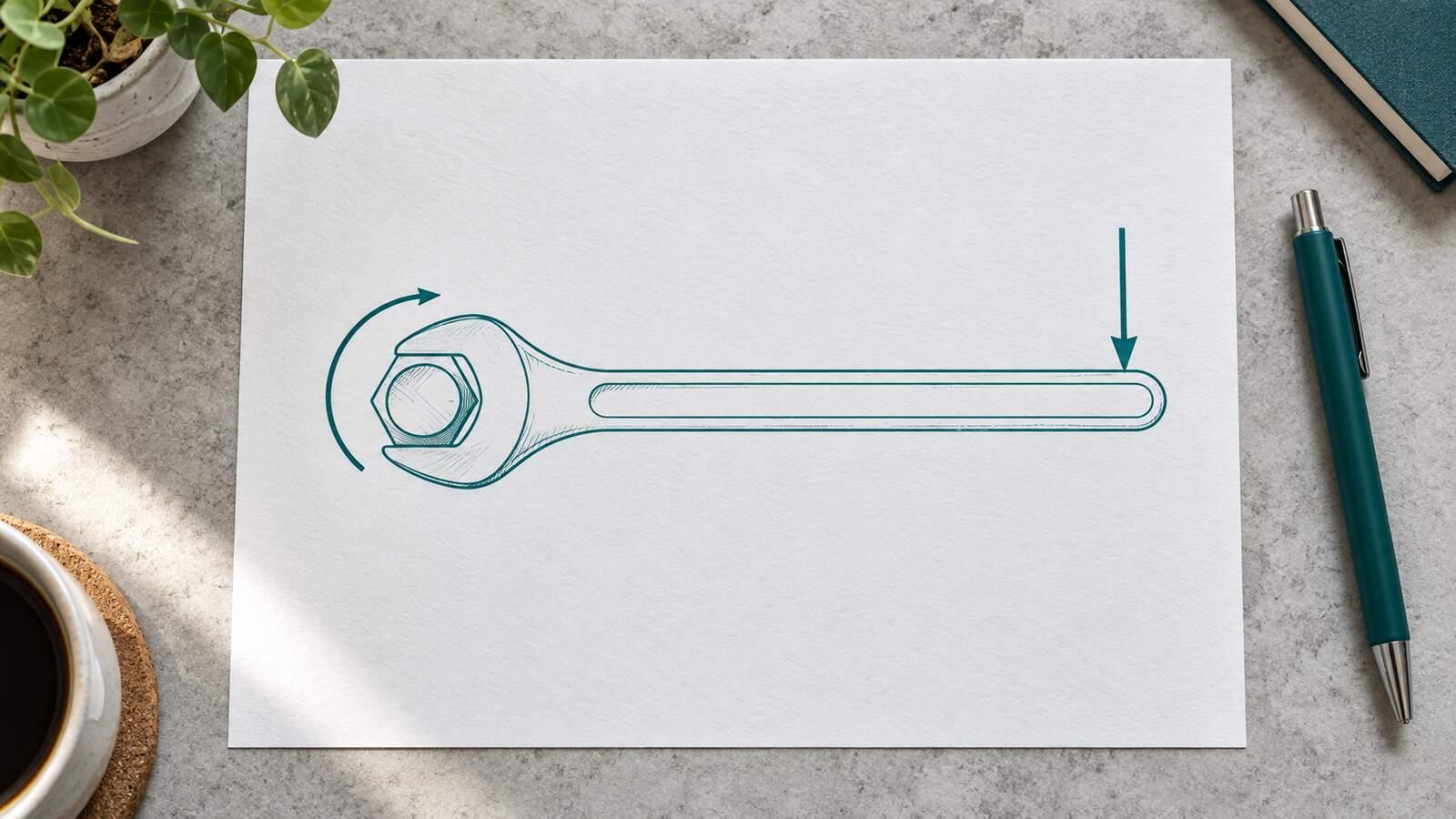
Imagine looking down at a horizontal spanner. Its left end grips a bolt. You pull upward on the right end, perpendicular to the handle. The bolt is the pivot, and the handle gives your force a turning advantage.
Move your hand halfway toward the bolt while keeping the same force. The turning effect halves. Pull directly along the handle toward or away from the bolt, and the turning effect disappears: the force's line passes through the pivot.
That last phrase is useful. Extend the force arrow in both directions to make an imaginary straight line. This is its line of action. The perpendicular distance from the pivot to that line is the lever arm, also called the moment arm.
The larger that perpendicular distance, the larger the torque for the same force. A long tool helps only if the force direction uses its length effectively.
Two equivalent torque formulas
For a force acting in the plane perpendicular to a fixed rotation axis, the torque magnitude is:
Here is the distance from the pivot to the point where the force acts, is force magnitude, and is the angle between the outward position vector and the force vector.
You can instead use the perpendicular lever arm :
These are the same calculation. One uses the full position-vector length and an angle. The other uses the perpendicular distance directly. Do not multiply by sine again after you already have the perpendicular lever arm.
OpenStax's torque chapter gives the vector form . For a flat diagram, you can usually work with magnitudes and a clockwise or counterclockwise sign instead of computing a cross product component by component.
The units are newton-metres, written . They have the same dimensions as joules, but torque is not energy. Keeping the torque unit as newton-metres helps keep the two quantities distinct.
Worked example: a perpendicular pull
A spanner is long from the bolt center to your hand. You apply at right angles to the handle.
Because , its sine is 1:
The same force at gives:
You can now explain the result before calculating: the first position is 2.5 times as far from the pivot, so it gives 2.5 times the torque.
This is why door handles sit far from hinges. The everyday design is the equation made visible. It is not evidence that a larger force always produces more rotation: the distance and direction matter too.
Worked example: an angled pull
Keep the same spanner and pull, but apply the force at to the outward handle direction.
Only the component perpendicular to the handle contributes to the turning effect:
Multiplying that component by the handle length gives the same answer: .
The component along the handle can still exert a force on the object or its support. It simply produces no torque about the bolt. Zero torque does not mean zero force.
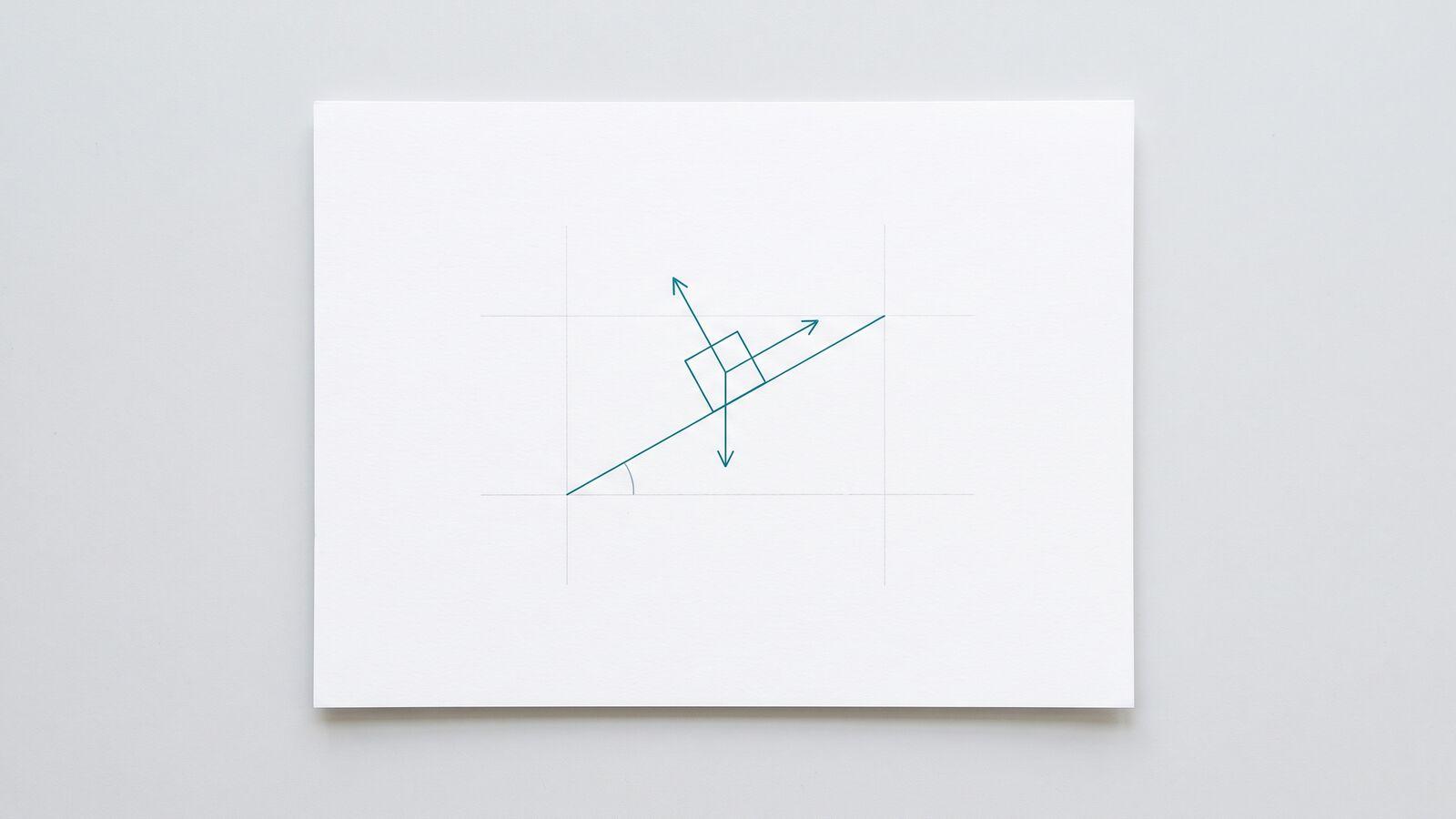
Always inspect how an angle is drawn. If the diagram gives an angle to a line perpendicular to the handle, that is not directly . You may need the complementary angle, or equivalently a cosine. Memorizing "always use sine" without identifying the vectors is how a correct formula gets the wrong answer.
Clockwise and counterclockwise torques oppose each other
For a flat problem, choose one rotational direction as positive. Counterclockwise is a common choice; clockwise then becomes negative. Either convention works if you use it consistently.
Suppose two forces act on a horizontal beam about a central pivot:
- A downward force acts to the left.
- A downward force acts to the right.
The left force tends to turn the beam counterclockwise. The right force tends to turn it clockwise. Their signed torques are:
Therefore:
The net turning effect is counterclockwise. Do not assign the sign from whether the force points up or down. Both forces point down here, but they turn the beam in opposite directions because they act on opposite sides of the pivot.
Balance requires force and torque conditions
A beam at rest must satisfy both translational and rotational equilibrium:
Use a lightweight horizontal beam with a pivot at its center. Hang a mass to the left. Where should a mass hang on the right to balance it?
Taking moments about the pivot:
Both weights share the same gravitational acceleration, so cancels:
The smaller mass needs a longer lever arm. The support must also provide an upward force equal to the two weights, approximately when .
That support force produces no torque about the pivot because it acts through the pivot. Choosing this point makes the torque calculation simpler without pretending the support force does not exist.
If the beam's own weight matters, include it at the beam's center of mass. A uniform beam supported at its center has zero gravitational torque about that support. An off-center support changes that conclusion. Start with a free-body diagram so no force quietly disappears.
Torque changes rotation rather than setting its speed
For a rigid body rotating about a fixed axis with constant rotational inertia , the rotational counterpart of Newton's second law is:
Angular acceleration measures how quickly angular velocity changes. The same net torque gives less angular acceleration when rotational inertia is larger.
For example, a net torque of acting on a body with gives:
Zero net torque means no angular acceleration under these assumptions. An object already spinning can continue at constant angular velocity. Compare this with Newton's laws: zero net force does not require zero velocity either.
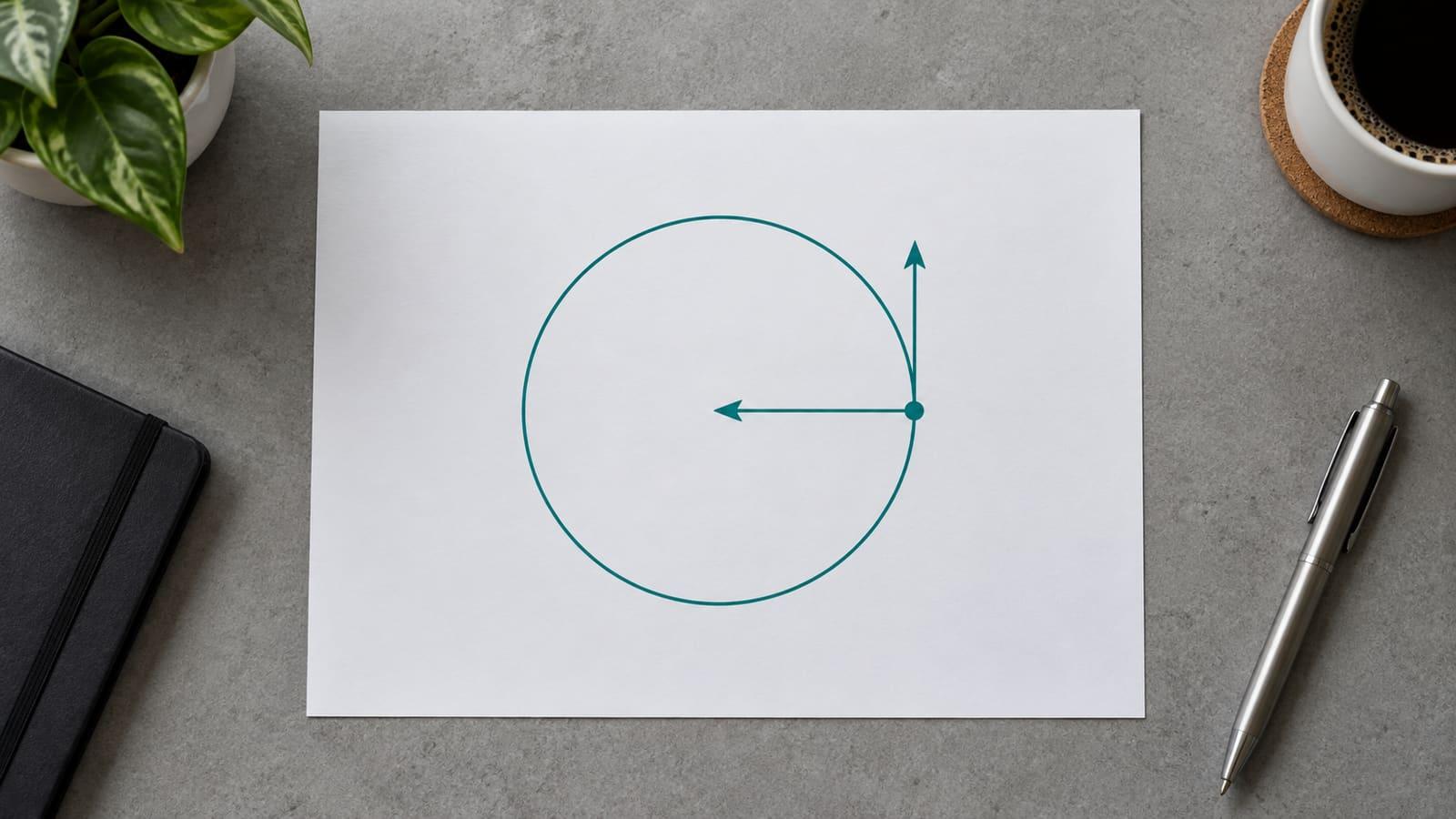
Torque is also different from the inward force discussed in circular motion. A force directed toward the center has zero torque about that center, yet can change the direction of velocity and keep an object on a circular path.
A reliable torque checklist
Choose the pivot and draw every external force. Identify each force's line of action, then measure the perpendicular lever arm or use . Convert centimetres to metres before multiplying. Assign a sign from the direction each force tends to turn the object, and only then add the torques.
For equilibrium, check forces as well as torques. For angular acceleration, check the fixed-axis assumptions before using . Finally, test the limiting case: a force through the pivot must give zero torque.
Physics Zen's Rotational Motion topic includes Torque & Rotational Inertia and Rotational Dynamics in Premium, on iPhone and Android. Practice by sketching the geometry first. A correct lever arm usually matters more than a fast multiplication.
Common questions
- What is torque in simple terms?
- Torque measures the turning effect of a force about a chosen point or axis. It depends on the force, where it acts, and its direction. A force whose line of action passes through the pivot produces zero torque about that pivot.
- What is the difference between distance and lever arm?
- The position-vector length r runs from the pivot to the force application point. The lever arm is the perpendicular distance from the pivot to the force's line of action. Its length is r sin θ, where θ is the angle between the position vector and the force.
- Does zero net torque mean an object is not rotating?
- No. For a rigid body with constant rotational inertia about a fixed axis, zero net torque means zero angular acceleration. It may remain at rest or keep rotating at constant angular velocity. Static equilibrium also requires zero net force.