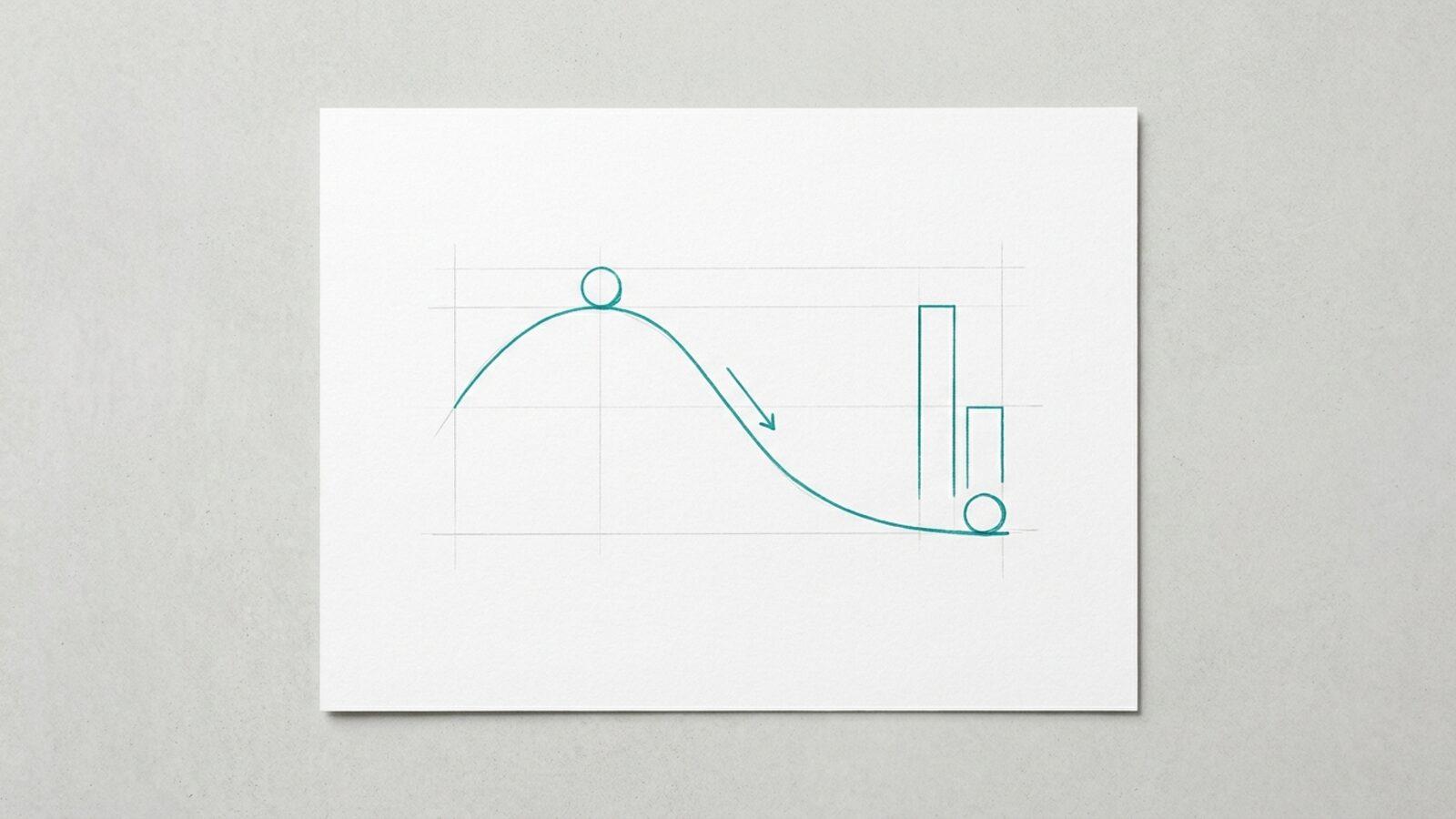
Specific Heat Capacity: Q = mc Delta T Worked Examples
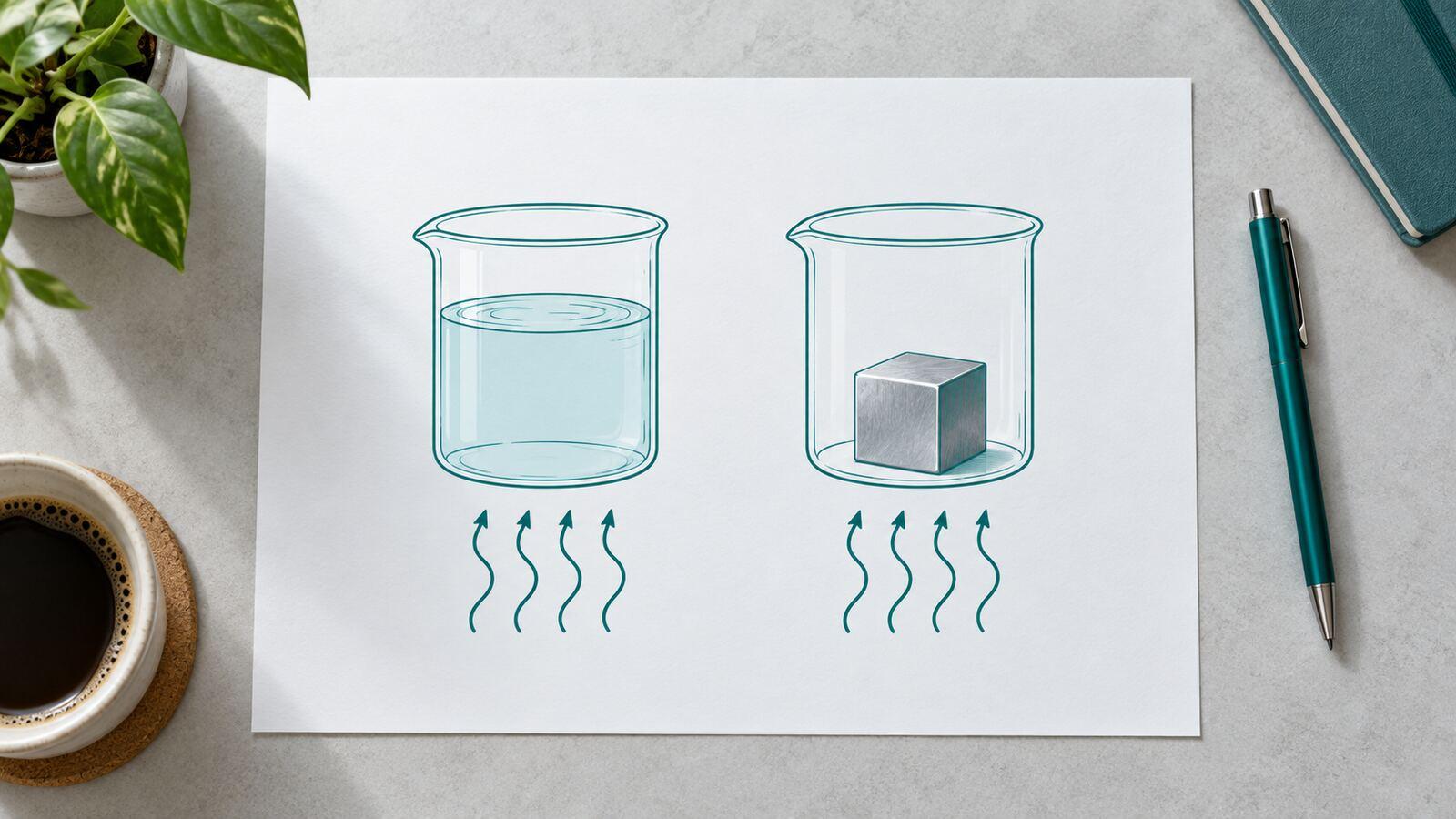
Two cups can receive the same amount of energy and warm by different amounts. A small cup of water warms more than a large one; a copper object and the same mass of water respond differently again. Specific heat capacity is the material part of that comparison. The equation is short, yet many wrong answers come from confusing heat with temperature, using grams against a value quoted per kilogram, or forgetting that cooling gives a negative temperature change.
This guide works through heating, finding an unknown mass, finding a final temperature, cooling and an insulated mixing problem. A unit-error table and an energy-balance check make the examples reusable. The water, copper and aluminium values used here come from OpenStax's specific-heat table. They are representative values for textbook calculations, not exact constants at every temperature.
Heat, temperature and capacity are different quantities
Temperature tells you about the thermal state of a material. Heat transfer is energy crossing a boundary because of a temperature difference; it is measured in joules. A hot object does not "contain heat" as a stored substance. It has internal energy, and heat can transfer energy to or from it. Our work and energy guide introduces the broader energy bookkeeping that makes this distinction useful.
The specific heat capacity belongs to a material and phase. In SI units, it is energy per kilogram per kelvin: . Liquid water is often represented in introductory problems by ; copper by ; and aluminium by . These values indicate how much energy a kilogram needs for a one-kelvin rise if the substance stays in the same phase. The value of can itself vary with temperature, so our calculations assume it is approximately constant across the stated interval.
A particular object's heat capacity is , with units . Double the mass of the same material and you double , while stays the same. For a water sample, . It needs about for each one-kelvin rise in this model. Keeping and separate prevents a common error in mixed-object problems.
Read Q = mcΔT with consistent units
Write the temperature change as final minus initial:
Here is the mass and is the energy transferred into the object. A positive gives positive for heating. A negative gives negative for cooling. The equation describes sensible heating or cooling while the material remains in one phase and can be treated as constant.
When is in , mass must be in kilograms and the temperature difference in kelvin. A Celsius difference has the same numerical size: from to is of change. You do not add 273.15 to a temperature difference. You may use with a Celsius difference instead, but never mix a gram value of mass with a per-kilogram heat capacity.
| Given in the question | Write for the equation | What goes wrong if you skip it |
|---|---|---|
| of water | Answer is times too large if is paired with | |
| Treating as the change overstates heating | ||
| Dropping the minus hides energy leaving the object | ||
| Mixing kJ with in J gives a factor-1000 error |
Use this table to check the quantities and units before substituting numbers. Each row connects a physical reading of the problem to the substitution that the formula actually accepts. If a result looks implausible, inspect these conversions before changing the physics. The broader pattern appears in physics mistakes that are really math mistakes.
Example 1: energy to heat water
Heat of liquid water from to . Take . The water stays liquid, and we ignore energy taken by the vessel and room. The change is . Therefore
Check without repeating the entire multiplication: the sample's heat capacity is , so a rise needs . Units also work: . The positive sign is consistent with energy entering the water.
If a heater supplies more than this, the difference can go to the container and surrounding air. calculated the energy received by the water, not necessarily the electrical energy taken from a wall outlet.
Example 2: solve for mass or temperature change
Suppose is transferred into liquid water and its temperature rises by . Rearrange before entering numbers:
That is . Substituting back gives . If the answer had been , a grams-to-kilograms slip would be the first suspect.
For a different unknown, give of aluminium . With , the temperature rise is
If it starts at , the final temperature is . The rise is , and the initial and final temperatures are stated in Celsius. Those are compatible statements because kelvin and Celsius increments are equal, even though their zero points differ.
Example 3: cooling and a negative Q
A copper piece cools from to . With , :
The minus sign means energy left the copper under our "into the object" convention. The copper released in magnitude. Do not report that the copper "contains negative heat". If another object receives all of this energy in an insulated setup, its is positive . In an open setup some energy can go to the surroundings, so you cannot assign the entire magnitude to one recipient without more information.
The estimate passes a size check: the copper piece's heat capacity is . Multiply by a fall to get , with a negative sign for energy leaving.
Example 4: mix hot copper and cool water
Put of copper initially at into of liquid water initially at . Imagine an insulated container with negligible heat capacity and no phase change. Both reach a shared final temperature . Energy lost by copper equals energy gained by water:
The heat capacities are for copper and for water. Rearranging gives
That result lies between and , closer to the water's starting temperature because its sample heat capacity is much larger. An answer above or below would violate the no-external-energy assumption.
Check the balance with the unrounded answer: copper has , and water has . They sum to zero up to rounding. OpenStax's calorimetry section uses the same lost-plus-gained balance. A real container would also absorb energy, so its heat capacity belongs in a more detailed balance.
When this equation is the wrong model
The equation assumes a temperature change within one phase. During melting or boiling, energy can enter while temperature stays roughly constant at the transition. Inserting into and concluding that no energy was needed is the wrong model. Split a multi-stage question into sensible-heating parts using and phase-change parts using with the appropriate latent heat supplied by the problem. OpenStax treats phase change separately.
Specific heat is also not perfectly constant at every temperature or in every state, and an exposed system does not keep all transferred energy in the named sample. For an introductory exercise, the question usually states the value of and which losses to ignore. Write those assumptions beside the equation. For an experiment or a real device, measure or model the container, environment and temperature dependence instead of forcing one textbook number onto them.
When you meet a new problem, list the object, its mass in kilograms, its material and phase, with units, and . Decide whether is into or out of that object. In a mixing problem, write one signed for each object and set their sum to zero only if the system is treated as insulated. The Heat and Temperature topic in Physics Zen lets you practise this setup with fresh values and worked solutions. The goal is to make the unit and energy-balance checks part of the calculation, not an afterthought.
Common questions
- What does specific heat capacity mean?
- Specific heat capacity c tells you how much energy must be transferred to change the temperature of one kilogram of a material by one kelvin, approximately over the range where c is treated as constant. Its SI unit is J/(kg·K). Heat capacity C=mc describes a particular sample instead.
- Can I use degrees Celsius in Q = mcΔT?
- Yes, for a temperature difference. A change of 1 °C has the same size as a change of 1 K, so 20 °C to 60 °C gives ΔT=40 °C=40 K. Do not treat an absolute Celsius temperature as a kelvin temperature in other formulas.
- Is Q negative when an object cools?
- With Q defined as energy transferred into the object, yes. Cooling makes ΔT=Tfinal−Tinitial negative, so Q=mcΔT is negative. Its magnitude is the energy the object releases in the ideal model.
- Does Q = mcΔT include melting or boiling?
- No single constant-c calculation covers a phase change. Temperature can remain constant while energy changes the phase. Split the path into temperature-change steps using mcΔT and phase-change steps using mL when the problem supplies latent heat.