Capacitors in Series and Parallel: Charge, Voltage, and C
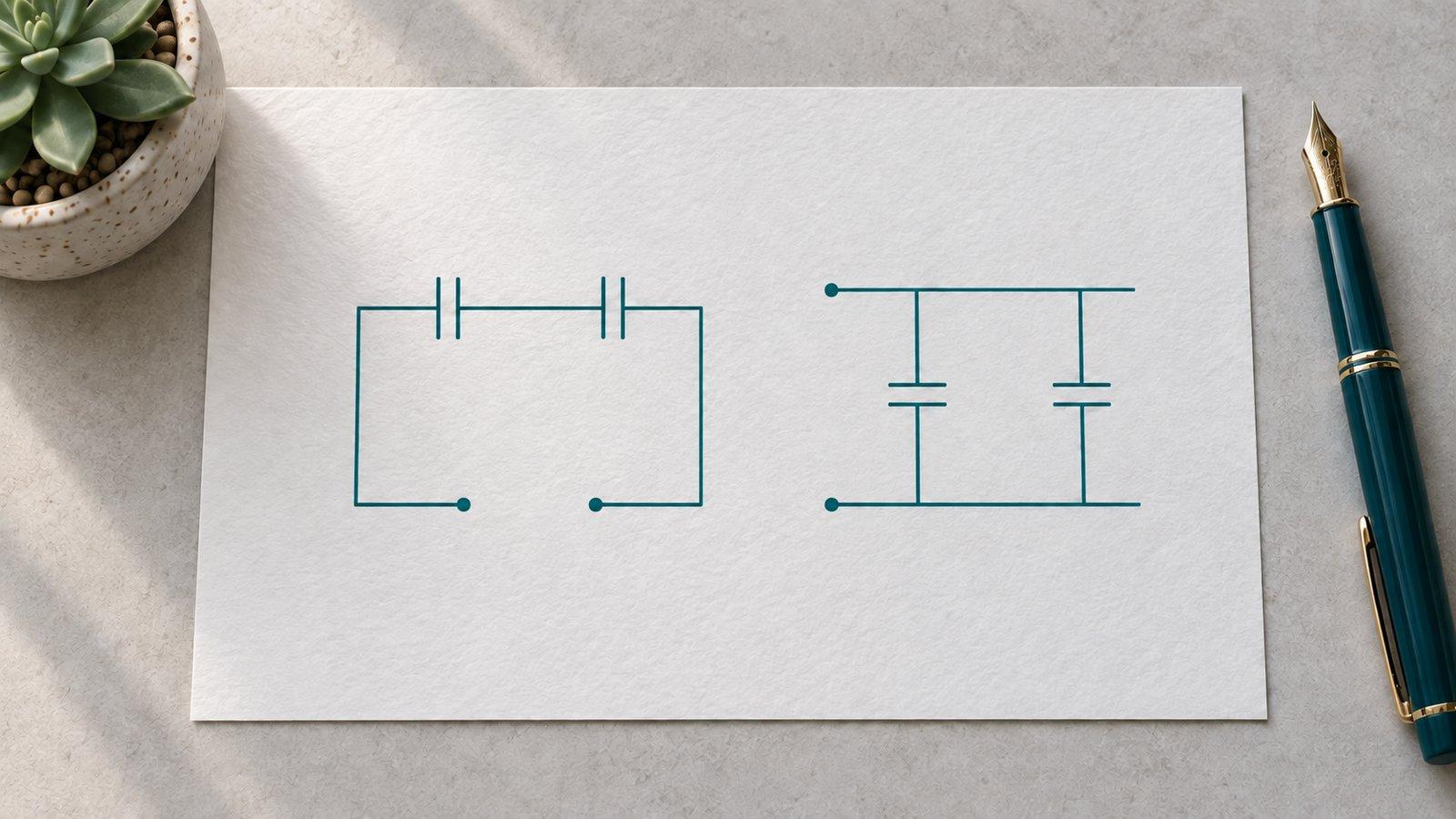
Two 6-microfarad capacitors connected to the same 12-volt source can produce different equivalent capacitances. Connect them across the same two nodes and the equivalent is 12 microfarads. Put them one after another and it is 3 microfarads. The components did not change. The connection decides which quantity they share.
For capacitor networks, the useful question is not “which formula do I remember?” It is “which two plates share the same nodes, and which junction is isolated?” This guide works with ideal capacitors, ideal wires, and a steady voltage applied to a network whose capacitors and isolated internal junctions are initially uncharged. Those assumptions matter for the usual equal-charge series rule.
Start with charge per volt
A capacitor has two separated conducting plates. In the simple model, one plate carries charge and the other . The symbol names the magnitude on either plate, not the sum of their absolute charges. Capacitance tells you how much of that charge magnitude is stored per volt across the plates:
A farad is a coulomb per volt. In worked problems, microfarads and microcoulombs keep the numbers manageable: . A 6-microfarad capacitor across 12 volts therefore has on each plate in magnitude. OpenStax's capacitance section defines this relation.
Do not treat capacitance as the charge itself. The capacitance is a property of the ideal component; charge changes when the voltage across it changes. Also do not add charge magnitudes on the positive and negative plates of one capacitor to claim it stores twice the value of . Its net charge is zero, while its two plates have equal and opposite charges.
Parallel: one voltage, charges add
Two capacitors are in parallel if each connects across the same pair of nodes. Both see the same potential difference . Each has its own plate charge magnitude, and . The source supplies the sum to the positive-side plates:
Since for the equivalent capacitor,
The rule extends to more parallel capacitors by adding their capacitances. It does not mean they have equal charge. The larger capacitance holds more charge at the shared voltage.
Take and across 12 volts. Both have . Their charge magnitudes are
Together they draw from the source, equivalent to . Equal voltage and unequal charge are exactly what predicts.
Series: one charge magnitude, voltages add
Now connect the same capacitors end to end between source terminals. There is one internal junction between them, with no third wire attached. In the stated model it begins with zero net charge and remains isolated. Charge induced on one side of that junction must be balanced by equal and opposite charge on the other side. The two capacitors therefore acquire the same charge magnitude , though their plate signs differ.
The source voltage is the sum of the capacitor voltage magnitudes. Because ,
The equivalent capacitor also obeys , giving
For 2 and 4 microfarads in series, . At 12 volts, the common charge magnitude is
The 2-microfarad capacitor gets ; the 4-microfarad one gets . Their voltages add to 12 volts. The smaller capacitance gets the larger voltage at the same charge. Equal charge does not mean equal voltage.
The series result is less than the smaller individual capacitance. To see why, keep fixed. The two voltage drops add, so the whole pair needs more volts per unit charge than either component alone. The total must therefore be smaller. OpenStax's series and parallel derivation follows the same shared-charge and shared-voltage logic.
The equal-charge shortcut needs its assumptions. An initially charged capacitor or a junction with a nonzero initial net charge may require charge conservation at each node instead. A bridge network may not reduce through simple series and parallel groups. State the setup before using the shortcut.
Be precise about the word charge in a series solution. The two facing plates at the isolated junction have opposite signs; saying “both capacitors have charge ” refers to the equal magnitudes on their plates. It does not mean that a positive charge crosses the insulating gap between the plates. Likewise, the 12-volt source voltage is across the whole chain, while each capacitor has only its own share. Keep the plate signs and the voltage endpoints in mind even if an exercise asks only for magnitudes. These distinctions prevent a correct equivalent-capacitance formula from being paired with an incorrect voltage or charge assignment.
Reduce a mixed network, then expand it
Consider a 12-microfarad capacitor in series with a parallel pair of 2 and 4 microfarads. Place the whole network across a 12-volt source. First combine the parallel pair:
Now the network is 12 microfarads in series with 6 microfarads:
The source supplies charge magnitude . That is also the charge on the 12-microfarad capacitor and on the equivalent 6-microfarad group, because those two groups are in series. The 12-microfarad capacitor has . The parallel group gets the remaining .
Both capacitors inside that parallel group see 8 volts. Their charges are
The branch charges add to , matching the series group's charge. The voltage check is . A common error is to assign 48 microcoulombs to each branch because the equivalent group has that charge. The group total is what matches the series capacitor; its branches split that total according to their capacitances.
This example has the same structure as OpenStax's mixed-network example, but the steps are useful for any reducible network: group by shared nodes, reduce inward, get source charge, then work outward. Do not combine capacitors just because they sit next to each other in a drawing. Our series and parallel circuits guide explains how to identify nodes; its numerical examples concern resistors, whose series and parallel formulas run the opposite way.
Four checks before you trust an answer
- Topology: Parallel components share both endpoint nodes. Series components share an isolated intermediate junction with no extra branch.
- Magnitude: For positive ideal capacitances, the parallel equivalent exceeds each member; the series equivalent is below each member.
- Units: Microfarads multiplied by volts produce microcoulombs. Do not report charge in farads or capacitance in coulombs.
- Reconstruction: Parallel branch voltages agree, series voltage drops sum to the source, and branch charges add to their parallel-group charge.
Try a short reverse check. Two capacitors in series have and across 18 volts. Their equivalent is 2 microfarads, so each has charge magnitude . Their voltages are 12 and 6 volts. The larger capacitor gets the smaller voltage, and the drops total 18 volts. If you obtained 18 volts across both, you accidentally applied the parallel rule.
In Physics Zen's capacitors topic, charge, capacitance, and energy problems give you a place to practice the basic relation before tackling mixed networks. Keep the connection type and units written beside every calculation. Once those are fixed, the arithmetic is usually the easy part.
Common questions
- What is the rule for capacitors in parallel?
- Parallel capacitors share the same voltage. Their charge magnitudes add, so their equivalent capacitance is the sum of their capacitances.
- What is the rule for capacitors in series?
- In the usual ideal network with initially uncharged isolated junctions, series capacitors carry equal charge magnitudes. Their voltages add, and the reciprocals of their capacitances add.
- Why is series capacitance less than either capacitor?
- At the same stored charge, the two voltage drops add. More total voltage is needed per unit charge, so equivalent capacitance Q/V is smaller than either individual capacitance.
- How do I solve a mixed capacitor network?
- Identify a simple series or parallel group, replace it with its equivalent, and repeat. Find total charge from C equivalent times source voltage, then work backward to each group's voltage and charge.