Electromagnetic Induction: Faraday's Law with Worked Examples
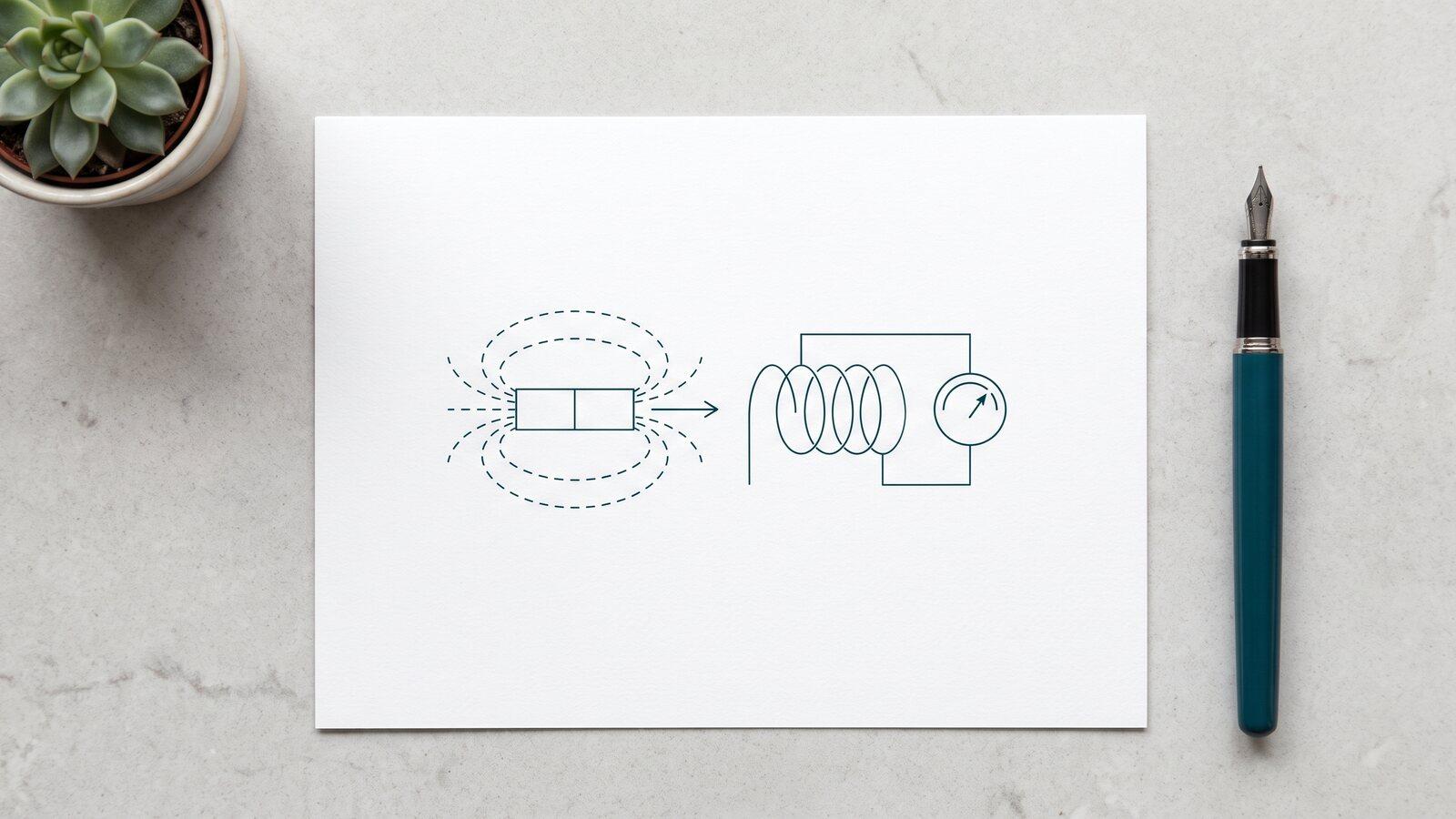
Push a magnet toward a coil of wire and a meter connected to the coil can deflect. Hold the magnet still and the deflection disappears. Pull it away and the deflection reverses. The coil has not stopped sitting in a magnetic field while the magnet is still. What changed was the magnetic flux through the coil.
Electromagnetic induction turns a change in that flux into an electromotive force, usually shortened to emf. Faraday's law tells us how large the induced emf is. Lenz's law tells us its direction. Both are easier to use if we keep three questions separate: what crosses the loop, how does that crossing change, and is there a closed path for current?
Magnetic flux counts field through an area
Imagine stretching a flat sheet across one loop of wire. Magnetic flux measures the magnetic field passing through that sheet, with direction accounted for. Its general definition is
The symbol is magnetic field, is a small piece of the sheet, and is a chosen unit normal, perpendicular to the sheet. The dot product means that only the field component perpendicular to the sheet counts. Choose which side of the loop the normal points toward and keep that choice consistent; if the loop rotates, its normal rotates with it. Reversing the normal reverses the signs of flux and emf, but does not change the physical current direction.
For a flat loop of area in a uniform field of magnitude , the integral becomes
where is the angle between the field and the surface normal. If the field points straight through the loop, and the flux magnitude is . If the field lies along the plane of the loop, and the flux is zero. Do not use the angle between the field and the plane without converting it first.
The SI unit is the weber, Wb: . Flux belongs to one loop. For a coil of identical turns that each see the same flux, the total flux linkage is . OpenStax's Faraday's law treatment gives the general flux definition and the uniform-field shortcut.
A first magnetic flux example
Suppose a flat loop has area in a uniform field. The field makes with the loop's normal. Choose the normal so the flux is positive:
Point the same loop's normal along the field and the flux becomes , even though the field strength and area have not changed. An orientation change can induce an emf in a constant field.
Faraday's law measures the rate of change
For identical turns, with the same flux through each, Faraday's law is
The emf is measured in volts. One weber per second is one volt. The magnitude grows if flux changes faster, and it scales with the number of turns. The chosen normal also sets the positive circulation around the loop by the right-hand rule: point your thumb along the normal and your fingers curl in the positive direction. The minus sign contains Lenz's direction rule; it is not a demand to report a negative magnitude.
If a question gives only starting and ending flux over a time interval, find the average induced emf:
This average cannot tell you the emf at every instant unless the flux changes at a constant rate. Also, a changing field is only one way to change flux. The loop's area or its angle can change while remains constant. A field that changes somewhere outside the loop is not enough by itself; the flux through the chosen loop must change.
Worked example: average induced emf
A coil has 80 turns, each enclosing . A uniform field perpendicular to the coils rises from to in . Take the positive normal along the field. The flux change per turn is
Then the average emf is
Its magnitude is . The negative sign means that, relative to our chosen positive normal and loop direction, the induced emf circulates the other way. If the field did not rise steadily, would still be the average magnitude over the interval, but the instantaneous value could differ.
Lenz's law: oppose the change, not the field
Before choosing clockwise or counterclockwise, decide whether the original flux through the loop increases or decreases. The induced current, if the circuit is closed, creates a magnetic field that resists that change. OpenStax's Lenz's law section connects this direction rule to energy conservation.
Try a loop lying flat on a page. A magnetic field points into the page and grows stronger. The through-page flux is increasing. The loop's induced field must point out of the page to oppose that increase. Curl the fingers of your right hand in the current direction while your thumb points out of the page: viewed from above, the current is counterclockwise.
Now keep the field pointing into the page but let it weaken. The induced field points into the page to resist the loss of flux. The right-hand rule gives a clockwise current. In both cases the original field points the same way. The change decides the induced direction.
The same steps work for a moving magnet. Specify which pole faces the loop and which side you are viewing, determine the flux change, then use the right-hand rule. An answer of merely “clockwise” is incomplete if the viewing side is unspecified.
Emf can exist without a circulating current
An induced emf is a drive around the loop. A sustained circulating conduction current needs a closed conducting path. Cut the wire and the changing flux still produces an induced emf, but charge cannot keep circulating across the gap. If the loop is closed and its resistance is known, a simple resistive model gives current magnitude . The induced emf alone does not fix the current: resistance matters too. Our series and parallel circuits guide develops the circuit side of that calculation.
A generator uses this principle by rotating a coil relative to a magnetic field, changing the angle and thus the flux. A stationary loop in an unchanged, uniform field has constant flux and no induced emf from Faraday's law, even though magnetic field passes through it. A moving conductor can require a more careful circuit picture, but the closed-loop flux rule is the right starting point for these examples.
Do not confuse induced emf with the electrostatic potential difference of a stationary-charge problem. Both are measured in volts, but a changing magnetic flux can drive charge around a closed path. For the static-field comparison, see electric potential versus electric field.
Three practice problems with solutions
1. Changing area in a constant field. A single rectangular conducting loop lies perpendicular to a uniform field. Its enclosed area falls from to in . What is the average emf magnitude? Choose the normal along the field. The flux change is . Therefore . The field was constant; the area change did the work.
2. Turning a coil. A 20-turn coil of area sits in a uniform field. In , its normal turns from parallel to the field to perpendicular to it. Find the average emf magnitude. Each turn's flux goes from to zero. Thus . The rate of turning need not be uniform for this average result.
3. Direction and current. Viewed from above, a field out of the page through a 5-turn closed coil grows stronger. Which way is the induced current? The out-of-page flux increases, so the induced field must point into the page. The right-hand rule gives clockwise, viewed from above. If the coil is opened, there is still induced emf but no circulating current through the break.
To practise the flux calculation and induced emf, use Physics Zen's magnetism and induction topic. Induction comes up in both A-level physics and the German Abitur; our A-level physics preparation guide and Abitur physics guide show where it fits among the other field and electricity topics.
Common questions
- What is electromagnetic induction in simple words?
- It is the production of an emf when the magnetic flux through a loop changes. Closing the conducting path lets that emf drive a current. The change may come from field strength, loop area, or orientation.
- Does a strong magnetic field always induce a current?
- No. A strong but steady flux through a stationary loop produces no induced emf by Faraday's law. A weak field whose flux changes rapidly can produce an emf. A current also needs a closed conducting path.
- Why is there a minus sign in Faraday's law?
- It records the direction given by Lenz's law: with a chosen positive normal, the induced effect opposes the change in flux. When a question asks how many volts, report the emf magnitude as positive, then state the direction separately if asked.
- How do you use the right-hand rule for induced current?
- First find the direction of the field the induced current must create. Point your right thumb that way. Your curled fingers then show the current around the loop, as seen from the side you specified.